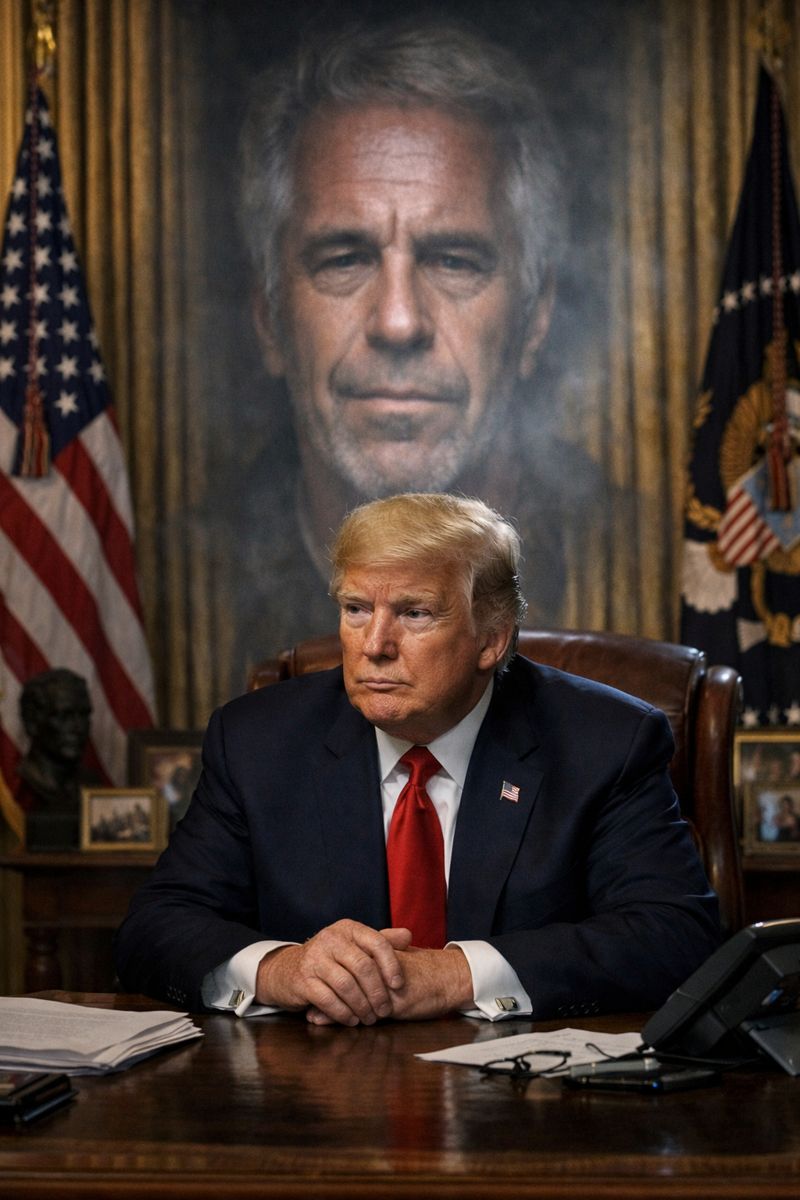
There are moments in politics when the past, long dismissed as irrelevant or inconvenient, returns with a thud.
The latest tranche of documents released by the US Justice Department relating to Jeffrey Epstein is one such moment. They do not introduce a wholly new scandal; rather, they deepen and darken one that many had assumed was already exhausted. At the centre of the renewed scrutiny stands President Donald Trump, a figure long practised in deflection, whose relationship with Epstein now looks more substantial than previously acknowledged.
According to an internal email written by a New York prosecutor in January 2020, recently disclosed as part of the Epstein files, flight records suggest that Trump flew on Epstein’s private jet on eight occasions during the 1990s. That alone is enough to raise eyebrows. More troubling still is the assertion that on at least four of those flights, Ghislaine Maxwell was also on board. Maxwell, now serving a 20-year prison sentence, was convicted of facilitating Epstein’s systematic sexual abuse of underage girls.
The White House has, over the years, sought to keep Trump’s association with Epstein at arm’s length. Trump himself has insisted that while he knew Epstein socially, he “was not a fan” and had severed ties long before Epstein’s first arrest in 2006. His defenders have often contrasted his position with that of Bill Clinton, whose documented presence on Epstein’s aircraft has long been a staple of conservative attack lines. Yet politics is rarely kind to double standards, and the suggestion that Trump’s own use of Epstein’s jet was more extensive than previously reported blurs the moral distinction his allies have tried to draw.
None of this constitutes proof of criminal wrongdoing by Trump. The documents do not allege that he was aware of, let alone involved in, Epstein’s crimes. But integrity in public life is not measured solely by criminal thresholds. It is also a matter of judgment, association and candour. On those counts, the revelations are undeniably uncomfortable.
They also revive another question that has never truly gone away: the circumstances of Epstein’s death. Officially, the financier died by suicide in a New York jail cell in August 2019 while awaiting trial on federal sex trafficking charges. Yet for many Americans, across the political spectrum, that conclusion has never quite settled. The catalogue of failures that night — malfunctioning cameras, guards who failed to make required checks, a prisoner held alone despite being on suicide watch weeks earlier — has fuelled suspicion that something more sinister may have been at work.
Was Epstein’s death the tragic end of a disgraced man facing the collapse of his carefully constructed world? Or was he silenced to protect others whose names might have emerged in open court? The latter theory, while unproven and often irresponsibly embellished online, persists precisely because Epstein occupied a unique position at the intersection of wealth, power and vice. He knew too many people, and he knew them too well.
If Epstein were indeed silenced — a proposition for which there is no hard evidence, but abundant public conjecture — the obvious follow-up question is: silenced for whom? The uncomfortable truth is that the answer cannot be confined neatly to one party, one ideology or one administration. Epstein’s contacts spanned decades and crossed political lines. Business leaders, royalty, academics, former presidents and serving officials all brushed past him at various points. That breadth is precisely what makes the case so corrosive to public trust.
In that context, the renewed attention on Trump’s past interactions with Epstein takes on added resonance. Not because it proves guilt, but because it situates the President within a wider elite culture that too often treated Epstein as a curiosity rather than a menace. Every new document, every forgotten email or flight log, reinforces the sense that the full truth about Epstein’s network has yet to be told.
The timing of the prosecutor’s email is also revealing. Written in early 2020, months before Maxwell’s conviction, it suggests that investigators already possessed information that contradicted the prevailing public narrative. Why such details took years to emerge will now be a matter for journalists and, potentially, congressional committees.
For Trump, the political risk lies less in any courtroom than in the slow erosion of credibility. His presidency has been defined by a combative relationship with transparency, from tax returns to business interests. Against that backdrop, fresh questions about candour over Epstein fit an unflattering pattern.
Republicans face an awkward dilemma. Having demanded relentless scrutiny of Epstein’s connections to Democrats, they cannot plausibly argue that similar scrutiny of Trump is out of bounds. Democrats, meanwhile, should resist the temptation to inflate suspicion into accusation. The public interest is not served by conspiracy, but by clarity.
The Epstein affair endures because it speaks to something profoundly unsettling: the suspicion that the powerful operate by different rules, and that when secrets become dangerous, the truth has a habit of dying quietly. Whether or not Epstein took his own life, the unanswered questions surrounding it continue to cast a long shadow. And as more documents surface, that shadow now falls ever closer to the Oval Office.
Click here for more News & Current Affairs at EU Today
Click here to check out EU TODAY’S SPORTS PAGE!
____________________________________________________________________________________________________________________________