
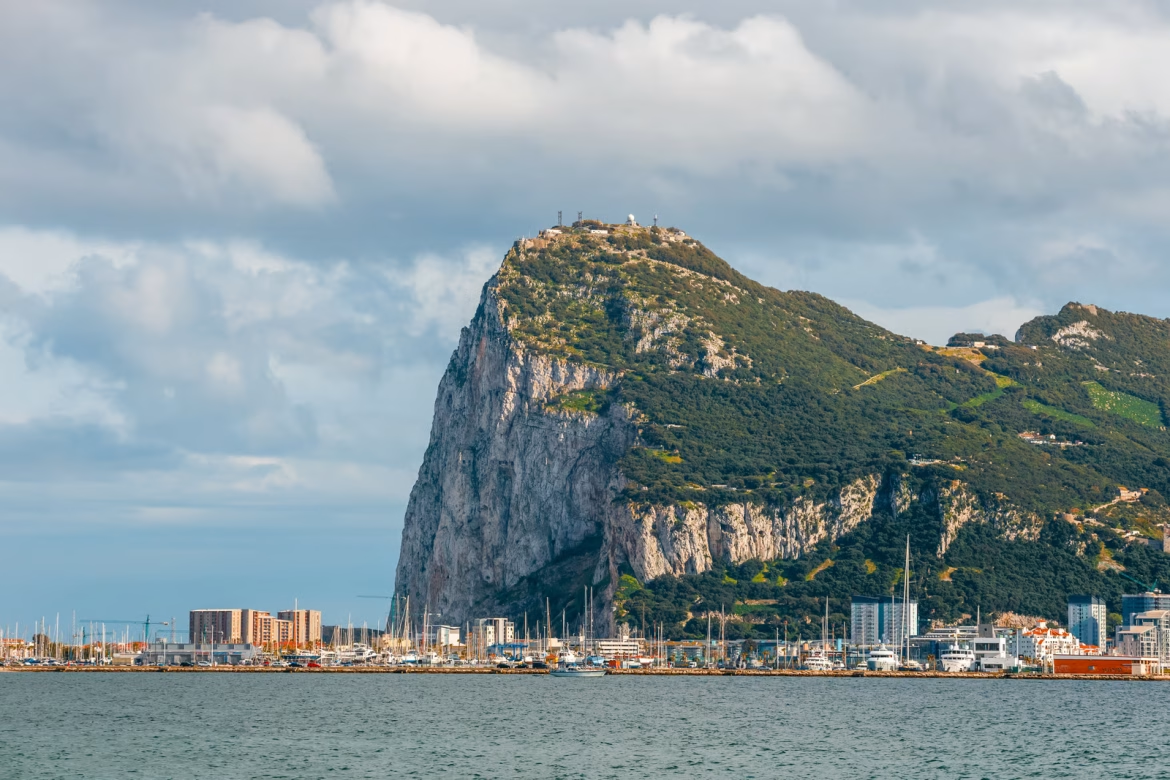
The UK-EU-Spain agreement is designed to remove daily friction at Gibraltar’s land border, while shifting the most sensitive checks to the airport and port.
The formal signing of the Gibraltar treaty brings one of Brexit’s longest-running territorial problems into a new enforcement phase: the land border with Spain is to become easier to cross, but immigration and customs control will move to more politically sensitive points inside Gibraltar’s transport system.
The agreement between the United Kingdom, the European Union, Spain and Gibraltar was signed in Brussels on 14 July and is due to reshape movement from 15 July. El Pais reported that the treaty removes physical controls on people and goods at the border between Gibraltar and La Linea de la Concepcion, while establishing checks at Gibraltar’s airport and port. The Financial Times reported that Spain will perform Schengen checks at Gibraltar airport as part of the arrangement.
The practical purpose is clear. Around 15,000 workers cross the land border from Spain into Gibraltar, and the post-Brexit risk was that a hard border would damage both Gibraltar’s economy and the surrounding Campo de Gibraltar region. Removing routine land-border checks should make daily commuting, local commerce and movement of goods less vulnerable to queues and political disputes.
The enforcement question is where control goes instead. Under the new model, Gibraltar’s airport and port become the effective external entry points for travellers arriving from the UK and other non-Schengen locations. Travellers are expected to pass through Gibraltar controls and then Schengen checks carried out by Spanish authorities. The Times reported that British visitors will face Entry/Exit System biometric checks, while registered Gibraltarians and qualifying residents are treated differently.
That arrangement is politically delicate. Gibraltar remains a British Overseas Territory, and the UK and Gibraltar insist the treaty does not alter sovereignty. Spain maintains its long-standing sovereignty position. The compromise is operational rather than constitutional: Spain, as the neighbouring Schengen state, carries out Schengen responsibilities, while Gibraltar and the UK retain their legal position on the territory.
The airport is the most sensitive site. Gibraltar’s airport sits on the isthmus, an area historically disputed by Spain, and has long complicated attempts to settle practical cross-border arrangements. Moving Schengen checks there may solve daily border friction, but it also places Spanish officers in a role that will be watched closely by Gibraltar’s government and public. The port raises similar questions for cruise passengers, ferry movements and goods flows.
Customs and goods movement are another part of the settlement. The agreement is designed to remove checks at the land frontier and align practical controls so that goods can move more freely. Spanish and EU concerns about tobacco, indirect taxation and unfair competition have shaped the deal, while Gibraltar has sought to preserve fiscal autonomy. The result is likely to require continuing cooperation on customs, anti-smuggling and tax-adjacent enforcement.
Dispute management will determine whether the treaty works. The text is intended to create mechanisms for cooperation between the UK, EU, Spain and Gibraltar, but political disputes are unlikely to disappear. If queues develop at the airport, if Spanish checks are seen as intrusive, or if smuggling concerns return, the treaty’s operational bodies will become the first line of crisis management.
For the EU, the agreement protects the Schengen area while avoiding a hard border on the edge of Spain. For the UK, it removes a post-Brexit irritant and stabilises Gibraltar’s economy. For Spain, it gives Madrid a formal role in Schengen enforcement connected to Gibraltar without forcing a sovereignty settlement. For Gibraltar, it offers mobility at the price of a more complex control system at entry points.
The treaty therefore removes the visible border barrier but not the politics behind it. Its success will depend on whether airport and port checks feel routine, whether workers can cross without friction, and whether the parties resist turning each operational dispute into a sovereignty argument.

