

There are countless shelves devoted to the Second World War, yet the conflict continues to yield stories that have somehow slipped through the cracks of public memory.
Survival: Memoir of a Forced Labourer in the Third Reich, by George Beeston, is one such account — a slim but deeply affecting narrative that illuminates a neglected chapter of wartime Europe: the mass deportation of Belgian civilians to work for Nazi Germany.
Beeston’s memoir arrives decades after the events it describes, rescued from obscurity by the Brussels branch of the Royal British Legion after lying unpublished for years. That delay is regrettable, for the book stands as a striking testimony to endurance and chance in the most unforgiving circumstances.
.
The historical backdrop is stark.
Beginning in October 1942, the German occupation authorities in Belgium began systematically deporting workers to the Reich to support the Nazi war economy. Initially Belgian companies were required to nominate ten per cent of their workforce; later the system hardened into outright conscription by age and social category. By the war’s end some 145,000 Belgians had been compelled to leave their homes and labour in German factories, farms and workshops.
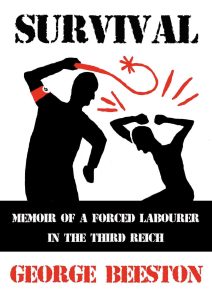 It is from within this grim machinery that Beeston tells his story.
His life had already been unusually international before the war intervened. Born in Australia in 1920 to a British father and Belgian mother, he spent his early childhood in New South Wales before the family returned to Belgium, settling in the industrial city of Charleroi.
There his father found work in the steel industry and the Beeston children grew up speaking English, French and Dutch — a multilingual upbringing that would later prove unexpectedly useful.
When German forces invaded Belgium in May 1940, Beeston was nineteen and determined to resist.
His first instinct was to reach Britain and join the Allied war effort. When that plan collapsed amid the chaos of France’s defeat, he enlisted instead in the French Foreign Legion. The experience proved brief and chaotic; abandoned by officers and surrounded by advancing German forces, his unit surrendered.
Beeston narrowly escaped execution as a suspected partisan. After a gruelling march across eastern France he was placed in a prisoner-of-war camp, where German interrogators took a particular interest in his Australian birthplace. His eventual escape — achieved with forged papers and a good deal of nerve — carries the breathless energy of a wartime thriller, yet the memoir recounts it with an almost disarming matter-of-factness.
Returning to occupied Belgium in late 1940 did not bring safety. His father was deported to an internment camp in Silesia the following year, leaving the young Beeston responsible for supporting his mother and younger brothers. Like many families under occupation, they lived precariously, taking whatever work could be found.
The real ordeal began in December 1942 when Beeston himself was deported to Germany as a forced labourer and sent to work for Siemens in Nuremberg. Here the memoir shifts tone, becoming darker and more reflective. The daily grind of industrial labour under Nazi supervision is described without embellishment: long hours, meagre pay, constant surveillance and the ever-present danger of punishment.
Added to this was the grim irony that forced labourers in German cities were exposed to the growing intensity of Allied bombing. Beeston writes of nights spent in fear beneath the thunder of air raids — caught between the regime that enslaved him and the bombs intended to destroy it.
What distinguishes Survival is not simply the catalogue of hardship but the author’s understated resilience. Beeston recounts moments of brutality and despair, yet the memoir never lapses into bitterness. Instead it records a series of narrow escapes and improbable survivals, particularly in the chaotic final weeks of the war when he twice fled German authorities as the front lines collapsed.
When American forces finally liberated the area, Beeston’s linguistic abilities once again proved valuable. He served briefly as an interpreter during the round-up of German officers and SS personnel — an extraordinary reversal for a man who had only recently been their captive labourer.
He returned to Belgium in June 1945 and later joined the British Army, serving for many years in the Royal Engineers. Yet, like many veterans and survivors, he left his wartime experiences largely unspoken in public. The memoir itself remained unpublished until shortly before his death in 2012, when he entrusted the manuscript to the Royal British Legion in Brussels.
That the book is now available — released as a free e-book after the author’s son granted permission — feels entirely fitting. Beeston did not write for literary acclaim but to ensure that a little-known injustice would not vanish from memory.
The power of Survival lies in its clarity and restraint. There are no grand historical pronouncements, only the voice of a young man navigating fear, uncertainty and endurance. In doing so, Beeston reminds readers that the history of the Second World War was not only written on battlefields but also in factories, fields and labour camps far from the front.
It is a modest memoir, but an important one — a testament to quiet courage and to the thousands whose wartime suffering rarely found its way into history books.
On 13th March journalist and author Dennis Abbott, Chair of the Royal British Legion in Brussels, will lead a discussion at a launch event along with Colin Puplett, former Chair of the Brussels RBL Welfare Committee, at the Fraternelle des Agents Parachutistes, Rue du Châtelain, 46, Ixelles.
“Publishing George’s extraordinary memoir of his wartime experiences has long been the wish of the Brussels branch of the RBL. It is an account like no other. That George survived his ordeal at the hands of the Nazis owed much to his never-say-die pluck and, on more than one occasion, miraculous luck. For the RBL, this publication is an honour and a duty,” commented Abbott.
Colin Puplett added: “On first reading his account I was convinced that such a record of courage, in the face of extreme deprivation and violence, should never be forgotten.”
Guests attending the talk are asked to assemble in the bar at the Fraternelle from 6pm (drinks and sandwiches available) with the presentation of the book and Q&A starting at 6.45pm.
If you wish to attend, register at: [email protected]
Click here for more News & Current Affairs at EU Today
Click here to check out EU TODAY’S SPORTS PAGE!
_______________________________________________________________________________________________________________________

