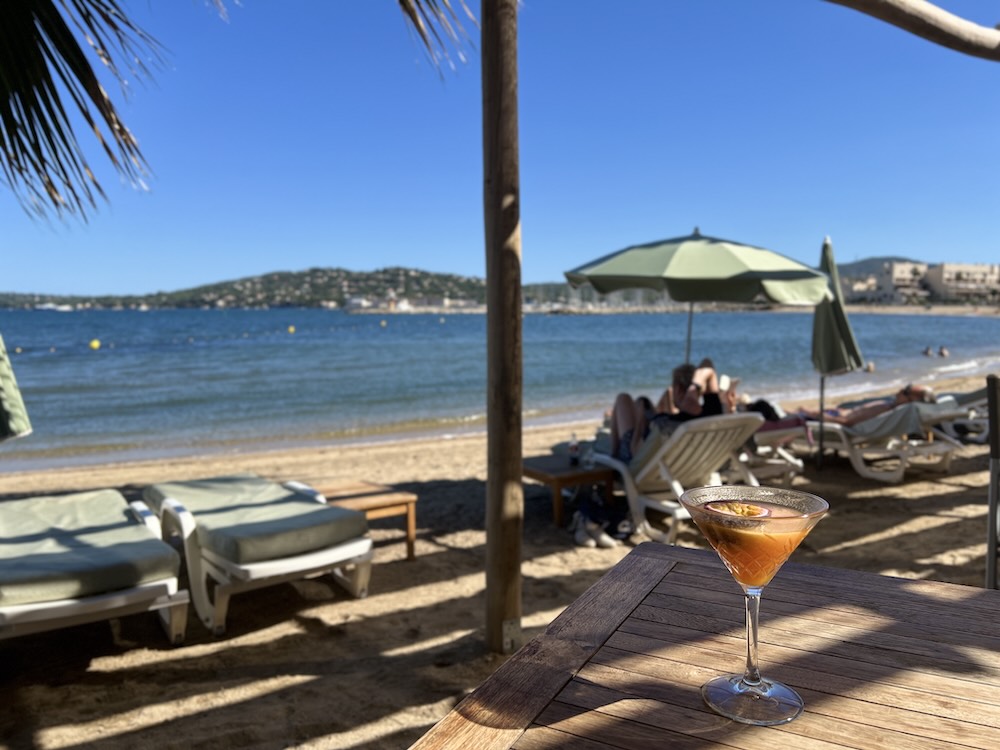
Set on the Gulf of Saint-Tropez, Port Grimaud is a 1960s waterside town within the commune of Grimaud in the Var.
Conceived and built by the French architect François Spoerry, it transformed marshland at the mouth of the River Giscle into a planned “cité lacustre” of canals, quays and pastel façades. It lies roughly seven kilometres west of Saint-Tropez and a similar distance southwest of Sainte-Maxime, sharing the same bay while retaining a residential character.
Spoerry’s scheme is best understood from ground level. Streets are low-rise and human in scale; many lanes are narrow by design, with parking kept to the edge so that most movement within the town is on foot or by boat. The architect aimed to evoke traditional Mediterranean villages while accommodating private moorings at many homes, integrating daily life with the water. The result is frequently described as the “Venice of Provence”, though its vernacular details—shutters, arcades and quayside steps—are firmly Provençal.
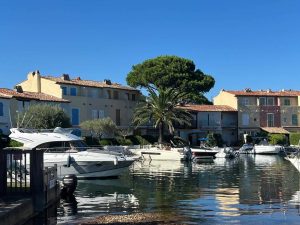
Streets of Port Grimaud
The principal monument is the ecumenical Church of Saint-François d’Assise, a blocky, Camargue-inspired structure facing the inner harbour. Inside, a set of stained-glass windows by Victor Vasarely tracks the sun’s course from dawn to dusk in a grid of circles and colour, an unusual piece of post-war art integrated into a working parish church. A short climb to the viewing platform gives a clear sense of Spoerry’s plan: tiled roofs, moorings at the doorstep and a lattice of basins connected by narrow canals.
Exploring is straightforward. Electric “Coches d’Eau” shuttle boats run along the canals with multiple stopping points around Port Grimaud’s three sectors, allowing visitors to move between the market square, bridges and beach approaches without using a car. Public canal tours operate most of the season, with September services scheduled during the daytime, which suits an unhurried circuit of the waterways. On foot, short bridges link quays flanked by fishermen’s-style houses; from the church steps, the classic photograph frames arcades and iron balconies over the water.
Although the town is quieter than its neighbour, it sits in the same social landscape as Saint-Tropez. The wider gulf has drawn high-profile visitors since the late 1950s, when Brigitte Bardot’s association with Saint-Tropez helped to project the area internationally; summer seasons still attract well-known names from music, film and sport. Port Grimaud shares the boating infrastructure of the bay but functions primarily as a residential marina rather than a nightlife centre.
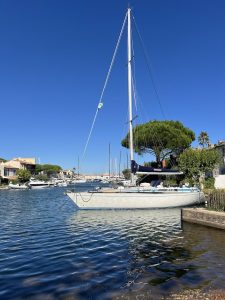 Early autumn is a practical time to come. In September, typical air temperatures around the gulf average about 24°C by day, with evenings near 16°C. Sea temperatures usually remain swimmable—around 21–23°C—so canal touring and short beach stops are feasible without summer heat. With the French school year beginning in early September, demand eases after the holiday peak; the town’s boats and canal paths are less crowded, and services such as the Coches d’Eau continue to operate on daytime schedules.
A simple day plan keeps distances short. Start at Place du Marché for a canal shuttle or a walk to the church; check the belvedere for an overview of the grid. From there, continue on foot across the small bridges to the quays by Place des Artisans and along the arcades that edge the water. Canal tours show the composition from the waterline—low arches, quay steps and a mix of boat sizes at the moorings—before returning to the cafés that face the inner basins. For a contrasting view, the medieval hill village of Grimaud stands above the bay a short drive inland, but the appeal here is the measured scale of Spoerry’s plan at sea level.
Port Grimaud’s draw is architectural and logistical rather than ostentatious: a planned Riviera settlement where boats and pavements take precedence over cars, and where a modern church carries a notable piece of French optical art. In September, conditions favour slow exploration by foot and by electric boat, with warm water and fewer crowds than high summer. For travellers who want the scenery of the Gulf of Saint-Tropez without its peak-season intensity, this waterside town offers a clear, compact alternative.
Croatia’s visitor numbers hit record; officials push year-round season