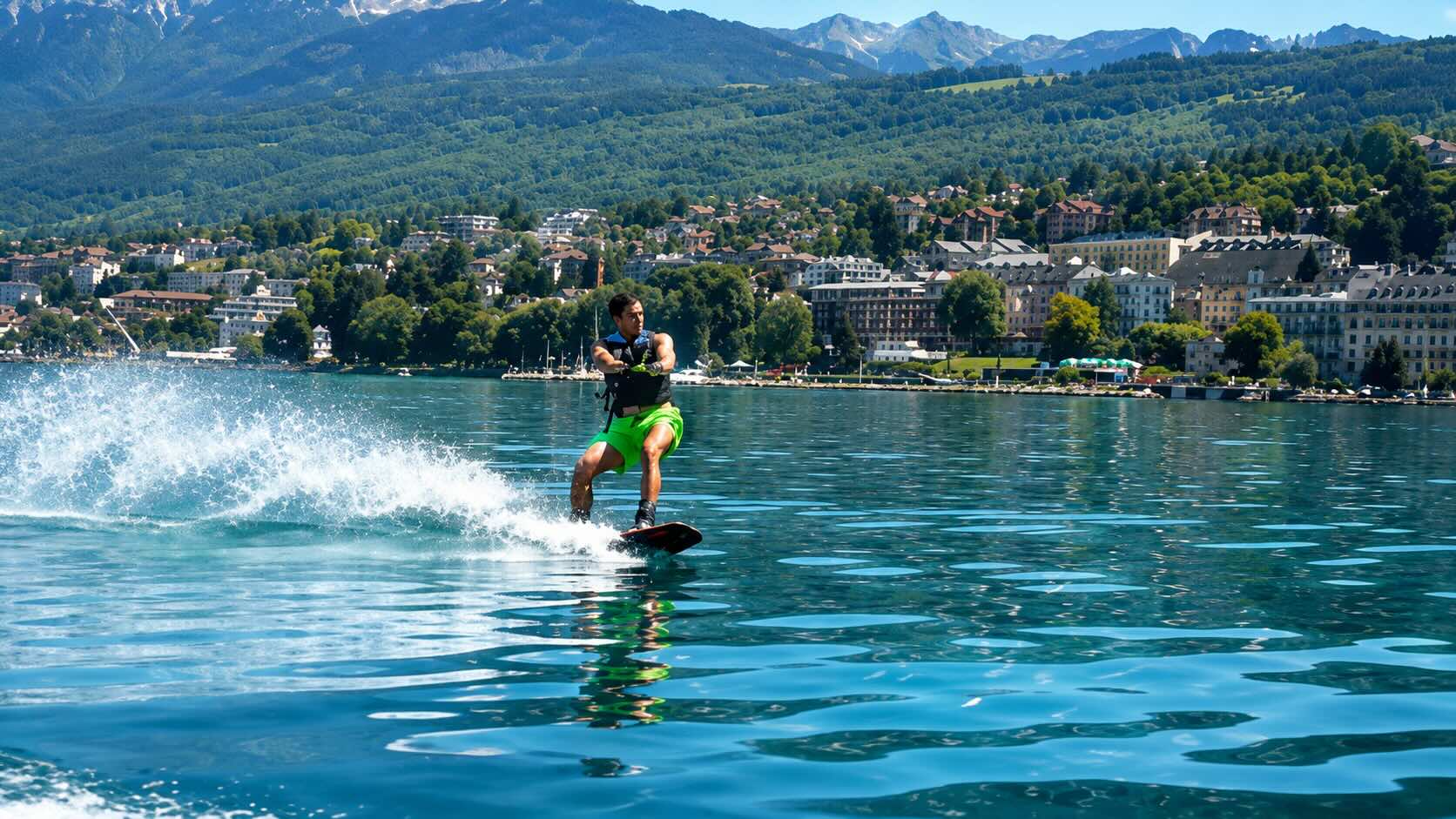
Évian-les-Bains returned to international attention after hosting the G7 summit in June 2026. Yet beyond diplomacy, the French spa town offers mineral springs, Belle Époque architecture, lake crossings, medieval villages and easy access to both the Alps and Switzerland.
Évian-les-Bains is one of those towns whose name has travelled farther than the place itself. The mineral water is known worldwide; the town remains quieter, more elegant and more interesting than its global brand might suggest. Set on the French shore of Lake Geneva, facing Lausanne and the Swiss Alps, Évian combines spa history, Alpine light, lakeside promenades and a recent return to international diplomacy after hosting the G7 summit from 15 to 17 June 2026.
That role was not accidental. Évian had already hosted the G8 summit in June 2003, when Russia was still part of the format and the meeting took place in the tense diplomatic aftermath of the Iraq War. Twenty-three years later, the 2026 summit placed the town again at the centre of international attention, with France using this compact resort on Lake Geneva as a stage for discussions on security, trade, technology, Ukraine and global economic coordination.
Yet Évian is more than a summit town. Its attraction is best understood slowly, by walking from the lakefront into the old spa quarter, then back towards the water as the mountains shift in the light. The town is neither a large resort nor a museum piece. Its charm lies in the relationship between architecture, water and geography: Belle Époque buildings below wooded slopes, ferries crossing to Switzerland, and the Alps visible without ever overwhelming the human scale of the streets.
The natural starting point is the Cachat spring, the physical source of Évian’s mineral-water story. Visitors still stop there to fill bottles, which gives the site a practical, local character rather than the feel of a tourist display. Opposite stands the Buvette Cachat, an Art Nouveau building linked to the town’s thermal past and now being brought back into public use as a heritage centre. Together, they form the most symbolic corner of Évian: the place where the commercial myth of the water bottle meets the older reality of a spa town built around springs.
A short walk away, the Palais Lumière gives Évian its most recognisable architectural landmark. Originally a hydrotherapy establishment, it now serves as a cultural and congress centre, with exhibitions that make it worth entering rather than simply photographing from outside. Its domed roof, tiled façade and lakeside position make it the building that best explains Évian’s early 20th-century prosperity.
One of the town’s most enjoyable experiences is the historic funicular. Built to connect the quays and thermal buildings with the grand hotels above the town, it still feels like a piece of resort history in motion. The line, sometimes described locally as Évian’s small metro, climbs through several stations and offers a view back over the lake that helps explain why the town became fashionable in the first place.
Évian’s lakefront is its public salon. The promenade is level, open and made for slow walking. Across the water lies Lausanne, close enough to feel part of the same landscape but different enough to turn a ferry crossing into a proper excursion. The Évian-Lausanne boat route takes about 35 minutes and is one of the most attractive ways to move between France and Switzerland. Lausanne itself offers a steeper, more urban rhythm: the old town, cathedral, Ouchy waterfront and Olympic Museum all make it an easy half-day or full-day trip.
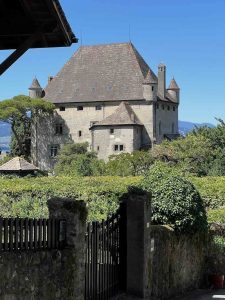
Yvoire
On the French side, the most picturesque nearby excursion is Yvoire, a medieval village west of Évian. Its stone houses, narrow lanes, flowers, small harbour and lake views make it one of the most visited places on the southern shore of Lake Geneva. It is undeniably popular, but its appeal is not artificial. Yvoire works because the setting and the architecture still hold together: a fortified village, a small port, and a sense of the lake as both border and route.
Closer to Évian, Thonon-les-Bains offers a more lived-in version of lakeside life. It is larger and less polished than Évian, with a working town centre, port, belvedere views and its own thermal history. For travellers staying in the area, Thonon is useful not only for practical reasons but also because it prevents the French shore from becoming too postcard-like. It gives the lake a local dimension.
The surrounding countryside adds another layer. Excenevex has one of Lake Geneva’s rare natural sandy beaches, while the Vallée d’Abondance leads inland towards mountain villages, farms, abbeys and walking routes. Across the lake, Montreux and Chillon Castle belong to the Swiss Riviera tradition, while Lavaux offers terraced vineyards above the water. The result is a region where a short stay can easily become a small cross-border itinerary.
Évian works best as a base rather than a single stop. One day can be spent inside the town: Cachat spring, Buvette Cachat, Palais Lumière, funicular and lakeside promenade. A second can follow the French shore towards Yvoire and Thonon. A third can cross to Lausanne or continue along the Swiss side towards Montreux.
The June 2026 G7 summit has given Évian a fresh political footnote, and the memory of the 2003 G8 summit gives it a longer diplomatic association. But the town’s deeper appeal remains older and simpler: water from the hillside, boats across the lake, architecture from the spa age, and mountains close enough to shape every view.