
This was announced this week by the official representative of the Ministry of Foreign Affairs of Kazakhstan Aibek Smadiyarov, the government news agency of Kazakhstan “Kazinform” reports.
“Relevant conversations took place with Alexey Borodavkin. Moreover, the speaker of the Mazhilis (the lower house of the Parliament of Kazakhstan) Yerlan Koshanov has already commented on the statements of the Russian ambassador. Also, Russian Foreign Minister Sergey Lavrov gave his explanations on this issue.
“We believe that the issue has been settled for today. The apologies of the Russian side have been accepted,” he said.
In early December 2022, Ambassador.Borodavkin, in an interview with one of the Russian-language media said: “Unfortunately, I can state and express concern about nationalist tendencies (in Kazakhstan). Radical, I emphasise, nationalist tendencies in Kazakhstan are being seen more and more clearly.”
At the same time, a senior diplomat said that Russia “if asked about it,” is ready to assist Kazakhstan in suppressing “all kinds of extremist nationalist speeches.”
Such a statement caused widespread and justified indignation among Kazakhstanis: interethnic harmony and stability is rightfully considered the main achievement of the Kazakh authorities in the entire history of Independence of this large Central Asian country.
Therefore, commenting on these statements, the speaker of the lower house of the Majilis Yerlan Koshanov, noted that “Alexey Borodavkin is an experienced diplomat and “should not behave like the propagandists and political scientists.
“I have read Mr. Borodavkin’s interview. Some moments of his interview really don’t correspond to his status and don’t work for his benefit. Although Mr. Borodavkin is a very experienced diplomat, we have known him for a long time… This is the first. The second is xenophobia, it exists both in Russia and in other countries, so we must work together for the benefit of our countries, our states, so that our statements of politicians, political scientists, politicians, first of all, do not harm our bilateral relations,” he said.
The official representative of the Ministry of Foreign Affairs of Kazakhstan stressed that the relations between Kazakhstan and Russia are determined by the heads of state.
During the last visit of President Kassym-Jomart Tokayev to Russia, the parties signed a declaration on the occasion of the 30th anniversary of the establishment of diplomatic relations.
“As our President (Kassym-Jomart, pictured 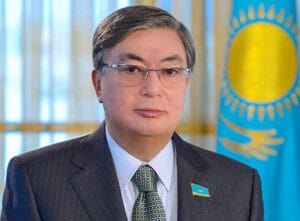 ) noted, during this time our states have been able to build a mutually beneficial strategic partnership based on strong ties of friendship and good neighborliness. A trustful and constructive dialogue has been established between our countries: a high level of cooperation has been achieved. There are no pressing issues between us,” concluded Aibek Smadiyarov.
After such a response, Russian Foreign Minister Sergei Lavrov was morally obliged to react.
The Russian diplomat stressed that the statement of the ambassador to Kazakhstan not only does not reflect the position of the Russian department, it “does not reflect the position of Alexei Borodavkin, because he never uttered what some Kazakh media are trying to accuse him of.”
According to Lavrov, the Russian Foreign Ministry proceeds from the fact that relations between the countries “are determined only by the presidents.”
Meanwhile, the Kazakh media note that in the Russian information sphere in recent weeks, the topic of nationalism in Kazakhstan has been actively discussed again.
This is not the first time this has happened. Whatever arguments were given in Astana that the multinational society of Kazakhstan lives in peace and harmony, some Russian “political scientists” choose to raise questions that the Kazakhstanis themselves do not seem to care much about.
Moreover, the flow of accusations of Russophobia in Kazakhstan intensified after the outbreak of war in Ukraine.
From the “timid” statements of part of the Russian establishment that “Nazi accomplices are sitting in the government of Kazakhstan” to the outspoken calls of imaginary experts “to restore order in Kazakhstan after Ukraine.”
Some commentators from Russia often accuse Kazakhstanis of being “unfriendly and ungrateful people.” They say they forgot about eternal friendship, a shared past and claim that they oppress the Russian-speaking population.
Some Russian commentators are spreading incorrect information that allegedly Russians in Kazakhstan, who have supported Russia since the beginning of the war in Ukraine, were “harassed, harassed, humiliated, and fired from work.”
In fact, no single person has been persecuted or dismissed from work in Kazakhstan for expressing political views.
In Kazakhstan, since the beginning of Russia’s aggression in Ukraine, there was one resonant case with a local radio host who promised on social networks to “call Uncle Vova for help”, responding to those who disapprove of Russian aggression.
After that, the local police registered a criminal case “on the grounds of the composition of the criminal offence provided for in article 174 of the Criminal Code – “incitement of national discord””.
Meanwhile, since the beginning of partial mobilization in Russia, Kazakhstan has been forced to actively accept those Russian citizens who do not want to go to the front. Now they are called “relocants”.
Nevertheless, the latter were very cordially received in Kazakhstan throughout September, fed, watered, and often placed free of charge. Russian Russians, without asking their attitude to the war, were certainly helped by the Kazakhs who allegedly “oppress the Russians in such a way.”
The above-mentioned radio host, by the way, eventually quit. The case was quickly forgotten by everyone, except, of course, the authors of countless anonymous channels, who were still trying to find signs of oppression on a national basis. But the idea is that this story would have developed according to the same scenario, no matter what nationality the main character was. The law is the law.
Interestingly, the Russians themselves in Kazakhstan after these attacks even held an action “We don’t need to be saved!”, making a video message in which they explained that they had never felt harassment or infringement of rights in Kazakhstan.
Therefore, those who say that Russians are fleeing Kazakhstan en masse want to tell only one story.
Financier Timur Turlov, a former Moscow resident who has been living in Kazakhstan for about 10 years and built his multi-billion dollar business there and took Kazakh citizenship this year, was recognised as the businessman of the year 2021 in Kazakhstan.
Perhaps Russian political strategists might wish to elaborate on how Russians are oppressed in Kazakhstan, the free world is listening…


