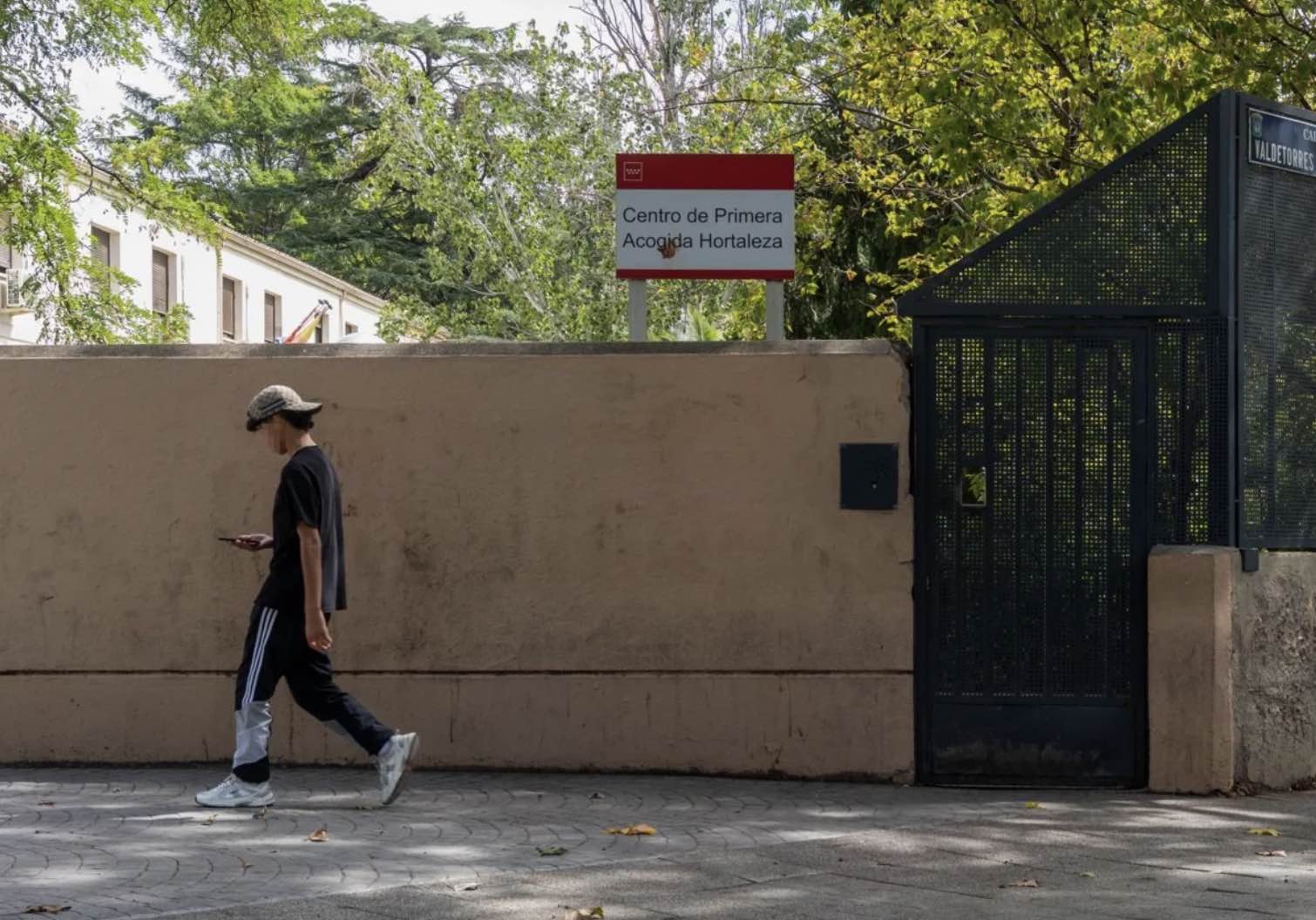
Spain’s uneasy debate over migration has exploded after the alleged rape of a 14-year-old girl by a Moroccan youth in Madrid was followed by a revenge attack on children at Hortaleza migrant reception centre.
Two hooded men assaulted three people outside the facility on Sunday night, including two minors. One required hospital treatment. Police now guard the entrance.
For Madrid, this was more than an isolated crime. It was a glimpse of a future that Europe knows all too well: the hardening of parallel societies, with mistrust on both sides calcifying into violence. Spain risks following the path of France, where suburban banlieues have become breeding grounds for unrest, crime, and alienation — places locals and police alike describe as “no-go zones.”
The spark in Hortaleza
The chain of events began when police arrested a Moroccan youth from the First Reception Centre in Hortaleza, suspected of raping a teenage girl in a nearby park. A judge has ordered his detention in a juvenile prison. The crime struck a raw nerve. Days later, vigilantes attacked other migrant children linked to the same centre.
Isabel Díaz Ayuso’s regional government, run by the conservative Popular Party (PP), quickly demanded the suspect be added to a list of “maladapted” minors earmarked for repatriation. For her, the issue is not only criminal justice but public safety and control of migration.
The socialist-led central government accused Ayuso of stigmatising an entire community. Francisco Martín, its delegate in Madrid, pointed out that more than 250 rapes have been reported in the city this year. Yet, he argued, only this one has been weaponised politically. “It is unacceptable to criminalise vulnerable populations,” he said.
The populist Vox party seized the moment with predictable relish. Javier Ortega Smith, its Madrid spokesman, declared the rape a consequence of “progressive consensus” between the Left and PP, and called for a demonstration outside the reception centre. For Vox, Hortaleza epitomises the failure of “open borders.”
France as the warning
What alarms observers is how closely this resembles the trajectory of France. There, decades of neglect, mass immigration and failed integration policies have left vast swathes of suburbs effectively outside the control of the state. Riots erupt at regular intervals, triggered by crimes or confrontations with police. Shops are torched, cars burned, and officers attacked with impunity.
The French banlieues are now synonymous with entrenched alienation: communities where unemployment, crime, and radicalisation flourish, while law-abiding residents despair of any future. Politicians tiptoe around the problem, fearing accusations of racism or heavy-handedness. The result has been paralysis — and an unspoken acknowledgment that certain districts are beyond the reach of the Republic.
Spain has so far avoided this fate. But Madrid’s Hortaleza district, and Murcia’s Torre Pacheco before it, show the same early signs: migrant reception centres becoming flashpoints, locals fearful and resentful, politicians either in denial or exploiting events for short-term gain. Without intervention, Spain could replicate France’s cycle of crime, alienation and periodic insurrection.
Britain’s uneasy echoes
The United Kingdom offers another warning. While it has largely avoided banlieue-style segregation, the influx of asylum seekers into hotels and small towns has provoked mounting unrest. Anti-migrant protests outside accommodation centres have become more common. At the same time, high-profile sexual assaults committed by recent arrivals have undermined public trust.
The grooming scandals of past decades, and the murders and assaults committed by men who slipped through Britain’s asylum system, are now referenced at every protest. Locals believe their concerns were brushed aside for years by political elites more worried about appearing tolerant than about protecting their own citizens.
Madrid’s outrage will be read by many Britons as vindication: another European capital discovering, too late, the consequences of uncontrolled migration.
The making of ‘no-go zones’
What defines a “no-go zone” is not simply crime, but the collapse of trust between communities and the state. Residents feel unsafe, the police lose legitimacy, and the authorities retreat into platitudes. Migrants, demonised and fearful, retreat further into their own networks. The gulf widens until confrontation becomes inevitable.
Spain is not yet at that point, but the signs are troubling. Migrant minors being attacked in the streets; political leaders trading accusations rather than solutions; populist parties mobilising crowds outside reception centres. Each incident pushes Madrid closer to the point where law enforcement is no longer enough, and whole districts become battlegrounds of ideology and identity.
Europe’s political failure
The political consequences are stark. Populist parties thrive on precisely these conditions, presenting themselves as the only voices willing to speak the truth. Mainstream parties, by contrast, appear paralysed — the Left obsessed with denouncing “hate speech,” the centre-Right fearful of admitting the scale of the problem, the far Right stoking anger.
This is a European problem, not just a Spanish one. From Malmö to Marseille, Birmingham to Brussels, citizens see governments losing control of borders, failing to deport offenders, and neglecting integration. They also see each fresh outrage treated as an ideological weapon rather than a wake-up call.
The road ahead
Spain still has a chance to avoid France’s fate. That would require honesty on both sides: acknowledging that some migrants do commit serious crimes and should be swiftly deported, while also condemning vigilantism and ensuring migrants who follow the rules are protected. Above all, it requires political leaders willing to act, not posture.
Yet the early signs are not encouraging. Madrid’s political class is treating Hortaleza as a theatre for point-scoring. Vox is organising demonstrations, Ayuso is demanding deportations, and the Left is scolding them all for fuelling hate. Meanwhile, the local community sees police cars parked outside a migrant centre, and feels abandoned by the very institutions meant to protect them.
The Madrid case is not simply a Spanish story. It is part of a continental drift towards parallel societies and unrest. France shows where that path leads: cities divided into zones of calm and zones of chaos, with the state barely present in the latter. Britain shows how quickly protests can erupt when communities feel unheard.
Spain is now walking the same tightrope. If its leaders continue to dodge reality, Madrid will not be remembered as a one-off outrage but as the moment Spain began to create its own “no-go zones.”
_________________________________________________________________________________________________________________________

READ ALSO: BRITAIN HOSTS THE LARGEST NUMBER OF ILLEGAL MIGRANTS IN EUROPE, STUDY FINDS
Britain is home to more illegal migrants than any other European country, according to a recent study conducted by Oxford University researchers.
The term “illegal migrants” encompasses several groups: individuals who have overstayed their visas, failed asylum seekers who have evaded deportation, and those who have entered the country illegally, often through small boat crossings across the English Channel.
_________________________________________________________________________________________________________________________
Main Image: Entrance to the reception centre for foreign minors in Hortaleza. IGNACIO GIL via ABC Madrid