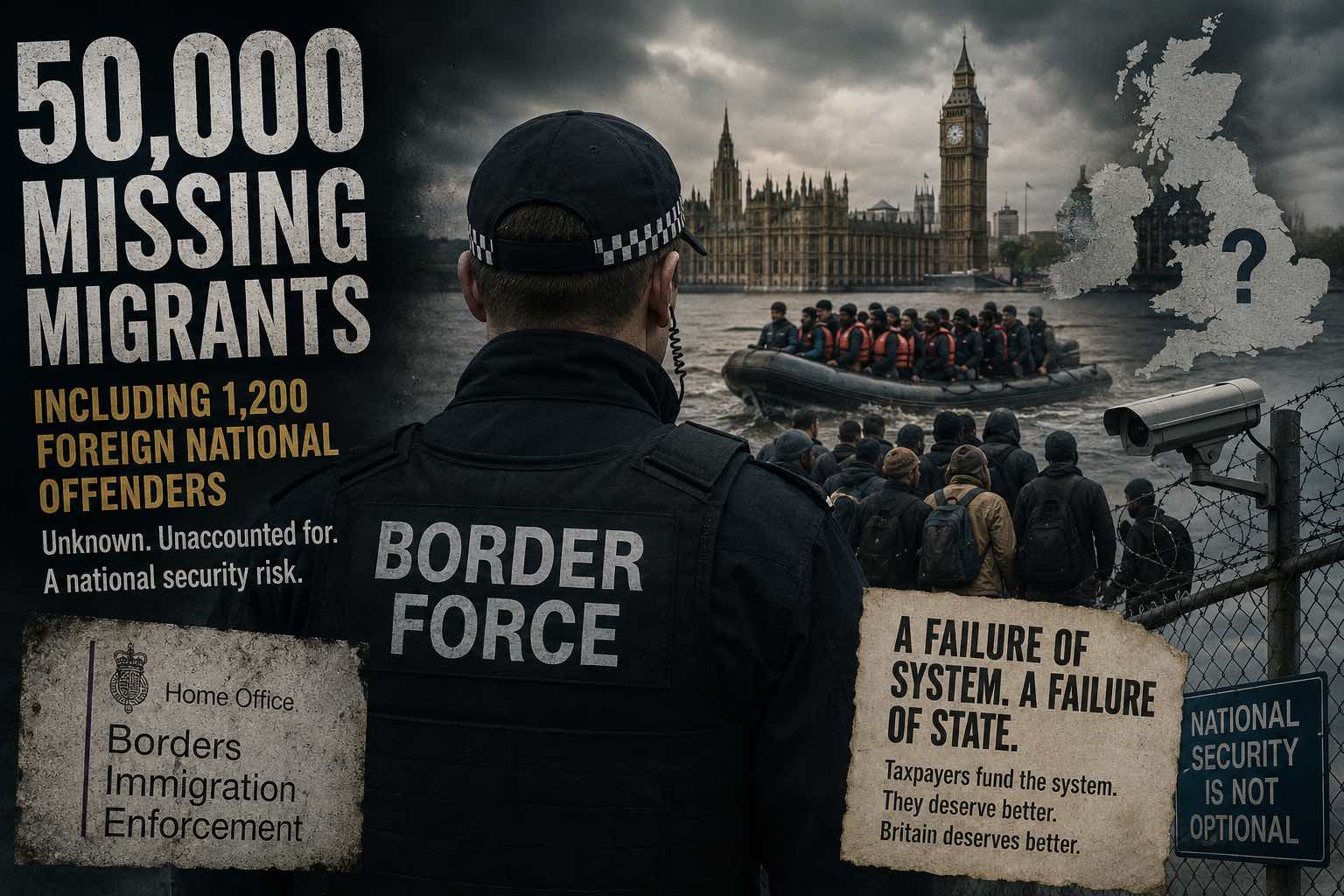
When the government no longer knows who is within its borders, immigration ceases to be merely a political issue and becomes a national security concern
There are moments when a government statistic reveals something far more significant than the number itself. The reported disclosure that more than 50,000 illegal migrants are currently missing from official oversight in Britain is one such moment.
For years, the immigration debate has focused on the visible manifestations of a system under strain: small boats crossing the Channel, mounting asylum backlogs, overcrowded accommodation and repeated promises from ministers to “take back control” of Britain’s borders. Yet the revelation that tens of thousands of individuals have effectively disappeared from the view of the authorities raises a more troubling question.
Does the British state still possess the ability to know who is within its borders?
That question should concern citizens irrespective of where they stand on immigration policy. It is possible to support high levels of legal migration and still regard the situation as unacceptable. Equally, it is possible to favour stricter immigration controls while recognising that the issue extends beyond politics and into the realm of governance itself.
At its core, this is not simply an immigration story. It is a story about state capacity.
The first duty of any government is to uphold the rule of law and maintain a clear understanding of the population under its jurisdiction. That responsibility becomes especially important when dealing with individuals who have entered the immigration system, are subject to reporting requirements or are awaiting decisions regarding their legal status.
The concern is not necessarily who these people are. It is that the authorities do not know where they are.
Supporters of the current system will correctly point out that there is no evidence that the overwhelming majority of those who have disappeared from official oversight pose any threat to public safety. Most are likely seeking employment, accommodation and a means of remaining in the country undetected.
Yet that argument misses the central issue.
National security policy is not built around assumptions regarding the intentions of the majority. It is built around identifying and managing the risks posed by a potentially dangerous minority.
Security agencies do not concern themselves only with what is known. They concern themselves with what is unknown.
This becomes particularly relevant in light of reports that approximately 1,200 foreign national offenders are among those whose whereabouts are currently unknown. The significance of that figure is not that every one of those individuals presents a danger. The significance is that the state cannot readily determine which individuals might present a risk and which do not.
For taxpayers, this should be deeply unsettling.
The British public funds an extensive network of institutions tasked with border security, immigration enforcement, intelligence gathering and law enforcement. Citizens are entitled to expect that these organisations can perform their most basic functions. Maintaining accurate records of individuals subject to immigration controls would appear to be among the most fundamental of those functions.
Yet a system that loses track of more than 50,000 individuals—including roughly 1,200 foreign national offenders—can scarcely be described as operating effectively.
At some point, candour is required.
A system producing outcomes on this scale is not merely under pressure. It appears increasingly unfit for purpose.
The issue becomes even more concerning when viewed through the lens of the broader security environment confronting Europe today.
The continent continues to face challenges posed by organised crime, human trafficking networks, cyber-enabled criminal enterprises, hostile foreign actors and various forms of violent extremism. Among these threats, Islamist fundamentalism remains an enduring concern for intelligence and security services.
This observation should not be controversial. Nor should it be misinterpreted.
The overwhelming majority of migrants have no connection whatsoever to Islamist extremism. Equally, the overwhelming majority of Muslims reject extremist ideologies entirely. Yet governments do not construct security policy around generalisations regarding populations. They construct security policy around risk management.
Security planners are paid to ask difficult questions. They are required to consider worst-case scenarios rather than merely the most likely outcomes.
In an era in which intelligence agencies continue to monitor radicalisation networks and extremist recruitment efforts, governments cannot afford significant gaps in their understanding of who is present within their territory.
The concern is not that the 50,000 missing migrants constitute a threat. The concern is that nobody knows with certainty whether a tiny minority within that population might become one.
That uncertainty alone represents a strategic vulnerability.
For much of the past decade, immigration policy and national security policy have often been discussed as though they occupy separate worlds. In reality, they are increasingly intertwined.
A government that cannot accurately monitor immigration compliance is a government that is limiting its own ability to assess risk.
This inevitably leads to an uncomfortable question.
Should this issue now be placed in the hands of the military?
At first glance, such a proposition may appear extreme. Britain has long maintained a clear distinction between military and civilian responsibilities. Immigration enforcement is traditionally a matter for the Home Office, Border Force and police authorities, not the armed forces.
That distinction exists for good reason.
The military is trained to defend the nation against external threats. It is not designed to act as a domestic immigration agency. Deploying soldiers to identify and locate immigration absconders would represent a profound departure from established constitutional practice.
Yet the very fact that the question is being asked illustrates the scale of public frustration.
If policymakers were seriously to consider transferring responsibility for aspects of immigration enforcement to the armed forces, it would amount to an extraordinary admission. It would signal a belief that existing institutions have failed in their core responsibilities.
More significantly, it would suggest a profound lack of confidence in the ability of Border Force and associated agencies to restore control through conventional means.
It would also raise uncomfortable questions about political will.
If a government concludes that only military involvement can rectify the situation, critics would inevitably ask why civilian institutions were permitted to deteriorate to such a point in the first place. Was the problem one of capability, resources and organisation? Or was it a failure of political determination?
The armed forces should not become a substitute for effective government.
Nevertheless, completely dismissing any military role may also be unrealistic.
The military possesses expertise in intelligence analysis, surveillance technologies, logistical coordination, data integration and operational planning. These capabilities have frequently been deployed in support of civilian authorities during national emergencies.
If the government wished to elevate the issue to the level of a national security priority, military planners could potentially provide valuable support without assuming direct enforcement responsibilities.
A more sensible approach would be the creation of a dedicated National Security Migration Task Force operating under the authority of the Cabinet Office or National Security Council.
Such a body could integrate Border Force, immigration enforcement teams, police services, intelligence agencies and, where appropriate, military support functions.
Its objective would be straightforward: restore situational awareness.
Alongside this institutional reform, ministers should pursue a broader package of measures. Immigration databases should be modernised and fully integrated. Reporting requirements should be strengthened through digital monitoring technologies. Workplace enforcement should be expanded to reduce incentives for illegal employment. Asylum decisions should be accelerated to minimise opportunities for individuals to disappear into the system. Intelligence-sharing with European partners should be intensified.
Above all, the government must demonstrate that immigration laws are capable of being enforced consistently.
The public debate surrounding migration is often polarised between competing ideological camps. Yet the issue highlighted by the missing migrant figures is fundamentally practical rather than ideological.
Whether one supports more immigration or less immigration is ultimately beside the point.
The central question is whether the British state retains sufficient competence to administer the system it has created.
Taxpayers have a right to expect that public institutions funded by billions of pounds annually can account for those who enter the immigration system. They have a right to expect that foreign national offenders do not simply disappear from official oversight. They have a right to expect that ministers possess a clear understanding of who is residing within the country.
Most importantly, they have a right to expect that when systemic failures emerge, governments confront them honestly rather than seeking to manage perceptions.
National security crises rarely emerge overnight. More often, they arise from years of administrative weakness, neglected warning signs and institutional complacency.
Britain may not yet have reached that point.
But when more than 50,000 individuals have vanished from official oversight and approximately 1,200 foreign national offenders cannot be readily located, it becomes increasingly difficult to argue that the warning signs are not already visible.
The question facing ministers is whether they intend to address those warnings while they still have the luxury of choice—or wait until circumstances force their hand.
___________________________________________________________________________________________________________________
Click here for more News & Current Affairs at EU Today
Click here to check out EU TODAY’S SPORTS PAGE!
___________________________________________________________________________________________________________________