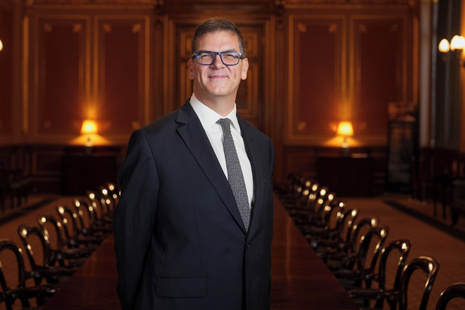
The unravelling of Keir Starmer’s government over the Mandelson affair has all the hallmarks of a familiar Westminster drama: a scandal, a denial, a sacrificial figure—and a Prime Minister hoping the storm will pass if someone else takes the fall. However, The sacking of Olly Robbins raises more questions than it answers.
At the centre of this latest crisis lies the astonishing revelation that Peter Mandelson—already a controversial figure owing to his past and his documented associations with Jeffrey Epstein—was appointed ambassador to Washington despite having failed the UK’s highest level of security vetting.
The official line from Downing Street is one of incredulity. Starmer insists it is “staggering” and “unforgivable” that neither he nor his ministers were informed of the failed vetting. The blame, we are told, lies squarely with the Foreign Office machine—a faceless bureaucratic apparatus that somehow overruled security professionals and neglected to inform the elected leadership.
And so, almost on cue, the head of that machine—Olly Robbins—has been ushered out of the door.
But this is where the official narrative begins to strain credulity.
Robbins, a seasoned operator at the very heart of government for decades, is not some obscure middle-ranking mandarin. He has served as Britain’s chief Brexit negotiator and held some of the most sensitive roles in Whitehall. To suggest that such a figure independently orchestrated the overriding of a failed Developed Vetting clearance—one of the most serious red flags in the security apparatus—without political cover or at least tacit approval is, frankly, difficult to accept.
Indeed, the broader context only deepens the scepticism. The Foreign Office did not merely overlook a procedural detail; it invoked rarely used powers to override a formal denial of clearance. That is not administrative oversight—it is a conscious, high-level decision.
The more plausible reading is that Robbins is being positioned as the fall guy in a crisis that reaches much higher up the chain.
This would not be the first time a Prime Minister has sought refuge behind the doctrine of “I was not told.” It is a well-worn escape route in British politics, offering just enough distance from the scandal while avoiding the more damaging admission of direct responsibility. But it is also a perilous strategy, for it invites an equally uncomfortable question: if the Prime Minister truly did not know, what does that say about his grip on government?
The truth may be that neither explanation is politically survivable.
If Starmer knew about the vetting concerns and pressed ahead regardless, then he stands accused of misleading Parliament when he claimed due process had been followed. If he did not know, then he presides over a government so dysfunctional that critical national security decisions are taken without his awareness.
Either way, the attempt to pin the blame on Robbins looks less like accountability and more like desperation.
There is also the small matter of timing. The revelations have surfaced just weeks before crucial elections, with Labour already showing signs of internal strain. The sudden dismissal of a senior civil servant in these circumstances inevitably appears less like a principled stand and more like a political calculation—an effort to draw a line under the affair before voters render their own verdict.
Yet history suggests that such manoeuvres rarely succeed.
The Mandelson saga is not an isolated misstep but part of a broader pattern of instability within Starmer’s administration. A string of high-profile resignations—from senior advisers to cabinet ministers—has created the impression of a government in constant firefighting mode. Each departure has been presented as an act of accountability; collectively, they point to something more systemic.
And then there is Mandelson himself. His long and controversial career has been punctuated by scandal, resignation, and improbable returns. That such a figure was deemed suitable for one of Britain’s most sensitive diplomatic posts, even before the vetting debacle came to light, raises serious questions about judgment at the highest level.
It is here that Starmer’s defence appears particularly thin. One cannot credibly argue that Mandelson’s background was unknown or unproblematic. The issue was not merely the failure of a vetting process but the decision to appoint him in the first place.
Which brings us back to Robbins.
By casting the departing civil servant as the architect of the debacle, Downing Street is asking the public to believe that a single official not only overruled security advice but did so in a manner that escaped ministerial scrutiny until exposed by the press. It is a narrative that demands a remarkable suspension of disbelief.
More likely, Robbins’ exit serves a different purpose: to demonstrate action, to offer a visible consequence, and—crucially—to redirect attention away from the political leadership.
Whether that will suffice is another matter.
The opposition has already seized upon the inconsistencies, with calls for Starmer’s resignation growing louder. The charge is not merely one of administrative failure but of integrity—of whether the Prime Minister has been entirely candid with Parliament and the public.
In such circumstances, scapegoats rarely provide lasting protection.
If anything, they tend to prolong the story, inviting further scrutiny of what really happened and who truly knew what, and when. The removal of Robbins may satisfy the immediate demand for accountability, but it does little to answer the underlying questions.
Ultimately, this is the danger facing Starmer: that in attempting to save his own skin by shifting the blame, he instead reinforces the perception of a government unwilling—or unable—to take responsibility at the top.
In politics, as in life, credibility once lost is not easily regained, and no amount of convenient resignations can substitute for it.
Main Image: Creator: BEN DANCE Copyright: FCDO
Starmer’s Credibility in Question: the growing fallout from the Mandelson affair
Click here for more News & Current Affairs at EU Today
Click here to check out EU TODAY’S SPORTS PAGE!
___________________________________________________________________________________________________________________