
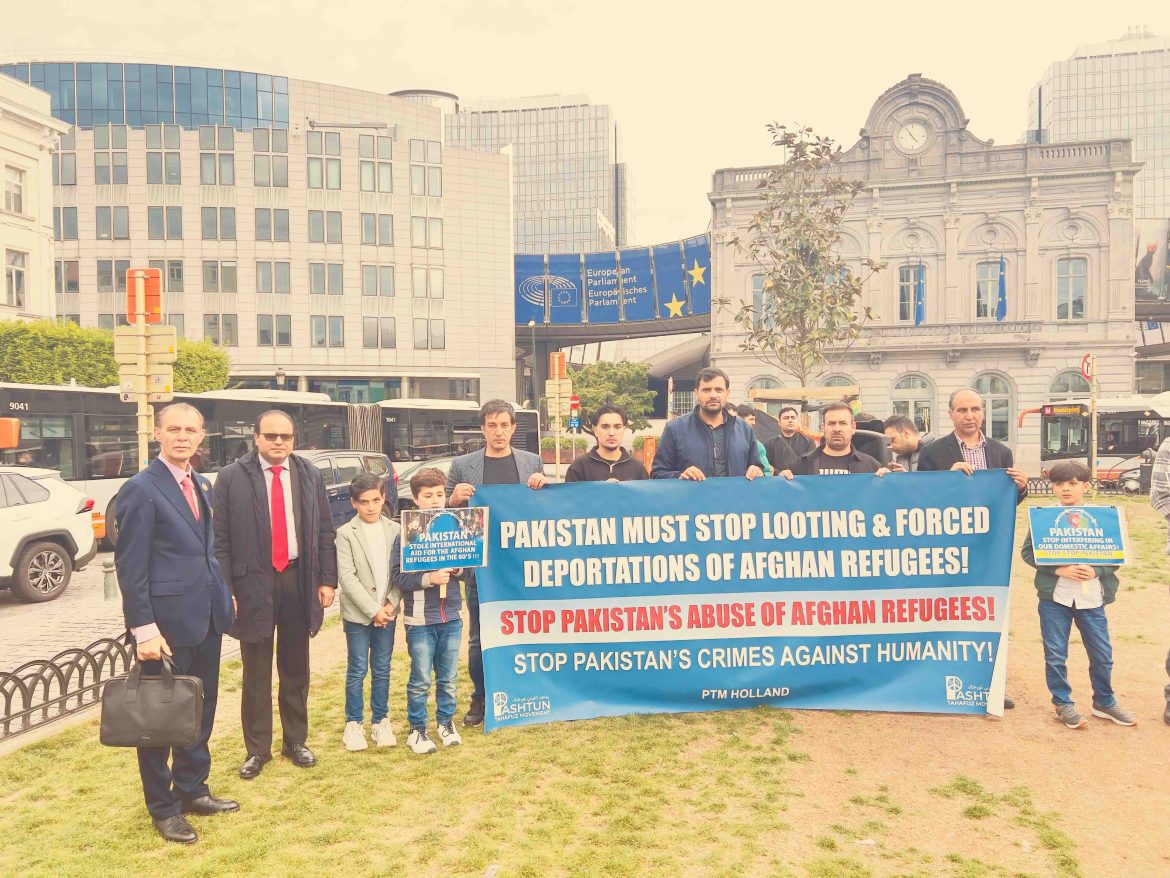
In a forceful resolution presented before the European Parliament, members of the Pashtun Tahafuz Movement (PTM) Holland and international human rights advocates condemned Pakistan’s “inhumane” treatment and mass deportation of Afghan refugees, demanding immediate suspension of the country’s GSP+ trading status with the European Union.
The resolution, titled Letter of Resolution Addressing the Mistreatment and Forced Deportation of Afghan Refugees by Pakistan, was unveiled in Brussels on 20th April, amid mounting concerns over alleged human rights violations. With thousands of Afghan families reportedly subjected to harassment, extortion, arbitrary arrest, and forced repatriation in recent months, the signatories called for swift EU action.
“What we are witnessing is not only a humanitarian catastrophe but a flagrant violation of international law,” said Zar Ali Khan, a leading voice of PTM Holland. “The Government of Pakistan is looting homes, tearing families apart, and forcibly deporting people who have nowhere safe to return.”
Afghan refugees have sought shelter in Pakistan for over four decades, many arriving during the Soviet invasion in the 1980s, and later waves escaping Taliban violence and foreign intervention. Today, an estimated 3.7 million Afghans reside in Pakistan—some registered, many undocumented.
However, reports of police raids, property seizures, and deportations have surged since late 2023, when Pakistan’s caretaker government issued orders expelling undocumented Afghan nationals. While Islamabad defends the crackdown as a matter of internal security, human rights observers argue it contravenes the UN principle of non-refoulement—the practice of not returning asylum seekers to a country where they face serious threats to life or freedom.
“Pakistan may not be a formal signatory to the 1951 Refugee Convention, but it is bound by moral and humanitarian obligations,” said Member of the European Parliament Clara Hofmann, who co-sponsored the resolution. “The treatment of Afghan refugees is disgraceful. If Pakistan continues to behave like a rogue state, it must not enjoy the privileges of preferential trade.”
Central to the resolution is a call to revoke Pakistan’s GSP+ (Generalised Scheme of Preferences Plus) status—a trade arrangement that grants developing countries tariff-free access to EU markets in return for commitments to uphold 27 core international conventions on human rights, labour standards, environmental protection, and governance.
The authors argue that by deporting Afghan refugees, cracking down on peaceful protests, and suppressing religious minorities and journalists, Pakistan has “utterly failed” to meet these commitments.
“GSP+ is not a gift. It is a contract,” said PTM Holland spokesperson Laila Nasir. “When Pakistan benefits economically while openly violating the very agreements it pledged to honour, it undermines the EU’s credibility as a defender of human rights.”
The resolution cites multiple forms of abuse: from the seizure of Afghan-owned businesses to the custodial torture of refugees and activists. It calls for:
An immediate halt to deportations, raids, and harassment;
Legal protections and humanitarian assistance for both registered and undocumented refugees;
UN-monitored investigations into reported abuses;
Accurate information campaigns and support for peaceful repatriation;
Accountability of those responsible—including elements of the Pakistani military and state apparatus.
Some MEPs warned that inaction could embolden authoritarian behaviour in the region.
“We are watching a tragedy unfold in slow motion,” said Dutch MEP Pieter van Leuwen. “Every day we delay action, more lives are shattered. We must not sacrifice human rights at the altar of economic convenience.”
The Pakistani government has previously dismissed such criticism as “politically motivated”, accusing Afghan refugees of harbouring militants and destabilising border regions. However, international agencies, including the United Nations High Commissioner for Refugees (UNHCR), have repeatedly warned that mass returns under current conditions are unsafe and destabilising.
“Afghan refugees are victims of war, not perpetrators of it,” the resolution asserts. “Instead of offering protection, Pakistan has chosen humiliation, abuse, and illegal deportation.”
Though the European Commission has yet to comment formally, sources inside the Parliament suggest growing cross-party support for at least a formal review of Pakistan’s GSP+ status. Such a move would not only have serious economic implications for Islamabad, but signal a broader shift in EU foreign policy toward greater accountability.
In the meantime, rights groups continue to raise the alarm over the deteriorating situation.
“Every Afghan family forced across the border without security, shelter, or dignity represents a failure of the international system,” said human rights lawyer Anwar Bashiri. “We cannot turn our backs. This is a test of Europe’s moral resolve.”
As the resolution circulates among parliamentary committees, pressure is mounting on EU leaders to match words with deeds—and ensure that trade privileges are not used as bargaining chips in the face of suffering.
Resolution Letter Afghan Refugees pdf

