
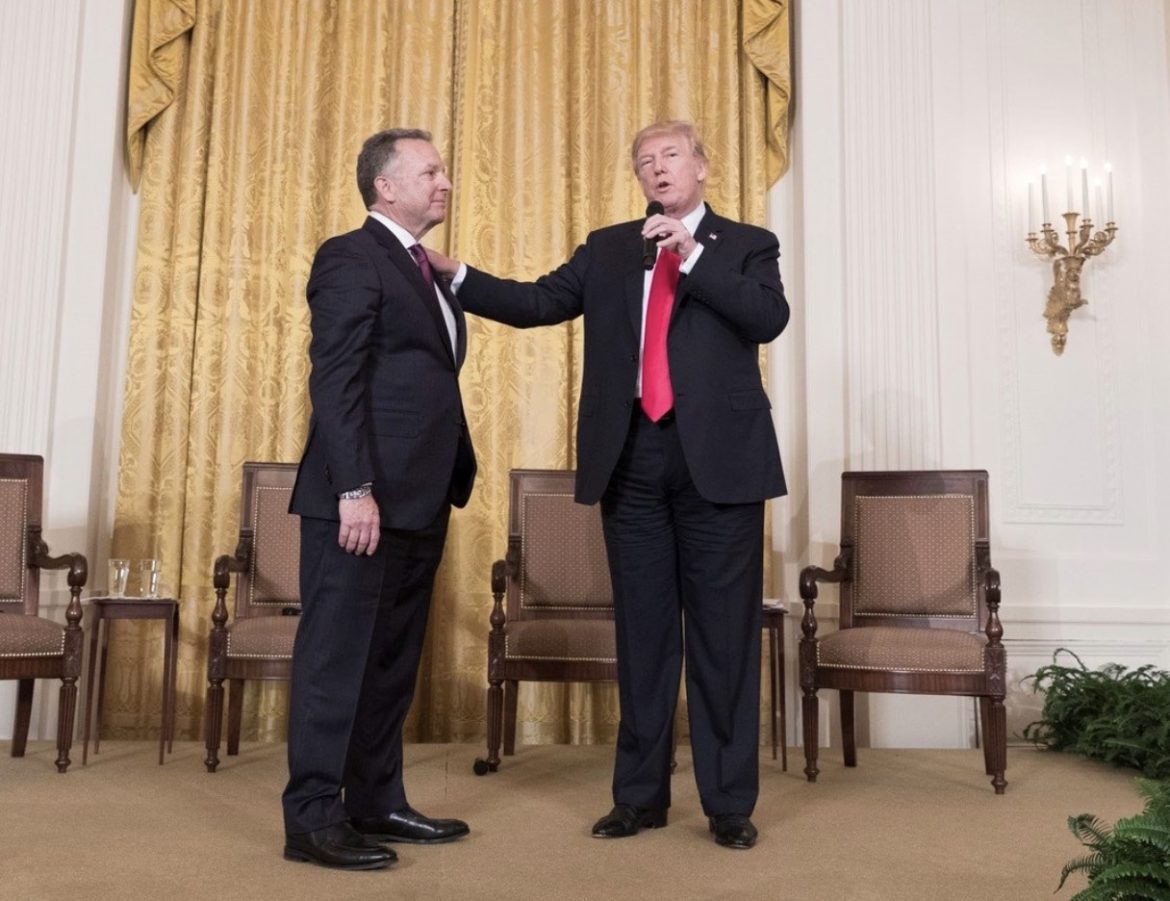
Steve Witkoff, the US President’s special envoy to the Middle East, has recently attracted attention for comments made during an interview with television host Tucker Carlson.
Though formally tasked with diplomatic efforts in the region, Witkoff has increasingly engaged in unofficial dialogue involving the Russian Federation, reportedly acting as a conduit between Donald Trump and Vladimir Putin.
Witkoff is not a career diplomat. His role appears to stem from his close personal ties with President Trump and the trust placed in him to conduct informal discussions with high-profile international leaders, including Putin and Israeli Prime Minister Benjamin Netanyahu. Witkoff’s comments, therefore, are understood by some observers as indicative of the broader outlook within the Trump circle, particularly on Russia and Ukraine.
During the interview, Witkoff recounted an anecdote in which Putin, following an assassination attempt on Donald Trump—at a time when Trump was not in office—claimed to have prayed for the former president in a church. The envoy also revealed that Putin had commissioned a portrait of Trump by a well-known Russian artist and delivered it to Witkoff as a gesture of respect. While Witkoff appeared to interpret these actions as signs of genuine admiration, critics argue they represent calculated moves by the Russian leadership to curry favour with Trump and his associates.
Witkoff did not question Putin’s motivations or background, including the Russian President’s origins in the Soviet KGB and Communist Party—institutions historically hostile to religious practice. There was no reflection on whether such symbolic acts were part of a broader strategy to influence Trump, whose affinity for praise is well-documented.
Crucially, Witkoff’s commentary on the ongoing conflict in Ukraine has prompted concern. Though not directly involved in US-Ukrainian negotiations—he did not participate in recent talks in Jeddah, where Senators Marco Rubio and Mike Waltz represented the US—Witkoff nonetheless expressed views aligning closely with Russian narratives.
He referred to Russia’s control of Ukrainian regions as legitimate and spoke of supposed referendums held in territories such as Donetsk, Luhansk, Kherson, and Zaporizhzhia as though they were credible expressions of local will, despite being widely condemned as illegitimate by the international community. No mention was made of the ethnic composition of these regions—where ethnic Ukrainians form a majority—or the role of the Russian military in securing and maintaining control.
Witkoff’s portrayal of events reportedly mirrors messaging from Moscow. According to his own account, Putin is attempting to reassure Washington that Russia has no broader territorial ambitions in Ukraine beyond what it already occupies. However, the Russian leadership continues to demand that Ukrainian forces withdraw from areas under Kyiv’s current control.
The suggestion that Ukraine should amend its Constitution to legitimise Russia’s occupation was also raised, reflecting an underlying aim to secure recognition of the new status quo not only from Ukraine but from other Western states. Such proposals, if pursued, would represent a significant shift in the US approach to the conflict and could weaken international support for Ukrainian sovereignty.
Witkoff also questioned the UK’s ongoing security commitments to Ukraine, appearing surprised by Britain’s efforts to provide long-term guarantees. This perspective was welcomed by Carlson, who is known for expressing views sympathetic to the Russian position on the conflict.
Despite his alignment with many Kremlin positions, Witkoff appeared to distance himself from certain aspects of Russian policy. He acknowledged the potential for renewed aggression should no credible security guarantees be established for Ukraine. He floated the idea that NATO’s Article 5 protections could, in theory, be extended to Ukraine without formal membership—a concept recently voiced by Italian Prime Minister Giorgia Meloni, a political ally of Trump within the EU.
The notion of conditional NATO protections suggests some awareness within the Trump camp that a fragile peace may not be sufficient to deter future hostilities. However, this remains speculative, as Russia has consistently opposed any form of Western security assistance to Ukraine, including informal guarantees.
Witkoff also commented on Ukraine’s willingness to hold presidential elections, portraying this as a recent development. In fact, Ukrainian law prohibits elections during martial law, which remains in effect due to the ongoing conflict. While Ukrainian authorities have not ruled out elections in principle, any vote is contingent on a cessation of hostilities, which has not been secured.
According to the envoy, Trump’s strategy is to negotiate a ceasefire, after which elections in Ukraine could take place. Yet, such negotiations would likely require security concessions from the US, including halting military and intelligence support—conditions which, if accepted, could undermine Ukraine’s ability to defend itself and further weaken its negotiating position.
To date, Trump has not announced any new aid packages for Ukraine. Existing support continues under frameworks established by the previous administration. Trump’s influence on the conflict may therefore be limited to leveraging this legacy assistance—unless he alters course on sanctions or security guarantees, which remains uncertain.
Ultimately, the interview raised questions about the coherence of US policy under Trump administration and the extent to which unofficial channels may shape future negotiations. Witkoff’s statements suggest a possible willingness to accommodate Russian demands in exchange for symbolic gestures and business cooperation—an approach likely to provoke concern in Kyiv and among NATO allies.
– https://trumpwhitehouse.archives.gov/briefings-statements/photos-of-the-week-030318/

