
The dispute over President Karol Nawrocki’s decision to revoke Volodymyr Zelenskyy’s Order of the White Eagle has turned a disagreement over historical memory into a test of Poland and Ukraine’s wartime partnership.
Polish President Karol Nawrocki’s decision to revoke the Order of the White Eagle from Ukrainian President Volodymyr Zelenskyy has opened a new dispute between Warsaw and Kyiv at a time when both countries remain central to Europe’s response to Russian aggression.
The decision followed Zelenskyy’s move to grant a Ukrainian Special Operations Forces unit the honorary name “Heroes of the UPA”, a reference to the Ukrainian Insurgent Army. The UPA is viewed by many Ukrainians through the prism of anti-Soviet resistance and the struggle for independence. In Poland, however, it is associated above all with the wartime massacres of Polish civilians in Volhynia and Eastern Galicia, which the Polish parliament has recognised as genocide.
Nawrocki argued that the naming decision was incompatible with the symbolic meaning of Poland’s highest state decoration. He said the revocation was not directed against the Ukrainian people and did not alter Poland’s strategic support for Ukraine. Yet the political effect of the move is difficult to separate from the broader context of domestic Polish politics and unresolved historical disputes between the two countries.
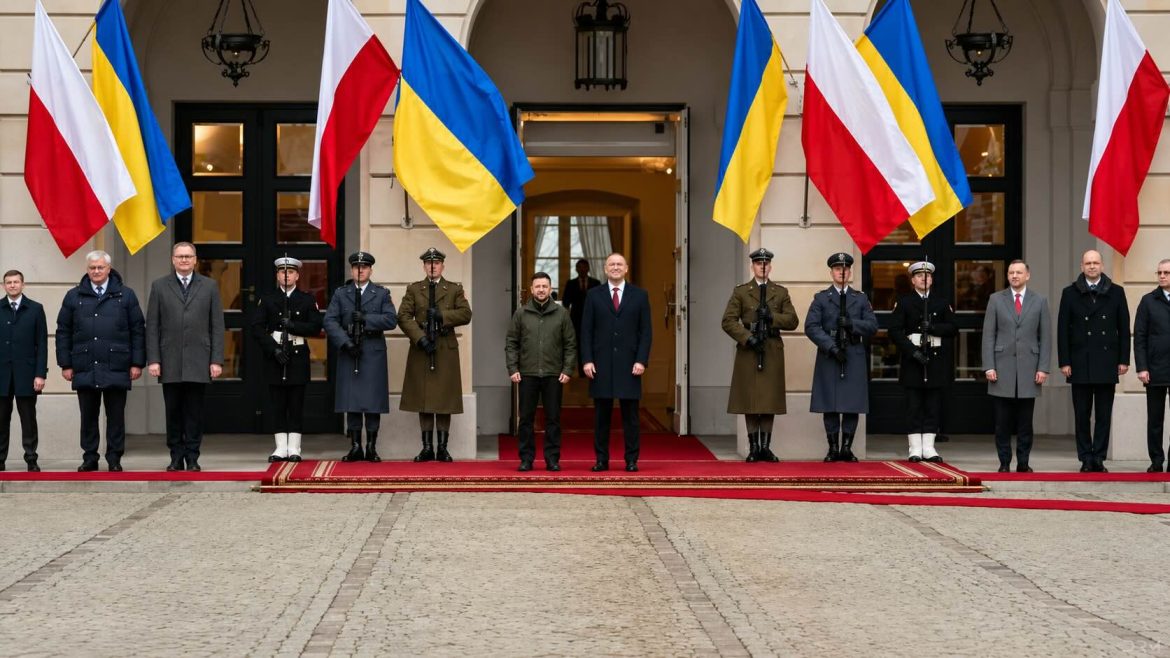
Zelenskyy received the Order of the White Eagle from then-President Andrzej Duda in April 2023, during a period when Poland was among Ukraine’s most important diplomatic, military and humanitarian supporters. The award was presented during Zelenskyy’s state visit to Warsaw, and was framed as recognition of his role in strengthening Polish-Ukrainian relations, security cooperation and the defence of human rights.
That context makes the revocation especially sensitive. Ukraine is still fighting a war whose outcome has direct implications for Poland’s own security. Since February 2022, Poland has served as a principal logistical, political and humanitarian rear base for Ukraine. It has hosted millions of Ukrainian refugees, supported weapons transfers, and pressed within NATO and the European Union for stronger backing for Kyiv.
The present dispute therefore risks shifting attention from shared strategic interests to competing historical narratives. Poland has every right to maintain its own historical memory and to honour the victims of wartime crimes committed against Polish civilians. Kyiv cannot dictate how Polish society interprets the UPA, the Home Army, Volhynia, or any other contested chapter of the twentieth century.
The same principle applies in reverse. Decisions on Ukrainian military names, state symbols and historical references are made in Kyiv, not in Warsaw. If those decisions cause offence in Poland, the proper channel is diplomatic protest, scholarly dialogue and continued work on commemoration, archival access and exhumations. Turning such disputes into state-level punitive gestures carries a different meaning. It suggests not merely disagreement, but a willingness to downgrade the political relationship itself.
The White Eagle controversy also places Prime Minister Donald Tusk in a difficult position. His government has also criticised Zelenskyy’s decision over the military unit’s name, but Tusk has urged restraint and warned against allowing tensions between Poland and Ukraine to benefit Moscow. That distinction matters. One can object to Kyiv’s historical symbolism without turning the dispute into a rupture between two states whose security interests remain closely aligned.
There is no indication that the Russian threat to Poland would diminish if relations with Ukraine deteriorated. On the contrary, Ukraine’s continued resistance remains one of the main factors shaping Poland’s security environment. If Kyiv were weakened, Warsaw would face a more direct and more dangerous strategic position on NATO’s eastern flank.
This does not mean that historical grievances should be ignored. Polish demands for remembrance, access to burial sites and proper recognition of victims are legitimate and will remain part of any serious Polish-Ukrainian dialogue. But such issues require discipline from political leaders. They cannot be resolved through symbolic escalation designed for domestic audiences.
The relationship between Poland and Ukraine has always contained difficult historical layers. It has also shown, particularly since 2022, that societies can act with political maturity when faced with a larger threat. Millions of Poles supported Ukrainian refugees. Ukrainians recognised Poland’s role as one of the first and most active partners in their defence. That civic solidarity remains a more durable foundation than the actions of any single government or presidency.
The task now is to prevent the dispute from becoming a structural break in relations. Warsaw and Kyiv need a mechanism that separates historical dialogue from current security cooperation. Historians, archivists, local communities and families of victims should have the space to address the past. Political leaders should avoid using those disputes as instruments in domestic competition.
Nawrocki’s decision may satisfy part of the Polish electorate, but it carries diplomatic costs. For Ukraine, the lesson is also clear: symbolic decisions taken in wartime can have consequences beyond the domestic audience for which they are intended. Both capitals should recognise that humiliation is not a basis for partnership, and that unresolved history becomes more dangerous when placed above present security interests.
Poland and Ukraine do not need agreement on every historical question to maintain a strategic alliance. They do, however, need a shared understanding that their present security is interdependent. At a time when Russia continues its war against Ukraine and continues to test European resolve, neither Warsaw nor Kyiv benefits from transforming memory politics into a diplomatic crisis.

