
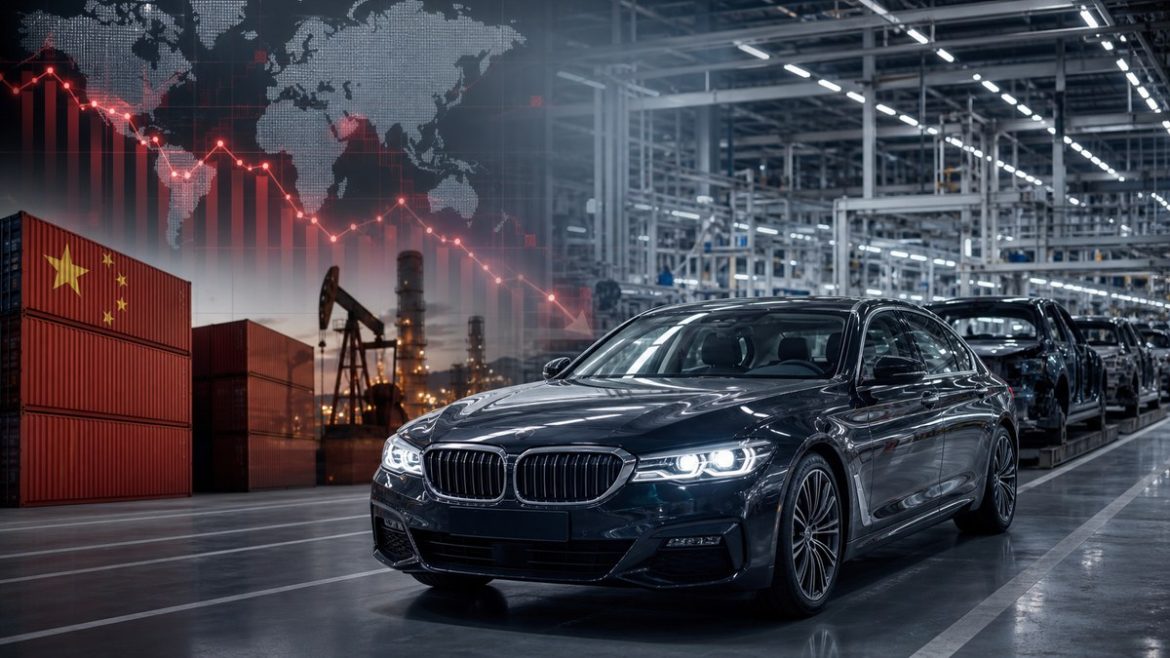
BMW’s profit warning shows how geopolitical shocks are feeding directly into European industrial earnings, as energy costs, weaker China demand and fragile consumer sentiment squeeze Germany’s car sector.
BMW’s latest profit warning has turned geopolitical instability into a concrete corporate problem for Europe’s largest industrial economy, after the German carmaker cut its outlook and saw its shares fall sharply in response.
The Munich-based company said its 2026 performance would be weaker than previously expected, citing a deteriorating Chinese market and the impact of the Iran war on energy prices, costs and global customer sentiment. Financial Times reporting said BMW shares fell almost 8 per cent in early trading on Wednesday after the warning, while the company lowered its expected automotive operating margin to 1-3 per cent from 4-6 per cent.
The warning matters because it connects two pressures that are often discussed separately in Europe: China’s slowdown and geopolitical energy shocks. For BMW, they are now part of the same earnings story. Weaker Chinese demand and fiercer competition in Asia are hitting volumes and pricing. The Iran war has raised energy costs and damaged consumer confidence, making global demand for high-value vehicles more fragile.
Geopolitics reaches the factory floor
European industry has spent years warning that external shocks are becoming harder to absorb. Russia’s war against Ukraine exposed the danger of energy dependence. China’s electric-vehicle push has intensified pressure on European carmakers. The Iran war has now added another layer: a Middle East conflict can raise energy costs, unsettle shipping and weaken consumer sentiment even for companies headquartered far from the battlefield.
BMW’s warning shows how fast those pressures can reach corporate guidance. Higher energy prices do not only affect household bills. They increase production costs, transport costs and supplier costs. When consumers become less confident because of war, inflation or uncertainty, purchases of expensive vehicles are among the first decisions that can be delayed.
That is why the market reaction was so sharp. Investors were not only responding to one company’s revised margin target. They were reading BMW as a signal for the wider European auto sector, including Mercedes-Benz, Volkswagen and suppliers tied to Germany’s industrial base.
China is no longer the easy growth answer
The second pressure is China. For years, China was the growth engine that helped German premium carmakers offset weaker demand elsewhere. That model is now less secure. Chinese consumers are more cautious, local electric-vehicle manufacturers have become more competitive, and foreign brands face tougher pricing pressure.
BMW’s problem is therefore not simply a cyclical dip. It reflects a structural challenge for European carmakers: their most important overseas market is becoming more difficult at the same time that the transition to electric vehicles requires enormous capital spending.
Competition from Chinese EV makers also complicates Europe’s industrial-policy debate. Brussels has imposed tariffs on Chinese electric vehicles, arguing that state support has distorted competition. But tariffs do not solve the demand problem for European brands in China, nor do they remove the need for German manufacturers to become faster, leaner and more technologically competitive.
Competitiveness debate becomes less abstract
BMW’s guidance cut lands directly inside Europe’s competitiveness debate. EU policymakers frequently discuss energy prices, industrial resilience, supply chains and China exposure as strategic problems. The BMW warning puts those themes into an earnings statement.
If Germany’s car sector is hit simultaneously by weak China demand, high energy costs and falling consumer sentiment, the consequences go beyond shareholders. The sector supports hundreds of thousands of jobs across manufacturing, engineering, logistics, software and component suppliers. Cost-cutting at a major carmaker can ripple through regions and supply chains long before it appears in national employment data.
The company has signalled further efficiency and structural measures. Those may protect margins over time, but they can also create short-term pressure through restructuring costs and labour-market uncertainty. For Germany, that is politically sensitive. For the EU, it reinforces the argument that industrial competitiveness is no longer a technocratic slogan.
EU Today has recently examined how Europe’s competitiveness debate is influencing sectors such as telecoms, where regulators are being asked to weigh scale, investment and market structure differently. The auto sector faces a parallel question: can Europe keep high-value manufacturing competitive while exposed to external shocks it does not control?
Energy relief may not be enough
Markets have also been pricing the possibility that the US-Iran framework could lower oil risk and reduce some of the pressure on energy prices. But BMW’s warning is a reminder that corporate damage can persist even if the immediate market shock eases.
Energy costs may fall, but consumer confidence can take longer to recover. Shipping risk may decline, but companies still face higher insurance, logistics caution and planning uncertainty. China demand may stabilise, but European brands will still face stronger domestic rivals and a more price-sensitive market.
That is why the BMW warning should be read as more than a company update. It is a warning about Europe’s industrial exposure to a world in which geopolitical shocks, energy volatility and Chinese competition increasingly arrive together.
For Brussels and Berlin, the lesson is uncomfortable. European industry does not need a crisis inside Europe to suffer. A war in the Gulf, a demand shock in China and a shift in global consumer sentiment can all show up in a German manufacturer’s margin guidance within weeks.
BMW’s shares fell because investors saw weaker earnings. The wider question is whether Europe sees the strategic signal: competitiveness now depends as much on resilience to external shocks as on productivity, technology and regulation at home.

