

The standoff in Epping Forest is more than a row over a hotel. It is the clearest signal yet that the rights of asylum seekers in the UK now outweigh the voices of the British citizens, and their families, who live, work and pay taxes in the country.
A High Court injunction, stopping the Bell Hotel from being used to house 138 single male asylum seekers, was hailed locally as a long-overdue victory for common sense. Parents had been ignored, councillors overruled, planning laws brushed aside. It took a judge to force Whitehall to listen.
Yet the Home Office’s response was instant and telling: it is challenging the ruling in the Court of Appeal, determined to re-assert that international human rights duties come before the safety concerns of British families.
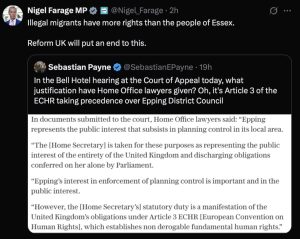
Edward Brown KC, speaking for the department, could not have been clearer. Planning rules, local democracy, and even the possibility of disorder are all secondary to Home Secretary Yvette Cooper’s obligations under the European Convention on Human Rights.
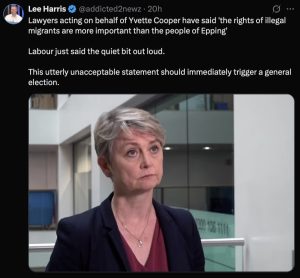
Hotels, she insisted, are now “critical national infrastructure”. In other words: like power stations or motorways, they cannot be turned off just because the public objects.
This language reveals much about the mindset in Whitehall. A hotel that once hosted weddings and Sunday lunches is now spoken of in the same breath as nuclear plants. And when parents raise concerns about sending children back to school beside a site housing 138 men—after a 14-year-old girl was allegedly assaulted—the Home Office shrugs and tells them that in “a free society” everyone must put up with “a degree of perceived nuisance.”
That phrase alone will ring in voters’ ears. Nuisance? Is that how ministers describe parental fear when walking a child past a police cordon? Is that how taxpayers’ anger is dismissed, as public services are collapsing while millions are funnelled into yet another hotel contract?
The Government insists that it does not want to use hotels. But the numbers tell a different story. Over 103,000 asylum seekers are currently being housed at public expense, 3,000 more than before Labour took power just months ago. Small boat arrivals are up 50 per cent this year. Every new arrival has to be accommodated somewhere, and hotels are the path of least resistance.
Yet resistance is precisely what Epping has provided. Its council argued, rightly, that Parliament never decreed asylum seekers’ rights should automatically trump planning law. What is the point of local regulation if ministers can tear it up the moment it becomes inconvenient? And what is the point of electing councillors if they can be overruled by Whitehall lawyers invoking Strasbourg?
This is why the Bell Hotel has become a national symbol. It is about much more than one building. It is about a Government that appears more concerned with meeting international obligations than protecting its own citizens.
The political fallout is already spreading.
Nigel Farage has urged councils everywhere to follow Epping’s lead. Kemi Badenoch, leader of the Conservatives, bluntly declared the migrants should be “moved out immediately.”
Labour, meanwhile, is in the humiliating position of defending the very hotel-based system it once attacked, its promises of competence collapsing into a desperate courtroom battle to keep beds filled.
And then there is the cost. Taxpayers are footing the bill for hotels that were meant as emergency measures years ago but have quietly become permanent. Each fresh extension enriches hotel chains while eroding public patience. When ministers talk of “hardship” for the 138 men in Epping should they be moved, residents are entitled to ask: what about the hardship for communities forced to shoulder the burden indefinitely, with no say in the matter?
The deeper danger is that the Home Office’s legal case confirms exactly what many Britons suspect: that ordinary people’s rights come second. Every time a lawyer insists that local democracy is irrelevant compared to obligations under the ECHR, the gulf widens between Westminster and the public.
Yes, Britain must treat genuine refugees with decency. But there is nothing decent about riding roughshod over communities, dismissing parental fears as a “nuisance,” and burning through taxpayers’ money with no end in sight. Hotels are not infrastructure. They are temporary fixes that have become permanent because ministers lack the courage to confront the problem at its source.
The Court of Appeal will rule soon on whether the injunction stands. If it sides with the council, ministers face chaos as other towns follow suit. If it sides with the Home Office, the public will be told again, in effect, that their views are immaterial. Either way, the Government is caught in a bind of its own making: trapped between international law on one hand, and the demands of its own citizens on the other.
Epping has exposed the contradiction at the heart of asylum policy. Britain’s duty to protect the vulnerable must be balanced against the rights of its own people. At present, that balance has snapped. Asylum seekers’ rights are trumping taxpayers’ rights, and the people of Epping know it. Unless ministers restore equilibrium, the Bell Hotel will not be the last flashpoint—it will be the first of many.
Keir Starmer might heed the words of Rudyard Kipling: “When Time shall count from the date, That the English began to hate”.
Main Image: Bell Hotel Epping Protest via X

