
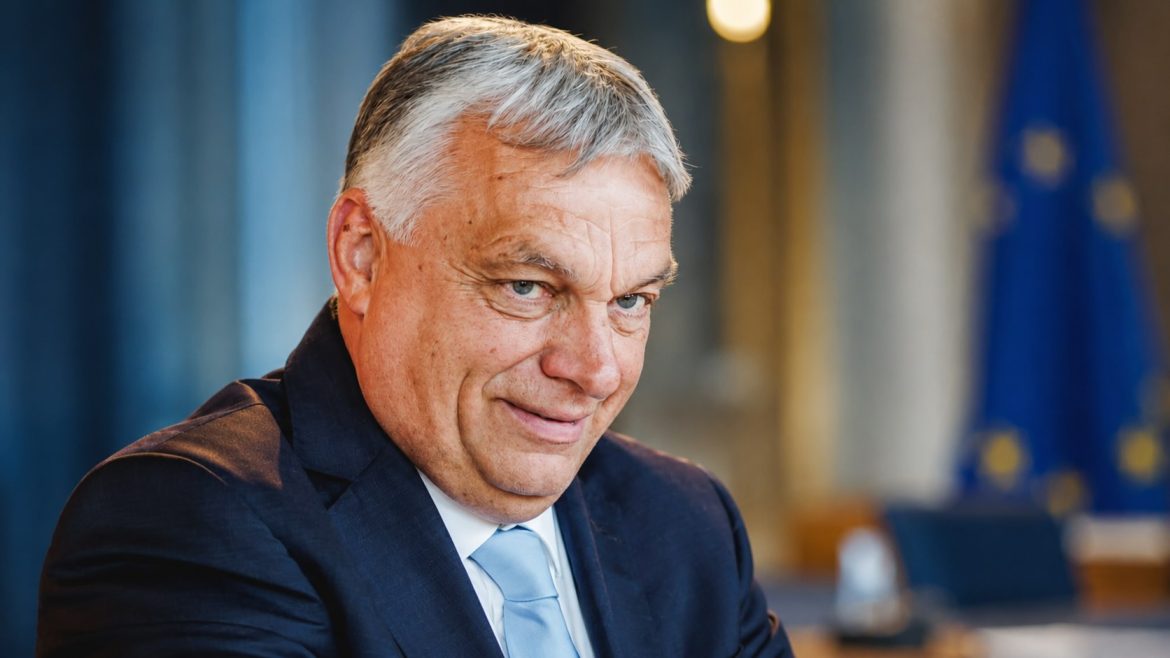
Viktor Orbán is no longer Hungary’s prime minister, but his Patriots for Europe network is still trying to shape the EU debate by linking opposition to Ukraine’s accession with themes long promoted by Moscow.
Viktor Orbán’s defeat in Hungary has not ended his influence in European politics. It has changed the form in which that influence is being exercised.
The former Hungarian prime minister, who lost office after the April 2026 parliamentary election, has been re-elected as leader of Fidesz and is now operating from opposition rather than government. That distinction matters. Orbán can no longer speak for the Hungarian state. He can, however, still act as a political organiser for a European nationalist network that is increasingly using Ukraine’s EU accession as a point of confrontation with Brussels.
That strategy was visible in Brussels on 18 June, when the Patriots for Europe group issued a statement warning against further steps in Ukraine’s accession process. The timing was not accidental. The declaration came as EU leaders were meeting at the European Council, where Ukraine, defence support and the next long-term EU budget were all on the agenda.
The Patriots statement framed Ukraine’s possible membership as a threat to European agriculture, labour markets and security. It argued that accession would place pressure on farmers, create labour competition and increase the risk of deeper confrontation with Russia. These are now becoming the central arguments of Europe’s anti-enlargement right.
The claims are politically effective because they touch real policy areas. Ukraine is a major agricultural producer. Its entry into the EU would require decisions on subsidies, market access, transition periods, quotas, food standards and the future of the Common Agricultural Policy. These issues are legitimate subjects for negotiation. The problem is that they are being presented not as technical questions to be managed, but as reasons to halt Ukraine’s European path altogether.
This is where the Russian dimension becomes central. Moscow’s strategic interest is not only military. It is also political. Russia benefits when EU support for Ukraine is delayed, fragmented or made hostage to domestic election campaigns. Arguments that Ukraine is too expensive, too agricultural, too dangerous or too disruptive all serve the same practical effect: they weaken the political conditions for continued European backing.
Orbán’s own record gives that line additional significance. During his years in power, he repeatedly obstructed EU positions on Ukraine, opposed or delayed common measures, and kept Hungary closer to Moscow than most other member states. His government also maintained a strong emphasis on access to Russian energy, even as the EU moved to reduce dependency following Russia’s full-scale invasion of Ukraine.
Now out of office, Orbán is trying to preserve the same political line through a transnational party structure. Patriots for Europe brings together parties from several member states, including France’s National Rally, Italy’s League, Austria’s Freedom Party, Spain’s Vox, the Dutch Party for Freedom and Czechia’s ANO. The group presents itself as a defender of national sovereignty. In practice, its Brussels declaration linked that sovereignty agenda to opposition against Ukraine’s accession, resistance to EU budgetary leverage, rejection of migration rules and hostility to climate policy.
The budget issue is especially important. The EU is preparing its next long-term budget for 2028–2034. That budget will have to cover defence, Ukraine support, reconstruction, enlargement preparation, migration, competitiveness and climate policy. Any attempt to restore broad national veto power over these decisions would give individual governments greater capacity to block common EU action.
That is precisely why the Patriots agenda matters even if the group does not command a majority in the European Parliament. Its influence may be indirect. If its arguments shape national elections or coalition talks in France, Spain, the Netherlands, Austria, Czechia or Poland, they could affect EU decision-making from inside the Council.
Ukraine’s accession is therefore becoming a proxy battle over the future structure of the EU. Supporters of enlargement argue that Kyiv’s path is merit-based and conditional on reforms. The opening of the fundamentals cluster was designed to anchor the process in rule of law, democratic institutions, public administration, economic criteria and fundamental rights. In other words, Ukraine is not being admitted by political declaration. It is being tested through the same enlargement machinery used for other candidates.
Opponents of accession are trying to move the argument out of that technical framework and into mass politics. Their message is simpler: Ukraine will cost too much, its farmers will undercut European producers, its workers will disrupt labour markets, and its membership will bring Europe closer to war. These claims require detailed rebuttal, because if left unanswered they can turn accession policy into an electoral weapon.
The new Hungarian government under Péter Magyar has changed the formal balance inside the EU. Orbán no longer holds Hungary’s veto as prime minister. That removes one of the most visible obstacles to EU decisions on Ukraine. But it does not remove the political network that Orbán helped build. On the contrary, his defeat may have pushed him to rely more heavily on that network as a way to remain relevant in European politics.
That is also why linking the Patriots campaign to Russia should be done carefully. It is not necessary to claim direct command or coordination. The stronger and safer argument is that the group’s position objectively advances several Russian interests: it seeks to slow Ukraine’s integration, weaken EU financial tools, question military and economic support for Kyiv, restore the appeal of cheap Russian energy, and divide member states against each other.
For Moscow, this is valuable. Russia does not need every sympathetic European actor to be formally controlled. It needs them to repeat arguments that reduce the cost of Russian aggression and increase the political cost of supporting Ukraine.
Orbán’s Brussels move should therefore be read as part of a post-defeat strategy. He is no longer Hungary’s head of government, but he remains a political broker for forces that want a weaker, more divided EU. Ukraine’s accession has become the issue through which that project is being tested.
The response from Brussels and Kyiv cannot rely only on denunciation. It must explain, in practical terms, how enlargement would be managed, how farmers would be protected during transition, how labour markets would be regulated, and how Ukraine’s reforms would be assessed. The anti-Ukraine campaign is organised, cross-border and repetitive. The answer must be equally factual and sustained.

