
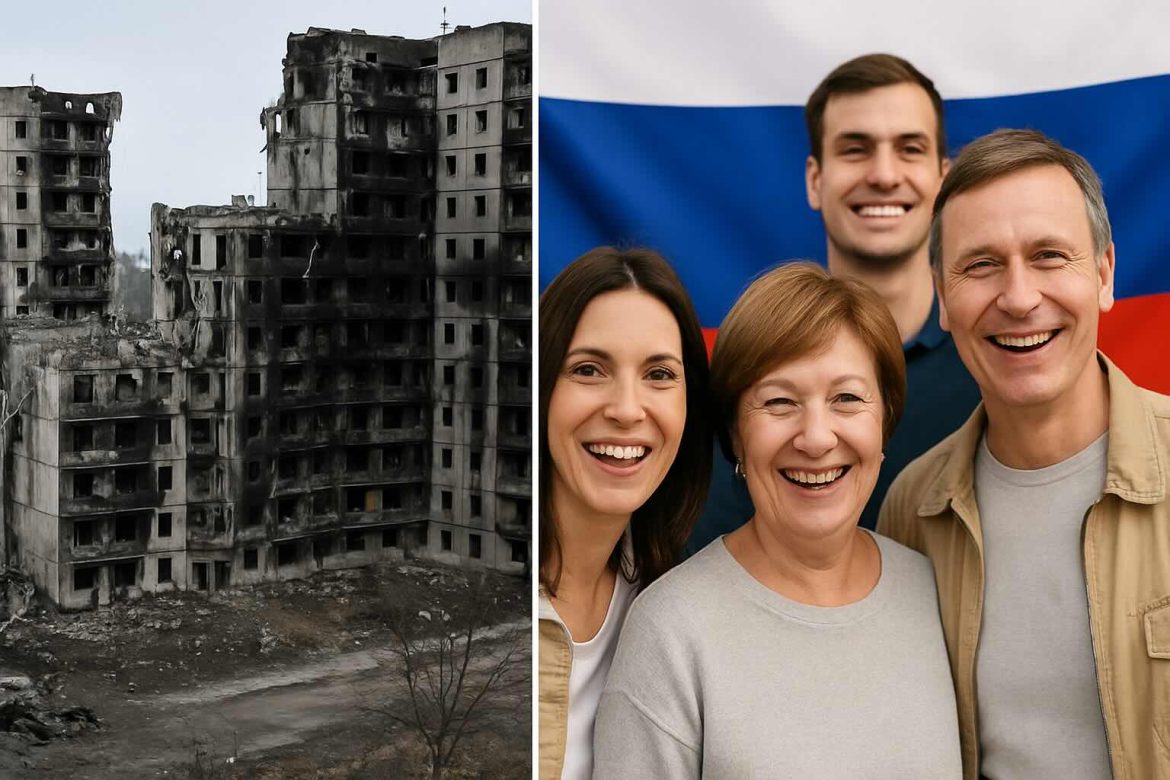
More than three years after the Russian Federation launched its full-scale invasion of Ukraine, recent sociological research indicates that the war has had little discernible impact on public sentiment within Russia.
According to the latest data from the Levada Centre (June–July 2025), a significant majority of Russians maintain a stable or positive outlook on their personal circumstances and on the direction in which the country is heading.
The data show that 70% of respondents consider Russia to be moving in the “right direction”, while only 17% disagree. Meanwhile, almost 80% of those surveyed describe their emotional state as either neutral or positive, with 16% reporting an “excellent” mood. These figures underscore a consistent trend: the war is largely absent from the daily lives of Russian citizens, particularly in metropolitan areas such as Moscow and St Petersburg.
The durability of this sentiment comes despite mounting evidence of economic slowdown. In June, the Financial Times reported that GDP growth in the first quarter of 2025 had declined to 1.4%, down from 4.5% in late 2024, while the Central Bank is preparing to lower interest rates to 19% amid a forecasted annual inflation rate of 7%. Manufacturing activity is also declining, with the Purchasing Managers’ Index falling to its lowest level since early 2022.
Nevertheless, these macroeconomic indicators have not translated into visible public dissatisfaction. In a July survey published by El País, only 20% of Russians reported a deterioration in household finances during 2025, while a growing share believe their quality of life has improved. This is particularly true among low-income groups, for whom state subsidies and wage adjustments have buffered the effects of inflation.
Support for Russia’s military operations remains strong. According to Levada, 75–80% of Russians currently back the war, with nearly half stating that they support it “fully and unconditionally”. At the same time, two-thirds of respondents said they favour initiating peace talks with Ukraine—an apparent contradiction that reflects a broader pattern in Russian public opinion: conditional approval of diplomacy, provided it does not imply concession or defeat.
Among Russia’s political and business elites, there is no indication of meaningful dissent. The expectation—particularly prevalent in Western capitals early in the conflict—that domestic economic strain or battlefield losses might compel the Kremlin to change course, has not been borne out. Moscow’s leadership remains under no visible pressure to de-escalate.
This dynamic presents a difficult reality for Ukraine and its partners. The assumption that time and sanctions would gradually undermine Russia’s internal consensus has not materialised. On the contrary, the Kremlin has succeeded in insulating the public from the war’s consequences through a combination of economic adaptation, suppression of dissent, and control of the information space.
It is in this context that a remark made by U.S. President Donald Trump during his Oval Office meeting with President Volodymyr Zelenskyy on 28 February 2025 has gained renewed relevance. In that exchange, Trump told the Ukrainian leader: “You’re not in a good position. You don’t have the cards right now.” The comment, referencing Ukraine’s limited leverage without American support, underscores a wider strategic imbalance. Russia, unlike Ukraine, is not under sustained missile attack, nor are its cities subjected to regular air-raid alerts or blackouts. While Ukraine faces continuous pressure on its infrastructure and population, Russia’s domestic environment remains largely insulated from the realities of war.
From a policy standpoint, several implications arise:
Western assumptions about internal Russian pressure need revision. The war has become routinised within Russian society, and domestic opposition remains marginalised.
Strategic support for Ukraine should be reconceived on a long-term basis, with multiyear security and economic frameworks that reflect the possibility of a protracted conflict.
Narratives of Russian weakness may require recalibration. While Moscow faces mounting costs, these have not destabilised the regime nor undermined popular support.
Public diplomacy efforts must be intensified, both within Russia—where feasible—and across Western societies, where attention spans and political cycles risk eroding support for Ukraine.
The persistence of high approval ratings, combined with a general sense of national resilience, suggests that the Kremlin retains broad public latitude to continue its war. The notion that economic fatigue or elite defection might shorten the conflict is not supported by current data.
In contrast, Ukraine’s position remains dependent on continued international assistance. Its capacity to sustain military operations, reconstruct civilian infrastructure, and uphold public morale is closely tied to the coherence and resolve of its partners.
For now, the strategic landscape remains defined by an imbalance in domestic vulnerability. While Ukraine absorbs the human and material costs of daily warfare, Russian citizens—by large margins—report normality, optimism, and trust in their government’s direction.
Unless this reality is addressed in Western planning, the war risks settling into a prolonged stalemate favourable to Moscow’s long-term objectives.
Read also:
EU’s 18th Sanctions Package on Russia: Criticism Mounts Over Limited Impact

