
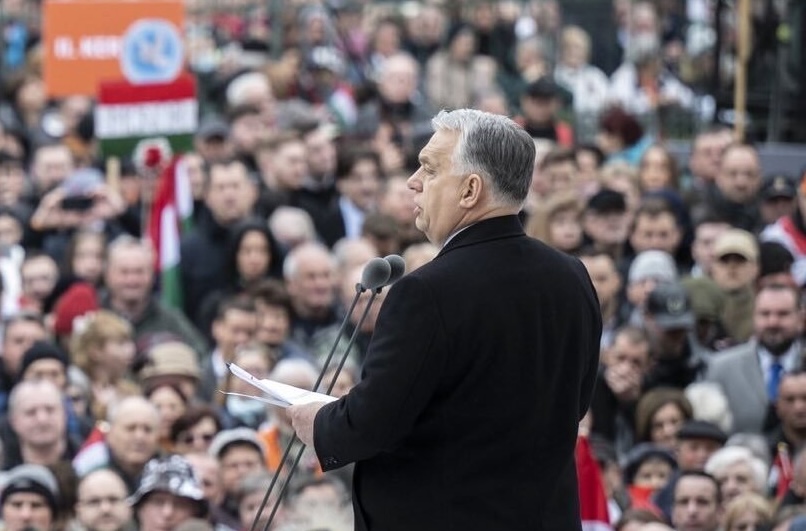
A report in The Washington Post, citing information from a European intelligence service, says Russia’s Foreign Intelligence Service, the SVR, discussed staging a fake assassination attempt on Hungarian Prime Minister Viktor Orbán in order to improve his prospects before Hungary’s parliamentary election on 12 April.
According to the report, the objective was to shift the campaign away from economic dissatisfaction and into the realm of national security, stability and emotional mobilisation.
The report suggested the plan arose from growing concern within Russian intelligence circles over Orbán’s weakening political position. Recent opinion polls showed the centre-right Tisza party, led by Péter Magyar, ahead of Orbán’s Fidesz, pointing to the prime minister’s most serious electoral challenge since his return to power in 2010.
According to the Post, an internal report prepared by Russian operatives described the need for a strategy capable of “fundamentally changing the entire paradigm of the election campaign”. The proposed “gamechanger” was an apparent assassination attempt on Orbán, designed not to eliminate him physically, but to recast him as the central guarantor of order in a period of supposed external danger. The alleged rationale was straightforward: social and economic grievances were damaging the government, while a security crisis could rally wavering voters around the incumbent.
There is no indication that any such operation was carried out. The Washington Post said there had been no physical attack on Orbán. Kremlin spokesman Dmitry Peskov dismissed the report as disinformation, while Orbán’s spokesman, Zoltán Kovács, did not respond to the newspaper’s request for comment, according to the same account.
Even so, the report is politically significant because it points to the scale of Moscow’s interest in the Hungarian election. Orbán has long occupied a singular position inside the European Union and NATO as the bloc’s most openly Russia-friendly leader. His government has maintained close ties with Moscow over energy and has repeatedly obstructed or delayed collective EU action in support of Ukraine. Orbán is still blocking a €90 billion EU loan package for Ukraine as well as further sanctions steps, linking his position to the continued outage of the Druzhba oil pipeline route serving Hungary.
That energy dispute has become one of the central features of Hungary’s late election campaign. Hungary has accused Ukraine of responsibility for the interruption of pipeline supplies, while Kyiv says the damage was caused by a Russian strike and that repairs are under way with EU assistance. Brussels has stepped in with technical and financial support in an effort to restore the route and reduce tensions between Budapest and Kyiv.
EU sanctions or EU subsidy for Russian oil? Brussels cannot have it both ways
At the same time, Orbán and senior members of his government have increasingly framed the campaign in terms of foreign threats. Orbán has portrayed his re-election as a national security necessity, while accusing Ukraine of planning disruptive steps against Hungary’s energy system.
This broader atmosphere gives added weight to the allegation contained in the Washington Post report. If the account is accurate, Russian planners were not merely seeking to amplify Orbán’s message through propaganda or online disinformation, but were prepared to consider a theatrical act of political violence to alter the terms of democratic competition. That would represent an escalation from influence operations into direct manipulation of the electoral environment itself.
The issue also matters beyond Hungary. A parliamentary election in an EU and NATO member state is not only a domestic contest; it has direct implications for European policy on Ukraine, sanctions, energy security and the Union’s internal cohesion. Orbán has already used Hungary’s veto power to complicate decision-making in Brussels, and his continued alignment with Moscow has become a source of growing frustration among other European leaders. Several EU leaders openly accused him of using policy obstruction as an electoral tool.
For now, the reported plot remains an intelligence claim reported through the press, not a judicial finding. There is no evidence that an attack took place, and Moscow denies the allegation. But the episode fits a wider pattern in which Hungary’s election is being treated not simply as a national political event, but as a strategic contest with implications far beyond Budapest. In that sense, whether or not the alleged plan progressed beyond paper, the report underlines how high the stakes have become — for Orbán, for Russia, and for the European Union.

