
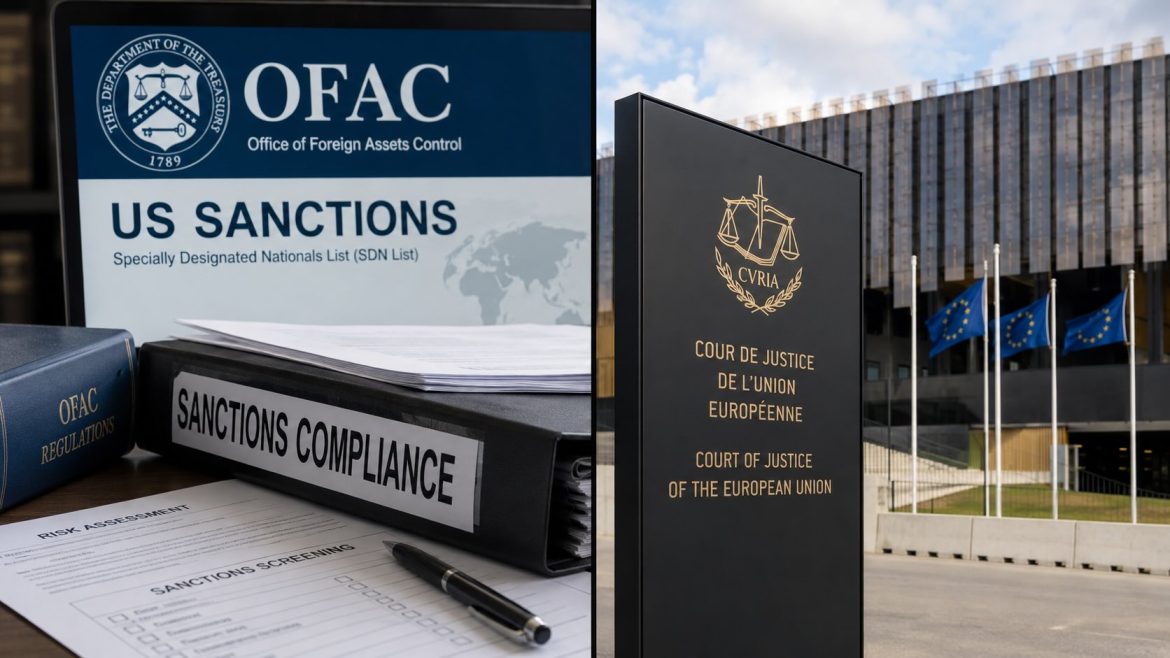
The Court of Justice of the European Union has ruled that a person’s inclusion on a United States sanctions list is not, by itself, sufficient grounds for a bank in the European Union to refuse to open a basic payment account.
The judgment, delivered on 11 June in Case C-81/24, draws a legal boundary between foreign sanctions regimes and rights protected under EU law. It does not prevent banks from taking US sanctions listings into account. It does, however, require them to carry out an individual risk assessment before denying access to basic banking services.
The case arose in Slovenia after Nova Kreditna Banka Maribor, later acquired by OTP Group, refused in 2022 to open a payment account with basic features for a consumer identified in the proceedings as LH. The individual was included on a sanctions list maintained by the US Office of Foreign Assets Control, which provides public access to its sanctions list search tool and publishes data from the Specially Designated Nationals list and other sanctions lists.
According to the Court, the applicant had not been convicted of the criminal offence that led to his inclusion on the US list. He was also not subject to sanctions imposed by the United Nations, the European Union or Slovenia.
The legal issue before the Court was whether a bank operating in the EU may refuse a basic payment account solely because the applicant appears on a sanctions list adopted by a third country. The Court answered that question in restrictive terms.
EU law gives legally resident consumers the right to open and use a payment account with basic features. The European Commission’s guidance on access to bank accounts states that the Payment Accounts Directive gives people in the EU the right to a basic payment account regardless of their place of residence or financial situation. That right is not absolute. Banks remain bound by anti-money laundering and counter-terrorist financing obligations. They may refuse an account where opening one would breach those rules. But the Court held that a foreign sanctions listing cannot automatically decide the matter.
The ruling therefore does not remove compliance duties from banks. It requires them to apply those duties under EU law, rather than treating US sanctions designations as automatically binding inside the EU legal order.
That distinction matters. European banks often operate under pressure from several overlapping regimes: EU sanctions, national rules, US secondary sanctions exposure, anti-money laundering obligations and correspondent banking relationships. In practice, many banks have tended to reduce risk by refusing clients associated with sanctions exposure, even where the applicable EU legal position is more complex.
The Court’s ruling makes that approach harder to defend where it is automatic. A bank may still consider an OFAC listing as a relevant risk factor. It may still refuse a customer if, after assessment, it concludes that the risk of money laundering or terrorist financing cannot be managed. What it cannot do is treat a third-country listing as conclusive without examining the specific case.
For compliance departments, the judgment points towards a more documented and proportionate decision-making process. Banks will need to show that they assessed the customer, the nature of the account, the level of permitted activity, the risks identified and the measures available to manage those risks. A basic payment account is not the same as a full commercial banking relationship, and that difference is relevant to the risk assessment.
The ruling also has a wider policy dimension. It confirms that US sanctions may influence banking risk decisions in Europe, but do not automatically displace EU rules on access to basic financial services. That is significant at a time when sanctions policy is increasingly used as a foreign-policy instrument, and when financial institutions often act as the practical enforcement layer.
There is also a consumer-rights element. Access to a basic payment account is essential for ordinary economic life, including receiving income, paying rent, settling bills and participating in the formal economy. Denial of such access can have severe consequences, especially where the individual is not subject to EU, UN or national sanctions.
The decision is unlikely to end cautious banking practices. Institutions with US exposure will continue to consider OFAC listings carefully, particularly where they could affect dollar clearing, correspondent relationships or access to US markets. But the judgment makes clear that regulatory caution cannot replace legal reasoning.
According to reporting on the case, OTP Group said banks remain fully obliged to comply with anti-money laundering rules and must do so through proper individualised risk assessment.
The practical consequence is that EU banks may need to revisit internal policies that rely too heavily on foreign sanctions lists. Blanket refusals based only on OFAC designation now carry legal risk where the applicant seeks a basic payment account and no EU, UN or national sanctions apply.
The judgment does not create a right for sanctioned persons to obtain unrestricted banking services. It does something narrower but important: it requires European banks to justify refusals under EU law, on the facts of the individual case.
In doing so, the Court has reinforced a familiar principle in EU financial regulation. Risk control is permitted, and in many cases required. Automatic exclusion is not.

