
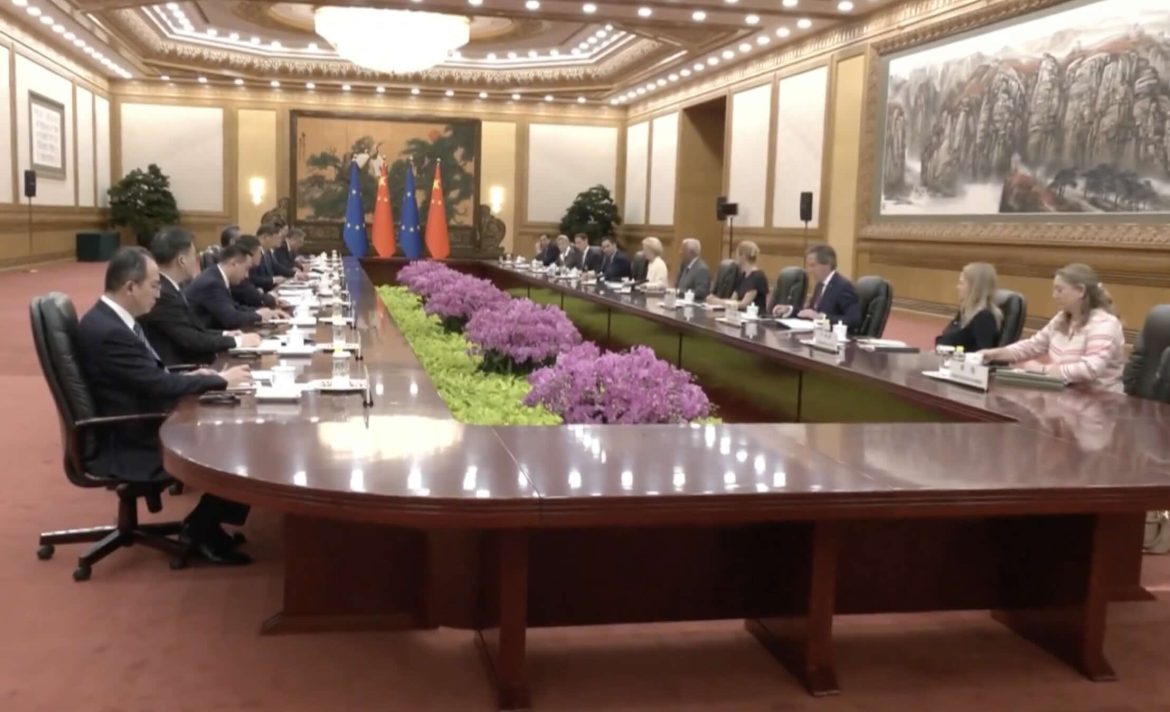
At the 25th European Union–China Summit in Beijing on 24 July, European Commission President Ursula von der Leyen described the relationship between the two blocs as having reached an “inflection point”, signalling mounting friction over trade imbalances, industrial overcapacity, and geopolitical divergences.
The summit, intended to mark 50 years of diplomatic relations between Brussels and Beijing, took place against the backdrop of deteriorating political trust and rising economic tensions. Originally scheduled to span two days, the meeting was truncated to a single day at China’s request, highlighting the lack of consensus over key agenda items.
Speaking at the Great Hall of the People alongside European Council President António Costa and Chinese President Xi Jinping, von der Leyen emphasised the need for what she termed an “essential” rebalancing of trade relations. “As our cooperation has deepened, so have imbalances. We have reached an inflection point,” she said. The EU’s trade deficit with China reached a record €305.8 billion in 2024, a figure that has drawn growing scrutiny in Brussels and prompted calls for corrective action.
Von der Leyen added that both sides must “acknowledge our respective concerns and come forward with real solutions”. The European Commission has repeatedly raised issues over Chinese state subsidies, market access restrictions, and export practices affecting European industries, particularly in the green technology and automotive sectors.
In response, President Xi urged the European Union to avoid what he called “strategic misjudgements”. According to Chinese state broadcaster CCTV, Xi called on EU leaders to “make correct strategic choices” and to deepen mutual trust. “The more severe and complex the international situation, the more China and the EU must strengthen communication,” Xi said.
Ahead of the summit, rhetoric on both sides had become increasingly confrontational. On 8 July, von der Leyen accused Beijing of enabling Russia’s war economy and distorting global markets through industrial overcapacity, particularly in sectors such as electric vehicles and solar panels. Nevertheless, in a post on social media platform X published hours before the summit, she struck a more measured tone, describing the meeting as an opportunity “to both advance and rebalance our relationship” and expressing confidence in the possibility of “mutually beneficial cooperation”.
The European delegation is also due to hold talks with Chinese Premier Li Qiang later in the day. While officials on both sides have tempered expectations for any substantive breakthroughs, negotiators are reportedly working towards a modest joint statement on climate change—a policy area which remains one of the few common priorities between the EU and China.
Trade tensions, however, continue to dominate the agenda. The EU has launched several investigations into Chinese industrial subsidies, while Beijing imposed export controls on rare earth elements in April, disrupting key European supply chains. The restrictions led to temporary stoppages at several automotive production lines across the EU in May, underlining Europe’s reliance on Chinese critical raw materials.
European concerns have centred on allegations that China is deliberately overproducing in strategic sectors such as batteries, wind turbines, and electric vehicles, creating global surpluses and driving down prices. Brussels has also expressed unease about Chinese involvement in Russia’s military-industrial complex, despite Beijing’s assertions of neutrality in the Ukraine conflict.
China May Call on Russia to Strike NATO in Event of Taiwan Invasion, Rutte Warns
For its part, China has sought to portray itself as a constructive partner rather than a rival. A commentary published by the official Xinhua news agency stated that “China is a critical partner to Europe, not a systemic rival,” and highlighted shared interests in climate, trade, and global governance. The commentary called for greater cooperation and warned against allowing “isolated points of friction” to dominate the relationship.
Despite such appeals, the EU continues to define China in strategic terms as simultaneously a “partner, competitor and systemic rival”. This threefold characterisation, adopted by the European Commission in 2019, continues to underpin the bloc’s approach to Beijing, balancing engagement in selected areas with increased scrutiny of economic and strategic dependencies.
Electric vehicles remain a particular flashpoint. The European Commission’s anti-subsidy investigation into Chinese electric car exports is ongoing, and officials have hinted at the possibility of provisional tariffs depending on the outcome. Meanwhile, Beijing has indicated it may retaliate with its own countermeasures, raising the prospect of a tit-for-tat trade dispute in a sector central to Europe’s climate and industrial policy ambitions.
While the summit may produce limited formal outcomes, it underscores the deepening complexity of EU-China ties. With geopolitical pressures mounting and economic frictions increasingly politicised, both sides face growing difficulty in managing the competing dimensions of interdependence, rivalry, and strategic competition.
Read also:
EU Refuses to Sign China Climate Declaration Without Concrete Commitments

