
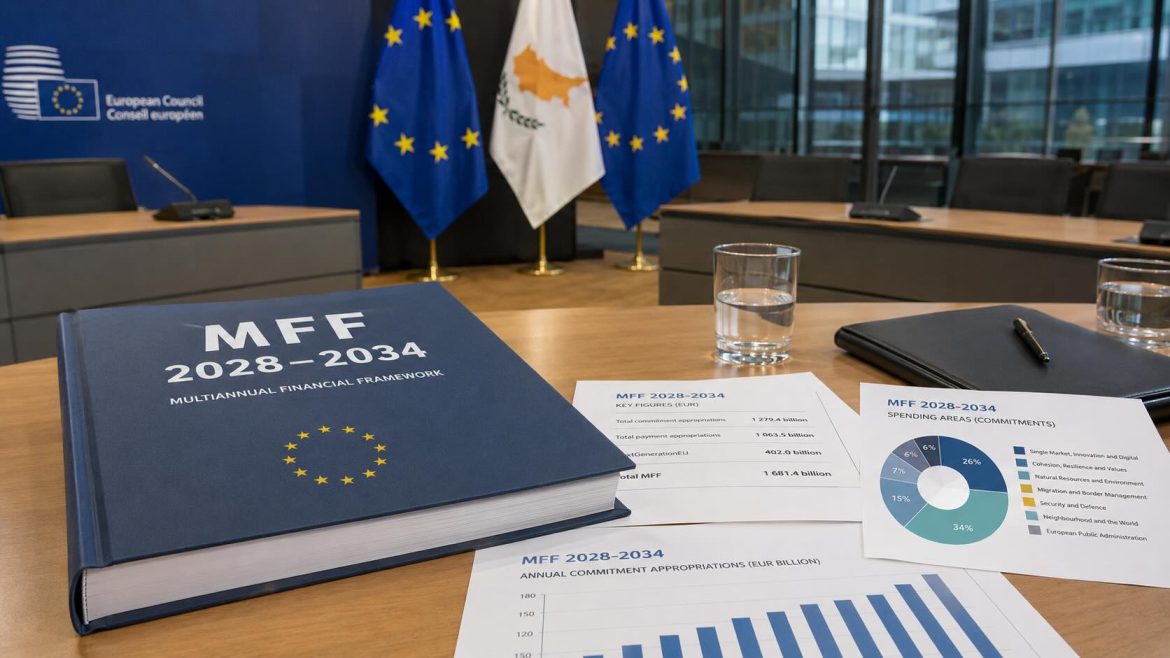
The next European Union budget has moved from institutional planning into political conflict, after the Cyprus Presidency proposed cutting the Commission’s draft long-term spending plan by about €32.8 billion.
The proposal concerns the Multiannual Financial Framework for 2028–2034, the seven-year budget that will determine how much the EU can spend on agriculture, regional development, competitiveness, defence, external action, migration, enlargement and support for Ukraine. The Commission presented its draft as a budget designed to match Europe’s new strategic priorities. The first serious Council-side compromise points in a different direction.
According to details of the Cypriot negotiating proposal, the Presidency is seeking a reduction of around 2 per cent from the Commission’s plan, equivalent to €32.8 billion. The proposed cuts would fall mainly on competitiveness, defence, external policy and EU-level programmes, while largely protecting agriculture and cohesion funds.
That distribution is politically important. It suggests that, at the start of the decisive negotiating phase, member states are moving to defend traditional national envelopes rather than expand the common EU instruments Brussels says are needed for a more dangerous economic and security environment.
The Commission’s proposed EU budget for 2028–2034 was designed around a different argument: that the Union needs a more flexible spending structure to finance priorities that individual national budgets cannot deliver alone. Those priorities include defence industrial capacity, competitiveness, energy security, external action, enlargement preparation and crisis response.
The Cyprus text exposes the central contradiction in EU policy. Leaders have spent the past two years arguing that Europe must do more on defence, reduce strategic dependencies, support Ukraine and compete with the United States and China. Yet the first budget numbers now circulating among governments would trim precisely the areas most closely linked to those ambitions.
The issue is not simply whether the EU spends more or less. It is about who controls the money. Agriculture and cohesion are politically entrenched because they are distributed through national or regional channels and have clear domestic constituencies. Competitiveness, defence, external action and cross-border funds are more closely linked to Brussels-managed priorities. Cutting the latter while protecting the former would shift the balance back towards member-state control.
That may help Cyprus build a compromise among governments. Many net recipients want to protect cohesion and farm spending. Spain and Italy also have reasons to defend traditional funds. Germany, the Netherlands, Sweden and other net contributors are pressing for budget restraint and are unlikely to support a large increase in national contributions without tighter priorities and stronger conditions.
The Cyprus Presidency programme states that advancing negotiations on the 2028–2034 budget is a top priority and that the Presidency aims to build a balanced framework capable of reaching agreement by the end of 2026. That timetable matters because failure to agree in time would delay the adoption of sectoral legislation in 2027 and risk disruption when the new budget period begins in January 2028.
The European Parliament is pulling in the opposite direction. In April, MEPs backed a position calling for a larger budget, arguing that the EU cannot take on new priorities while protecting existing programmes without additional resources. The Parliament’s interim report on the MFF supported a budget of 1.27 per cent of EU gross national income, with repayments for the NextGenerationEU recovery fund kept outside the spending ceilings.
That sets up a familiar but sharper institutional clash. Governments want control, predictability and restraint. Parliament wants more resources and protection for EU-level ambition. The Commission wants flexibility. The political question is whether those objectives can be reconciled at a time when the EU’s own list of priorities has expanded faster than its willingness to pay.
Defence is the most sensitive example. Since Russia’s full-scale invasion of Ukraine, the EU has repeatedly called for greater defence industrial capacity, more joint procurement and stronger support for Ukraine. Yet defence-related EU spending remains politically difficult because national governments remain protective of their own industries, procurement systems and budgetary choices. A cut to EU-level defence or competitiveness funding would signal that member states still prefer national control over a larger common defence-financing role.
External action faces a similar problem. The Commission’s proposal includes a larger, simplified Global Europe instrument, intended to finance external policy, enlargement preparation and crisis response. Reducing that envelope would weaken the EU’s claim that it can act as a geopolitical power while preparing for possible enlargement and continued support for Ukraine.
The Cyprus proposal also raises a question about the EU’s economic model. Brussels has argued that competitiveness requires strategic investment in technology, infrastructure, clean industry, critical raw materials and cross-border projects. If those areas are cut early in the budget talks, the EU risks protecting the spending patterns of the past while underfunding the policies it says are needed for the future.
There is also a distributional calculation. Cyprus is reportedly proposing a €5 billion top-up for member states with GDP per capita below 90 per cent of the EU average, financed from a fund intended for cross-border strategic projects. That would make the compromise more acceptable to poorer member states, but it would also reinforce the shift from common European investment towards nationally visible allocations.
None of this means that the Cyprus text will become the final budget. MFF negotiations are long, technical and often deliberately opaque. The “negotiating box” is a starting point, not an agreement. But starting points matter. They show where the Council believes a political bargain may be possible.
The emerging bargain is clear: protect agriculture and cohesion, trim newer EU priorities, and keep the overall figure closer to what net contributors can defend domestically. That may be the only way to move talks forward. It is also a warning that Europe’s strategic rhetoric is already colliding with budget arithmetic.
For the EU, the next budget is not an accounting exercise. It is a test of whether member states are prepared to finance the policy shift they have spent years announcing. The Cyprus proposal suggests that, when the numbers are placed on the table, the old budget politics remain stronger than the new geopolitical language.

