
Armenia’s attempt to deepen ties with the European Union has moved from a diplomatic question to an economic pressure point, after members of the Russia-led Eurasian Economic Union warned that Yerevan could face suspension over its European ambitions.
Armenia’s westward turn has prompted a direct warning from the Russia-led Eurasian Economic Union, whose members have said Yerevan may face suspension if it continues to pursue closer integration with the European Union.
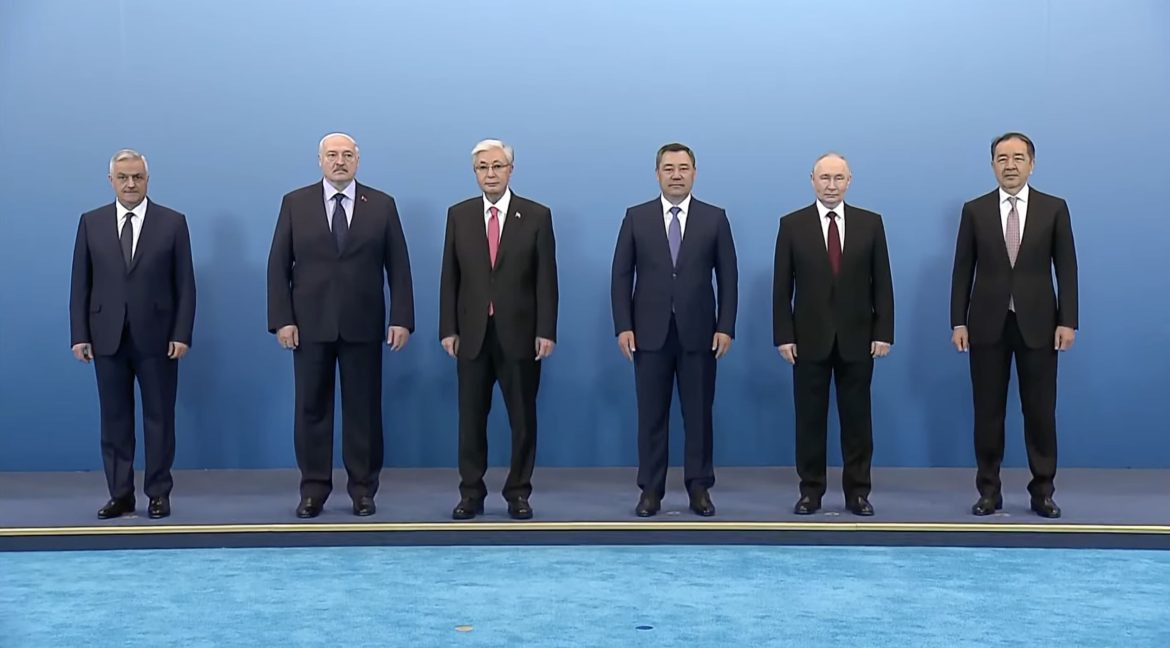
The warning, issued after an EAEU meeting in Astana on Friday, marks a new stage in the pressure being applied to Prime Minister Nikol Pashinyan’s government before Armenia’s parliamentary election on June 7. According to AP and Reuters, the bloc said Armenia’s EU aspirations posed risks to its economic security and called for the consequences of a possible suspension to be examined.
The move places Armenia in an increasingly difficult position between two economic and political systems. Yerevan remains a member of the Eurasian Economic Union, alongside Russia, Belarus, Kazakhstan and Kyrgyzstan, but has also taken visible steps to deepen cooperation with Brussels. Armenia has not formally applied for EU membership, but its parliament adopted legislation in March 2025 declaring the start of a process aimed at accession to the European Union, a step welcomed at the time by senior members of the European Parliament’s delegation for relations with the South Caucasus.
For Moscow, the issue is not only legal compatibility between trade regimes. It is also about influence. Armenia has been one of Russia’s traditional partners in the South Caucasus, hosting a Russian military base and maintaining deep economic links with Moscow. Yet relations have deteriorated since Azerbaijan’s recapture of Nagorno-Karabakh in 2023, after which many in Armenia accused Russia and the Moscow-led Collective Security Treaty Organisation of failing to protect Armenian security interests.
Pashinyan has since moved to reduce Armenia’s dependence on Russian-led structures. Armenia has frozen its participation in the CSTO, expanded contacts with the European Union and the United States, and sought to present closer European alignment as compatible with Armenian sovereignty. Brussels and Yerevan adopted a new strategic agenda for partnership in December 2025, while the European External Action Service describes the EU as Armenia’s largest donor and a key political and economic partner.
The EAEU warning therefore carries an economic message as well as a political one. Russia has already signalled that Armenia’s European path could have consequences for preferential supplies of energy and other goods. A separate Reuters report this week said Moscow had warned that preferential supplies of oil, gas and rough diamonds could be affected if Yerevan continued moving towards the EU.
That threat matters because Armenia has limited room for economic adjustment. It is landlocked, dependent on regional routes, and exposed to Russian trade, energy and remittance channels. Any suspension from the Eurasian Economic Union, or a sharp reduction in Russian preferential treatment, would not be a symbolic move. It could affect imports, exports, customs arrangements, energy costs and household purchasing power.
The timing is also significant. Armenia’s election campaign is taking place against a wider contest over the country’s strategic direction. Reuters reported on Friday that Western intelligence and documents it reviewed pointed to alleged Russian efforts to influence the election through disinformation, political support networks and plans involving diaspora voters. Moscow has denied interference. The report underlined the extent to which Armenia’s election is being watched not only as a domestic contest, but as a test of whether Yerevan’s foreign-policy shift can survive Russian pressure.
Pashinyan has rejected the idea of an immediate referendum forcing Armenians to choose between the EU and the EAEU. His position is that Armenia can maintain economic ties with the Eurasian bloc while expanding cooperation with Europe. The leaders of the other EAEU members are now challenging that assumption directly, arguing that the two paths cannot indefinitely coexist.
For the European Union, Armenia’s position presents both opportunity and constraint. Brussels has sought to strengthen ties with Yerevan, but it has not opened a formal accession process. EU support has so far focused on partnership, reform, resilience, connectivity and economic cooperation rather than a clear membership timetable. That leaves Armenia exposed to Russian retaliation while still lacking the kind of EU security and economic guarantees that candidate countries might expect.
The confrontation also has implications beyond Armenia. It shows how Moscow can use regional economic organisations as instruments of political discipline, particularly in states seeking to reduce their dependence on Russia without yet being fully anchored in Western institutions. The message to other countries in Russia’s neighbourhood is clear: movement towards the EU may carry immediate economic costs before any European benefits are guaranteed.
Armenia’s choice is therefore not only about long-term alignment with Brussels. It is about whether a small state can diversify its foreign policy while still embedded in Russian-led economic structures. The EAEU’s threat of suspension has made that contradiction explicit.
For now, Armenia has not left the Eurasian Economic Union and has not formally applied to join the EU. But the Astana warning has narrowed the space for ambiguity. As the June election approaches, Moscow and its partners have turned Armenia’s European orientation into a question of economic risk, domestic politics and regional power.

