
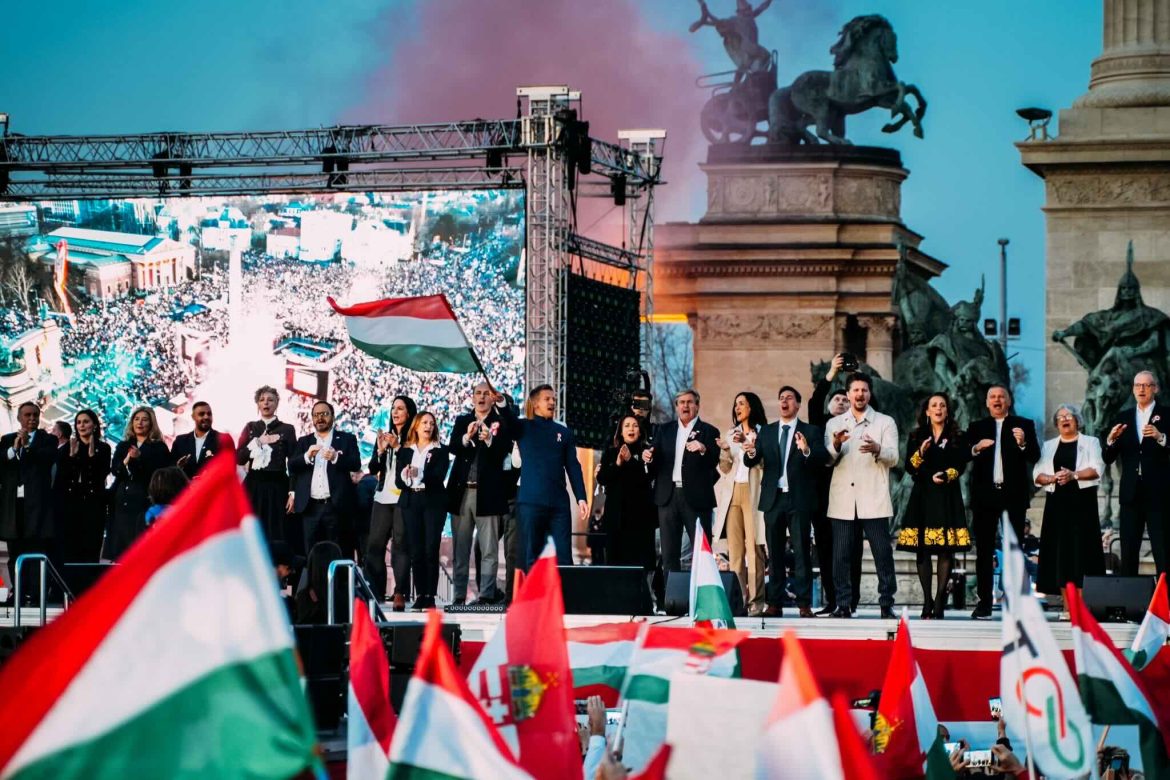
Hungary’s incoming governing party, Tisza, has indicated that it wants to place eventual eurozone membership back on the national agenda, with 2030 seen as a possible target if the necessary economic conditions can be met.
The signal comes as Brussels moves quickly to engage with prime minister-designate Péter Magyar’s team following the party’s election victory and as negotiations begin over frozen EU funds and Hungary’s wider relationship with the Union.
The clearest statement so far has come from András Kármán, Tisza’s lead figure on financial policy. In remarks reported by Telex, Kármán said a Tisza government would first assess the real state of Hungary’s public finances and hold consultations before fixing a target date for joining the single currency. He said the conditions for entry could likely be created by 2030, and possibly earlier under a more favourable scenario. Kármán viewed euro adoption as economically beneficial for Hungary, arguing that the country is already deeply integrated with the euro area economy.
That marks a distinct shift from the line associated with Viktor Orbán’s long period in office. Hungary, while treaty-bound in principle to adopt the euro at some point, has never moved decisively towards a timetable. Under Orbán, retaining the forint formed part of a broader preference for policy autonomy and nationally controlled economic management. Reuters reported after Tisza’s victory that investors read the result as opening the way not only to improved relations with Brussels but also to a more credible long-term path towards meeting eurozone accession criteria by 2030.
Market reaction suggests that financial actors see political change in Budapest as economically material. Reuters reported that the forint rose sharply after Orbán’s defeat, reaching near three-year highs against the euro and four-year highs against the dollar, amid expectations that a Tisza government would pursue reforms needed to unlock EU funding and restore confidence in Hungary’s direction. The same report noted that Goldman Sachs highlighted Tisza’s stated commitment to meeting the conditions for euro adoption by 2030.
Kármán’s formulation is notable because it links the euro question to macroeconomic repair rather than political symbolism. One of the central requirements he identified was price stability, though he also said this should not be pursued through state-administered price controls, which he argued run against the logic of a normal market economy. That matters because euro adoption is governed by formal convergence rules. According to the European Central Bank, a state seeking to join the euro area must demonstrate sustainable convergence in four main areas: price stability, sound public finances, exchange-rate stability and low long-term interest rates.
The regional backdrop has changed as well. Bulgaria joined the euro area on 1 January 2026, becoming the 21st member of the single-currency bloc. The ECB said Bulgaria’s accession should support smoother transactions, stronger integration and greater economic stability. Its entry has inevitably renewed attention on which non-euro EU states might realistically follow. In Central and Eastern Europe, that gives added weight to any indication that Hungary could once again treat euro adoption as a serious policy objective rather than a distant legal obligation.
The euro debate is unfolding in parallel with urgent negotiations between Budapest and the European Commission. Commission officials were expected in the Hungarian capital on Friday for talks with Péter Magyar’s incoming team, only days after the election, as both sides begin work on unlocking roughly €17 billion in EU funds frozen during the Orbán era. Commission President Ursula von der Leyen has already told Magyar that rapid progress will be required if Hungary is to regain access to the money, particularly on reforms linked to judicial independence and rule-of-law safeguards. The Commission has previously made clear, in its own Q&A on Hungary’s recovery plan, that any disbursement remains conditional on the fulfilment of 27 so-called “super milestones”.
Those discussions are not purely financial. They are taking place in a wider political context that includes Hungary’s previous obstruction on Ukraine-related decisions at EU level. Brussels sees the change in Budapest as an opportunity to reset relations, though it remains unclear how quickly a new government could translate electoral victory into institutional change.
For now, there is no formal accession schedule and no claim from Tisza that euro adoption is imminent. What exists is a political signal, backed by early market optimism, that Hungary’s incoming leadership may seek to re-anchor the country more firmly in the EU mainstream. If that direction holds, eurozone preparation by 2030 could become one of the clearest tests of whether Hungary’s post-Orbán turn produces structural economic change rather than only a change in tone.

