
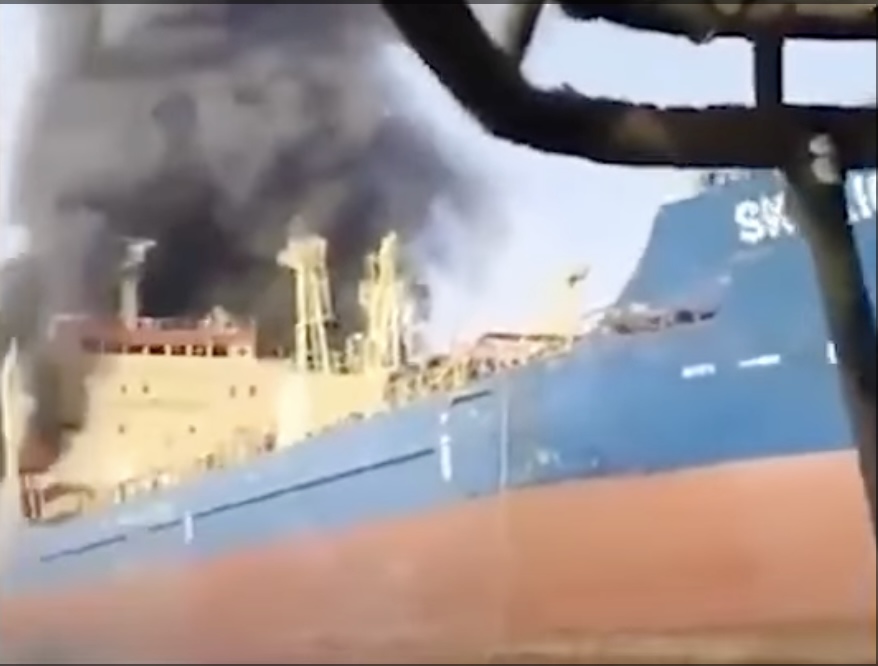
An attack on a tanker off Oman has sharpened fears over disruption in the Gulf’s main energy corridor, exposing Europe once again to the geopolitical fragility of global oil and gas trade.
The reported attack on an oil tanker off Oman’s Musandam peninsula on Sunday has injected a fresh geopolitical premium into global energy markets at the start of March. Omani authorities said four crew members were injured and the vessel’s 20-person crew was evacuated after the strike near Khasab, close to the Strait of Hormuz. Reuters identified the ship as the Palau-flagged tanker Skylight, a vessel previously placed under US sanctions. The immediate commercial significance lies less in the identity of the ship than in the location of the incident: a narrow maritime corridor through which a substantial share of the world’s oil and liquefied natural gas still passes.
The market reaction was swift. Reuters reported that Brent crude rose by about 10 per cent in over-the-counter trading on Sunday to around $80 a barrel, as traders priced in the risk that insecurity in and around Hormuz could lead to wider shipping disruption. Analysts cited by Reuters said oil could move towards $100 a barrel if transit constraints persist or intensify. Even before any formal interruption to supply, the perception of heightened military risk was enough to move the market sharply, underlining how sensitive oil pricing remains to threats around a small number of maritime chokepoints.
The reason is structural. According to the US Energy Information Administration, oil flows through the Strait of Hormuz averaged 20 million barrels a day in 2024, equivalent to roughly 20 per cent of global petroleum liquids consumption. The same route also handled around one fifth of global LNG trade. This is not merely a regional shipping lane; it is one of the central arteries of the world energy system. Any incident there, even if limited in immediate physical impact, is interpreted by markets as a potential precursor to wider disruption.
The latest reports suggest that shipping disruption is already materialising. Reuters said on Sunday that at least 150 crude and LNG tankers had dropped anchor in Gulf waters beyond the strait, while more vessels were stationary on both sides of the chokepoint. A separate Reuters report said that at least three tankers had been damaged in the Gulf and one seafarer had been killed as the wider conflict escalated. The US Navy-led Joint Maritime Information Center said it had received no report of a formal international suspension of navigation, but warned of heightened naval activity, anchorage congestion and rising insurance risk. That combination matters commercially: in energy logistics, even hesitation can become disruption.
For Europe, the direct exposure is smaller than it is for Asia. The EIA estimates that 84 per cent of crude and condensate and 83 per cent of LNG passing through Hormuz in 2024 went to Asian markets. China, India, Japan and South Korea are therefore the most immediate external economies at risk from any prolonged closure or severe restriction. But that does not mean Europe is insulated. Oil is globally priced, and any sharp move in Gulf risk is transmitted rapidly through Brent, freight rates, refining margins and insurance costs. Europe does not need to buy most of its oil through Hormuz in order to pay more for energy when Hormuz is under threat.
The gas dimension is more subtle but still important. Since 2022, the EU has cut dependence on Russian energy and expanded LNG imports from alternative suppliers including the United States and Qatar. The European Commission said in January that the United States supplied 58 per cent of EU LNG imports, with Qatar supplying 8 per cent. At the same time, the Commission’s REPowerEU policy framework is designed to continue phasing out Russian energy imports. That leaves Europe more diversified than before, but also more exposed to the global LNG market and to external shipping risks. If Gulf insecurity constrains Qatari LNG flows or redirects cargo competition towards Asia, Europe could still face tighter supply conditions and firmer gas prices.
That interdependence has grown stronger. The IEA said in its Gas Market Report Q1 2026 that price linkage between Asian and European LNG benchmarks has become extremely tight, with correlation reaching a record high in 2025. In practical terms, a disruption that begins as a Gulf shipping problem can quickly become a European price problem. This is particularly relevant at a time when Europe is expected to import record LNG volumes in 2026, reflecting both lower pipeline dependence and the continuing restructuring of its gas supply mix after Russia’s invasion of Ukraine.
The wider lesson is that Europe’s post-2022 energy adjustment has reduced one vulnerability while leaving others intact. The continent is less dependent on Russian pipeline gas than it was four years ago, but it remains exposed to instability in maritime routes far from European waters. The attack near Musandam is therefore significant not simply as a security incident, but as a reminder that Europe’s energy security now rests more heavily on the uninterrupted functioning of global shipping lanes. If attacks continue, the first effects will be visible in oil and freight markets; the second-round effects may appear in European gas pricing, industrial costs and inflation.

