
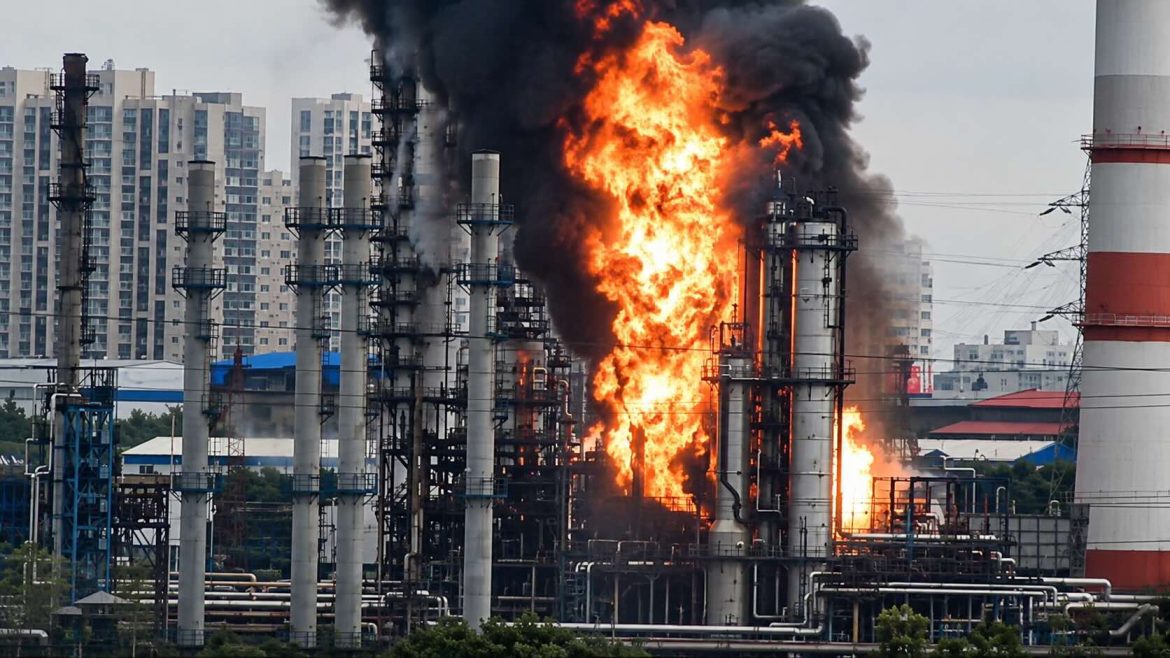
A reported drone strike on Gazprom Neft’s Moscow refinery points to Ukraine’s continued effort to put pressure on Russia’s domestic fuel system, not only its front-line logistics.
A Ukrainian drone attack damaged the Moscow oil refinery on Tuesday, according to Russian officials, in the latest indication that Kyiv is sustaining pressure on Russia’s energy infrastructure deep inside the country.
Moscow mayor Sergei Sobyanin said the refinery had been hit during a drone attack on the Russian capital. He said there were no casualties. The scale of the damage and the plant’s operational status were not immediately clear.
The refinery, operated by Gazprom Neft, is one of the most important fuel-processing sites serving the Russian capital and surrounding region. The plant processed 11.6 million tonnes of crude oil in 2024 and produced 3.2 million tonnes of petrol, 3.6 million tonnes of diesel, 2 million tonnes of fuel oil and 1.2 million tonnes of aviation fuel.
That makes the facility relevant beyond the immediate physical damage caused by a drone strike. Even limited disruption at a refinery of this scale can affect repair schedules, local fuel availability, military-related supply chains and Russia’s wider burden of protecting critical infrastructure.
The attack follows a pattern established over recent months, as Ukraine has used long-range drones to target Russian oil refineries, depots, logistics nodes and industrial facilities. A recent assessment of Russian energy sites hit by Ukrainian attacks showed the extent to which refineries have become a recurring target in the war.
Kyiv has rarely commented in detail on individual operations inside Russia, but Ukrainian officials have repeatedly argued that Russian energy infrastructure supports Moscow’s war effort. The logic is operational as well as economic: fuel production, transport networks and industrial resilience all matter in a prolonged war.
For Russia, the vulnerability of the Moscow refinery carries particular significance. Unlike facilities close to the Ukrainian border or in occupied territory, the plant sits within the capital’s wider industrial zone. Strikes reaching this area challenge the assumption that high-value infrastructure near Moscow can be reliably protected by layered air defences.
The timing is also notable. The refinery had already faced disruption after earlier drone attacks, with previous reporting saying that one of its units had suspended operations after a fire in 2024. A further reported strike underlines the continuing exposure of major Russian refining assets, even after previous incidents and repair efforts.
The military significance lies less in one isolated strike than in the cumulative effect of repeated attacks on refining capacity. Refineries are complex facilities. Damage to specific units, power systems, storage infrastructure or internal pipelines can take time to assess and repair. Even where a plant avoids catastrophic damage, operators may be forced to suspend production, slow throughput or reroute supply.
Ukraine’s campaign also imposes a defensive burden on Russia. Protecting refineries requires air-defence assets, electronic-warfare systems, firefighting capacity and repair crews. Each attack obliges Moscow to allocate resources to rear-area protection at a time when air defence is already under pressure across occupied Ukraine, border regions and major Russian cities.
The Moscow strike also fits into a broader wartime contest over energy resilience. Russia has used missiles and drones to attack Ukraine’s power grid, heating infrastructure and industrial sites throughout the war. Ukraine, with fewer long-range strike options, has increasingly targeted oil and fuel assets that are harder to defend and economically important to Russia.
The effects should not be overstated without firm evidence of sustained disruption. Russian refineries operate within a large national energy system, and Moscow may be able to compensate for limited damage by shifting volumes between facilities. The plant’s actual status after Tuesday’s attack remains unconfirmed by independent assessment.
However, the strategic pattern is becoming clearer. Ukraine is not only seeking to interrupt fuel flows near the front. It is also attempting to raise the cost of Russia’s war by putting pressure on infrastructure that supports the domestic economy, transport networks and military supply chains.
For European defence planners, the strike underlines several lessons from the war. Low-cost drones can impose disproportionate costs on large industrial systems. Civilian energy infrastructure is now part of the operational environment. Air defence cannot be measured only by the protection of military bases and command centres; it must also cover refineries, ports, rail hubs, ammunition plants and power systems.
The facility’s role is also industrial rather than symbolic. Specialist energy-sector data lists the refinery’s oil-processing capacity at about 12.76 million tonnes a year, with modernisation work aimed at improving refining depth and output quality. That makes repeated disruption costly even when damage is limited.
The attack also shows why Russia’s rear-area security problem is likely to persist. Even when drones are intercepted, debris can still damage sensitive facilities. When drones reach their target, repairs may be slow and expensive. As the range and sophistication of Ukrainian drones improves, Russian infrastructure deeper inside the country becomes more difficult to shield.
The Moscow refinery incident is therefore more than another entry in the daily exchange of drone strikes. It points to a war increasingly shaped by industrial endurance, repair capacity and the ability of each side to protect the systems that keep its military and economy functioning.
For Ukraine, these strikes offer a way to offset Russia’s advantage in missiles, aircraft and mass. For Russia, they expose a growing problem: the war is no longer contained by distance, and critical infrastructure near the capital is no longer beyond reach.

