
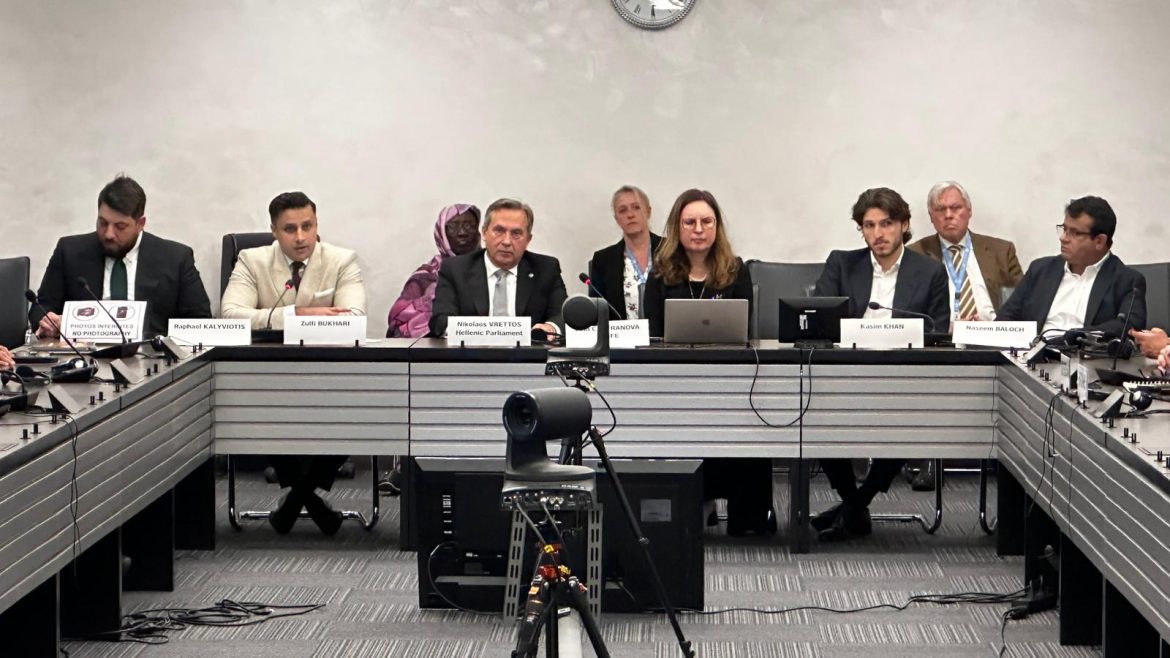
A side event at the 61st session of the UN Human Rights Council in Geneva brought together European politicians, campaigners and political representatives to press the case for closer scrutiny of Pakistan’s GSP+ trade status, arguing that the country’s human rights record is increasingly difficult to reconcile with the conditions attached to the European Union’s preferential market access scheme.
Held under the title Pakistan’s GSP+ status: human rights conditionality, treaty obligations and accountability, the meeting heard claims of religious persecution, political repression, enforced disappearances and the failure of successive Pakistani governments to uphold basic rights. While the speakers approached the issue from different angles, the broad thrust of the event was clear: the EU’s trade policy towards Pakistan is coming under growing public challenge.
In a recorded statement, Barbara Bonte, a Member of the European Parliament, said the matter went beyond commerce. “This is an issue that goes well beyond trade policy alone,” she said. “It concerns the credibility of the European Union’s commitment to link market access to respect for international obligations.”
She underlined that GSP+ was designed as a conditional instrument, not a permanent entitlement. “This privileged market access is conditional,” she said, adding that if Pakistan was to continue benefiting from the arrangement, it should do so “on merits alone, on evidence, on compliance and on real implementation of the international obligations it has undertaken”.
Bonte also linked the trade debate to conditions in Balochistan and to the treatment of political opponents, arguing that the evidence now extended well beyond any single community or individual case.
Nikolaos Vrettos, a member of the Hellenic Parliament, centred his remarks on the position of religious minorities, especially Christians. He argued that Pakistan’s blasphemy laws remained a mechanism through which accusation alone could trigger mob violence, prison terms and long-term fear.
“The situation in Pakistan stands out,” he said. “It demands our particular attention, especially because of the violence and impunity embedded in laws and policies that the government refuses to reform.”
He said the European Commission already had the legal authority to act in the face of serious and systematic violations, and called for enforcement mechanisms tied to measurable benchmarks. “We are not seeking punishment,” he said. “We are seeking justice, respect and genuine reforms.”
Zulfi Bukhari, a former minister in Imran Khan’s government, described what he said was an extensive crackdown on Khan, his family, political allies and party members. “I’m here to raise a particular point and that is the human rights abuse and violations on Imran Khan, his wife and his political party,” he said.
He referred to mass arrests, convictions of civilians in military courts and what he described as a climate of intimidation for journalists. “We’ve got journalists that have been assassinated. We have journalists that are in exile living in different countries for protection because they are not allowed to speak the truth,” he said.
Kasim Khan, son of the former prime minister, gave the most personal intervention of the afternoon, describing his father’s detention in stark terms. “My father, Imran Khan, the former prime minister of Pakistan, has been in detention for over 960 days,” he said. “He sits in a small cell designed for solitary confinement, infested with insects and under constant surveillance.”
He said the case should not be seen in isolation. “My father’s case is not an isolated incident,” he said. “It is just the most visible example of a much wider pattern of repression in Pakistan since 2022.” He argued that arbitrary detention, denial of family contact, inadequate medical care and the trial of civilians in military courts were incompatible with the treaty obligations Pakistan has undertaken under the GSP+ framework.
Raphael Kalyviotis, introduced as a geopolitical analyst, focused on the persecution of Christians and the continuing impact of the blasphemy laws. “The systematic persecution of Christians in Pakistan is no regional anomaly,” he said. “It is a fracture in our global peace, a contagion of intolerance.”
He was particularly blunt on the legal framework. “Article 295C is not an instrument of law, but a legal automation of death,” he said. He argued that the EU could not continue to treat the trade arrangement as routine where such conditions persisted.
The most politically awkward intervention came from Dr Naseem Baloch, chairman of the Baloch National Movement, who widened the discussion beyond both religious freedom and the current confrontation between Imran Khan’s supporters and the Pakistani state.
“For decades, the people of Balochistan have faced systematic and widespread human rights violations,” he said. He cited enforced disappearances, extrajudicial killings, arbitrary detention and torture, and gave figures which he said documented 1,355 enforced disappearances and 229 extrajudicial killings in 2025, with further cases already recorded this year.
But Dr Baloch did not present the matter as one that began with the present authorities. In one of the event’s more pointed passages, he said it was important to recognise that repression in Balochistan had continued under different governments, regardless of who held office in Islamabad. He said plainly that when Imran Khan was in power, “the suffering of the people of Balochistan did not come to an end”.
That was a notable intervention given the presence in the room of Khan’s son and one of his former ministers. Dr Baloch’s point was that many members of Khan’s party were now facing the same kind of abuses that Baloch activists, students and political workers had endured for years. “Whenever injustice is ignored because the victims are marginalised or politically inconvenient, it does not disappear. It spreads,” he said.
It was a direct challenge to any attempt to treat today’s political repression as a wholly new phenomenon. For Dr Baloch, the current plight of Khan’s supporters was serious, but it also exposed a longer pattern in which abuses tolerated when directed at peripheral communities eventually reached the centre of national politics.
That argument gave the event its sharpest edge. The central question raised in Geneva was not simply whether Pakistan is failing to meet its human rights obligations, but whether Europe is prepared to apply the conditions it has attached to its own trade policy when those failures are alleged to be serious, persistent and systemic.
Pakistan’s GSP+ record under formal scrutiny in new EU Today white paper

