
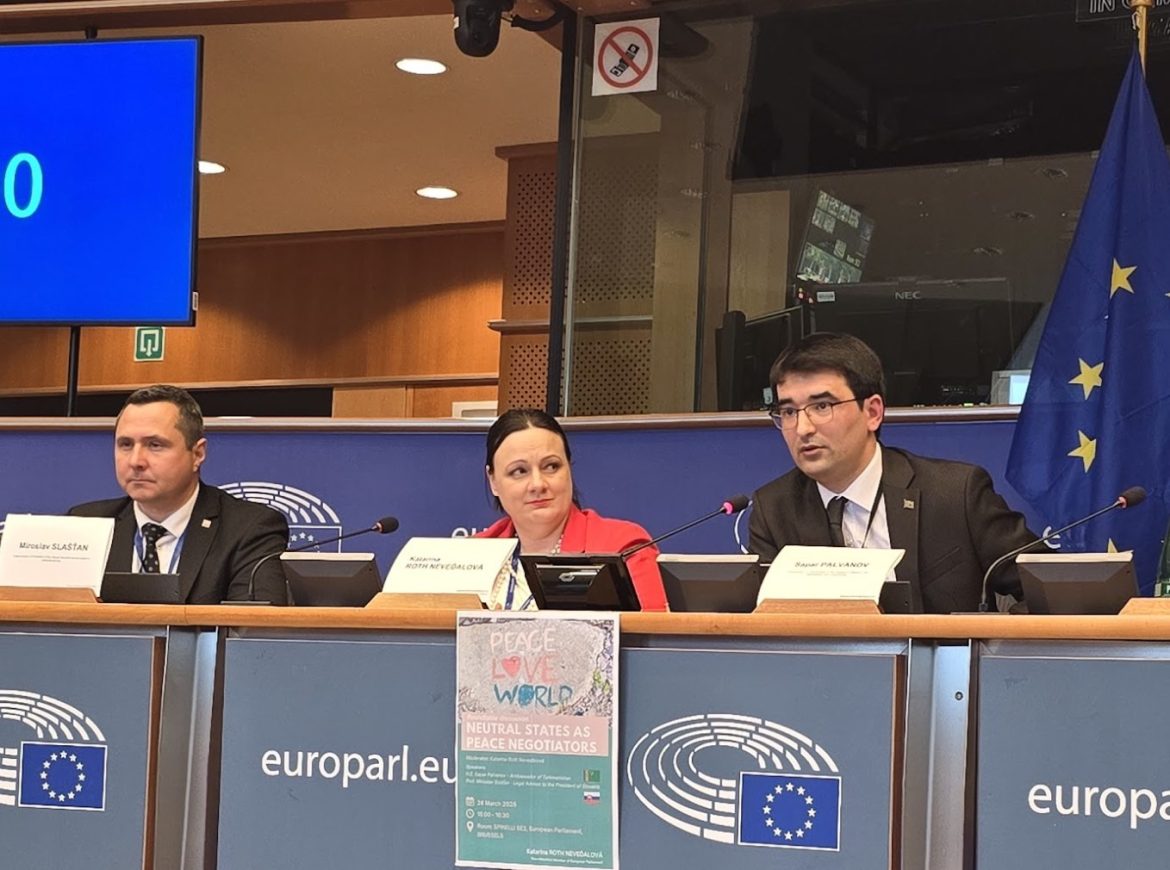
Turkmenistan’s status as a “neutral” state can help it forge closer ties with the international community, including the EU: that is the view of its Ambassador to the EU, Sapar Palvanov.
He was speaking to this website on Wednesday (26th April) in the European Parliament, Brussels, at an event on peace in a “troubled world.”
Ambassador Palvanov cited the fact that in 2025 the world is observing the International Year of Peace and Trust, an initiative unanimously adopted by the United Nations General Assembly to strengthen international efforts in promoting peace, trust, and solidarity among nations.
The idea of such a year, he said, was first mooted by his country which has enjoyed neutrality since 1995.
The year 2025, therefore, marks two significant anniversaries, he noted.
These are the 30th anniversary of Turkmenistan’s recognition as a permanently neutral state and the 80th anniversary of the United Nations. These anniversaries, he believes, serve as a backdrop for Turkmenistan’s comprehensive agenda, which “aims to foster a global culture of trust and cooperation.”
“The initiative is not merely symbolic but is designed to inspire practical steps toward conflict prevention, sustainable development, and humanitarian progress,” he told us.
The ambassador was speaking to EU Today before addressing a packed conference in the European Parliament on peace and stability.
Taking time out for a short interview, the diplomat said that, given the gradual shift in Europe from fossil fuels as a source of energy his country was keen to “focus more” on renewables.
But he went on to say that, in order to do this, it was necessary to make use of “European technology and experience” in this particular sphere.
Improved trade and economic links can, additionally, help build and promote much needed stability, he argued.
He was keen to emphasise the role his country enjoys as a “neutral” state which, he believes, can help it foster “peace and stability” in what he calls “an increasingly divided world.”
Its neutrality can help in both areas, he insists. First, as a model for fostering peace and, secondly, for forging ever closer ties and “tried and trusted cooperation” with the EU, Europe and wider international community.
He said, “Being neutral has not limited out engagement with the rest of the world. On the contrary, it has done the opposite.”
One example of this is the trans-Caspian Transport Corridor and Turkmenistan’s crucial role in this corridor, which enhances connectivity between Central Asia and Europe. He stresses the importance as of the country as a logistics hub connecting Europe and Asia and Turkmenistan’s key role in building stronger connections between Europe and Central Asia.
The Trans-Caspian Transport Corridor aims to create faster, more secure trade routes, attract investments, and generate jobs.
Turkmenistan is actively collaborating with the European Union on various projects in science, education, ecology, energy, and the development of transport and transit corridors.
Addressing the conference, he said International Year of Peace and Trust was “not a mere slogan but a turning point.”
“Neutrality does not mean being silent or withdrawn but allows us to have active and constructive engagement.
“It is not about taking sides,building blocks or alliances but about seeking engagement with everyone.
“Our neutrality defines our positive engagement with the rest of the world. It is about building trust in an increasingly divided world.
“ We have shown that this is possible without the need for confrontation. But we must remember that trust is not a luxury but is necessary for our survival.”
Turkmenistan is currently seeking accession to the World Trade Organisation and is keen on building stronger connections between Europe and Central Asia.
He also pointed to a conference on peace that his country will host later this year which aims to further enhance such efforts and “build bridges.”
Asked by this site, he would not be drawn on issues surrounding human rights and democratic reforms.
Rather, the overall message, he said, was that the whole region was “transforming into a space that is free of conflict.”
He was taking part in a roundtable with two other speakers: Professor Miroslav Slastan, a legal advisor to the Slovakian president, and non attached MEP Katrina Roth Nevedalova, who moderated the event.
The MEP said, “We live in troubled times and Turkmenistan is known for its neutrality.”
Prof Slastan sought to explain the meaning of neutrality, saying it was partly about a country, in this case Turkmenistan, agreeing not to “take sides” in a conflict between countries.
But the academic also stressed that, with this, comes certain “responsibilities.”
That country, he said, must ensure it does not become involved in any way in any such conflict and, also, must not join a military alliance such as Nato.

