
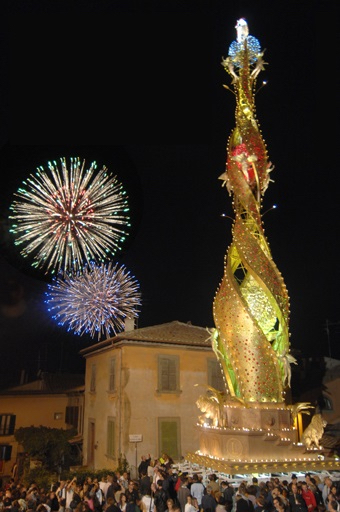
Two Turkish men, found with a 9mm semi-automatic pistol and an assault rifle made in Eastern Europe, were arrested this week in Viterbo, central Italy, as they prepared an armed assault on the Macchina di Santa Rosa, one of Europe’s most iconic Catholic festivals.
The immediate threat was neutralised thanks to swift police action. But the wider lesson cannot be dismissed: Europe’s Christian traditions are being directly targeted, and the continent’s leaders are unwilling—or unable—to face the link between uncontrolled migration, failed integration, and hostility towards the faith that built Europe.
Catholic Ritual in the Crosshairs
The Macchina di Santa Rosa is more than a local event. It is a UNESCO-recognised procession, where a 30-metre illuminated tower, carried on the shoulders of more than a hundred men, winds its way through medieval streets before packed crowds of worshippers and tourists. It is a living symbol of Catholic continuity.
For the two Turkish men now in custody, it was a soft target. Attacking such a festival would have been more than an act of violence. It would have been a symbolic blow against Europe’s Christian identity, delivered on Italian soil, in front of the world’s cameras.
The Turkish Connection and Europe’s Borders
The suspects’ nationality is not incidental. Turkey has become a key source of organised crime networks and a channel for radical Islamist currents entering Europe. Turkish communities within Europe are often poorly integrated, with parallel societies entrenched in parts of Germany, the Netherlands, and Belgium. In too many cases, loyalty to secular European states is weaker than ethnic or religious solidarity fostered from abroad.
How, then, were two Turkish nationals able to arm themselves and position for an attack in central Italy? Where were the border checks, the intelligence warnings, the alerts from Ankara? Europe’s porous Schengen system has once again been shown to be a liability. The free movement cherished by Brussels has become the easiest means for hostile actors to plan and move unobserved.
Failed Integration, Imported Hostility
Europe’s ruling class likes to pretend that migration is a one-way ticket to prosperity and diversity. Yet decades of experience show otherwise. Large migrant populations, left without serious integration requirements, foster cultural isolation rather than cohesion. Hostility towards Christianity is quietly imported into communities where mosques and satellite TV channels drown out the host nation’s culture.
In this environment, Catholic symbols are not seen as shared heritage but as alien markers. Viterbo is therefore not an isolated case. In France, the horrific murder of Father Jacques Hamel in 2016—slaughtered at the altar by jihadists—showed the deadly consequences of this imported hostility. The same year, the Nice truck attack on Bastille Day killed 86 people, striking at a national celebration rooted in Western identity. More recently, churches across France have been vandalised at an alarming rate, from smashed stained glass to statues of the Virgin daubed with graffiti. The pattern is undeniable.
Why the Silence?
Why do Europe’s leaders hesitate to acknowledge the religious dimension of such threats? Because doing so would puncture the myth that all cultures can be imported and co-exist peacefully without friction. It would force an admission that Europe’s migration policies are reckless and that integration has largely failed.
Brussels prefers to speak of “values” and “diversity,” sidestepping the faith that actually shaped Europe. Yet attackers have no such hesitation. They choose their targets precisely because of their Christian symbolism. Viterbo was not chosen by accident. It was chosen because it was Catholic.
Festivals as Symbols Under Siege
Public Christian rituals—Easter processions in Spain, Corpus Christi in Poland, saints’ days in southern Italy—are all increasingly vulnerable. They are visible, symbolic, and logistically hard to secure. Europe’s secular elites may view them as folkloric curiosities, but for those who despise Christianity, they are invitations.
The attackers understand what is at stake better than Europe’s own leaders. Destroying a festival like Santa Rosa is not about body counts. It is about cultural intimidation: driving faith from the public square by making its expression dangerous.
The Political Consequences
In the short term, governments will increase police presence around major festivals. Metal detectors and armed patrols will be deployed. Yet without addressing the deeper issue—unchecked migration and failed integration—these measures are mere sticking plaster.
In the medium term, Europe risks normalising hostility to Christianity. Every attack, or even attempted attack, chips away at the willingness of ordinary people to participate in public rituals. Parents hesitate to take children, processions shrink, and a sense of danger hangs over events once marked by joy.
In the long term, Europe could witness the hollowing out of its Christian culture. Processions reduced, churches locked, rituals abandoned. The continent that built cathedrals and spread Christianity across the globe would find its own faith pushed out of sight—an extraordinary act of cultural self-liquidation.
What Must Change
If Europe is serious about preventing another Viterbo, it must act decisively. That means more than reactive policing. It requires a wholesale shift in policy:
Tighter border controls within Schengen – Freedom of movement cannot mean freedom for armed suspects. Border checks and intelligence-sharing must be restored where threats are identified.
Mandatory integration requirements – Migrants must not be permitted to form parallel societies. Language acquisition, civic education, and loyalty to European institutions should be enforced, not optional.
Stronger protection of Christian heritage – Churches, processions, and festivals should be treated as priority sites for security planning, not afterthoughts.
Clear recognition of the religious dimension – Political leaders must stop sanitising threats as “random acts” when they are clearly directed at Christianity. Naming the problem is the first step to solving it.
Accountability from countries of origin – States such as Turkey must be pressed to cooperate on intelligence-sharing. If they fail, consequences should follow, including restrictions on entry.
The two Turks arrested in Viterbo were not petty criminals. They were armed and ready to attack a Catholic festival at the heart of Italy’s spiritual life. Their target was chosen for its symbolism: Christianity itself.
If Europe refuses to see that, it is choosing blindness. If it continues to prize open borders over secure ones, and diversity rhetoric over meaningful integration, it is choosing weakness. And if it refuses to defend its Christian festivals, it is surrendering the very soul of Europe.
Viterbo should have been a wake-up call. But unless Europe acts—by controlling borders, demanding integration, and protecting its faith—it will be remembered instead as just another warning ignored, before the next procession ends not in celebration, but in mourning.

