
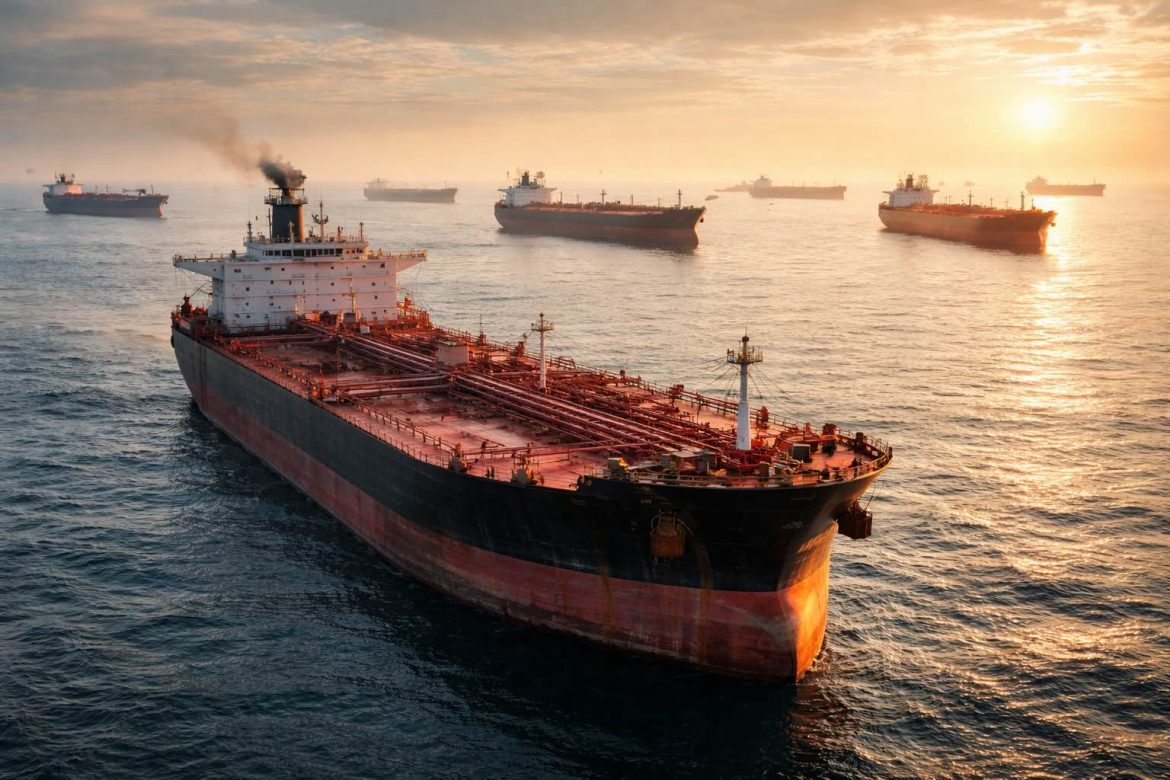
Russia’s seaborne oil trade is facing a growing bottleneck as sanctions tighten and some major buyers reduce intake, leaving large volumes of crude held in floating storage and complicating Moscow’s export logistics.
Bloomberg reported in late January that the amount of Russian crude held on tankers had stabilised at about 140 million barrels, after building by roughly 60 million barrels since late August. A subsequent Bloomberg update in early February said crude held at sea had continued to edge higher and was above 140 million barrels for a third week, as flows to India weakened. The accumulation suggests cargoes were loaded and dispatched in anticipation of buyers that have since been slower to take delivery, or have sought alternatives.
The logistical strain follows a major expansion of US sanctions in late 2025. On 22 October 2025, the US Treasury announced property-blocking sanctions targeting Rosneft and Lukoil, describing them as Russia’s two largest oil companies. The designations, and the wider sanctions architecture around shipping, insurance and payments, increased compliance risks for intermediaries and end-buyers, particularly where Washington signals the potential for secondary sanctions.
India has been central to the post-2022 re-routing of Russian crude. Since early 2022, Indian refiners increased purchases of discounted Russian oil, making India one of the largest destinations for seaborne Russian crude. In early February 2026, however, a series of reports indicated a shift. Reuters reported on 2 February 2026 that President Donald Trump announced a trade deal under which US tariffs on Indian goods would fall to 18 per cent from 50 per cent, in exchange for India halting Russian oil purchases and lowering trade barriers. Reuters added on 6 February 2026 that Trump signed an executive order rescinding a 25 per cent punitive tariff on Indian imports, while the same trade arrangement envisaged a gradual end to India’s Russian oil imports.
Indian officials have not publicly matched all of Washington’s claims, but market data and reporting point to a reduction in volumes. Reuters reported that India’s Russian crude imports fell to around 1.2 million barrels per day in January and were projected to drop further, with estimates suggesting about 800,000 barrels per day by March. In parallel, Reuters reported on 5 February 2026 that India said it was open to crude supplies from Venezuela on commercial terms, as New Delhi continues to emphasise diversification and energy security.
As Indian intake softens, the floating storage build-up becomes more consequential. Bloomberg’s vessel-tracking summaries indicate Russia’s crude shipments have held near recent averages, but the loss of a large incremental market forces more barrels to compete for placement, particularly among buyers wary of payment and shipping complications. With tanker availability finite and voyages longer, the system can absorb some friction, but persistent backlog raises costs and can require deeper discounts to clear cargoes.
There are also signs of greater enforcement pressure around “shadow” shipping networks used by sanctioned producers. On 8–9 February 2026, multiple reports said the Indian Coast Guard detained three tankers in connection with an oil-smuggling network, with media accounts linking the vessels to Iran. While these detentions were not presented as Russia-focused, Iran and Russia operate under overlapping sanctions constraints and have relied on similar techniques, including ship-to-ship transfers and opaque ownership structures, to move barrels to market.
Europe is also moving to restrict the infrastructure that supports Russian oil flows and circumvention. Reuters reported on 9 February 2026 that the EU proposed adding ports in Georgia (Kulevi) and Indonesia (Karimun) to a new sanctions package, marking the first time the bloc would target ports in third countries for facilitating Russian oil exports. The same proposal, according to Reuters, would tighten maritime service bans and introduce new anti-circumvention measures aimed at channels used to keep trade moving despite existing restrictions.
Taken together, the reported rise in oil held at sea, tighter scrutiny of shipping networks, and reduced purchases by key refiners point to a more constrained operating environment for Russia’s oil sector. For Moscow, oil and petroleum products remain among the main sources of export earnings and budget receipts. Pressure on marketing channels can translate into lower realised prices, higher transport and financing costs, and less predictable cash flow, even if headline export volumes remain resilient in the short term.
For the market, the immediate effect is not necessarily a supply shock, but a reallocation of barrels and a higher premium on “clean” logistics — cargoes that can be shipped, insured and paid for without sanctions exposure. The backlog on tankers is a visible indicator of that fragmentation. If large buyers continue to step back, Russia’s ability to clear seaborne cargoes may depend increasingly on a narrower set of counterparties and on price concessions large enough to compensate for legal and operational risk.
Risk in European Waters: The Shadow Fleet, Sanctions Evasion and Safety Gaps

