
The crack of gunfire at Washington’s most self-consciously convivial gathering of political elites is not easily mistaken. For decades, the White House Correspondents’ Dinner has prided itself on its peculiar blend of satire, celebrity and soft-power ritual. On Saturday night, that carefully choreographed theatre dissolved into something far more visceral.
According to early accounts, Donald Trump and the First Lady were hurriedly escorted from the stage at the Washington Hilton after shots rang out near a security checkpoint. Within moments, the ballroom’s easy laughter gave way to confusion, then alarm, as Secret Service agents flooded the area and guests were instructed to remain in place.
It is, perhaps, a measure of the times that such an incident, shocking as it is, no longer feels wholly inconceivable. The United States has grown accustomed to the language of “lone wolves” and “isolated actors”, labels that simultaneously reassure and obscure. Reassure, because they imply containment; obscure, because they rarely illuminate the deeper currents that produce such individuals.
In a hastily arranged press briefing some 90 minutes later, the President sought to project control. Still dressed in black tie, he confirmed that a suspect was in custody and described him as a “very sick person”. The phrase, deployed with characteristic bluntness, signals both condemnation and distance — the act is framed as aberration, the perpetrator as an outlier beyond the bounds of ordinary political grievance.
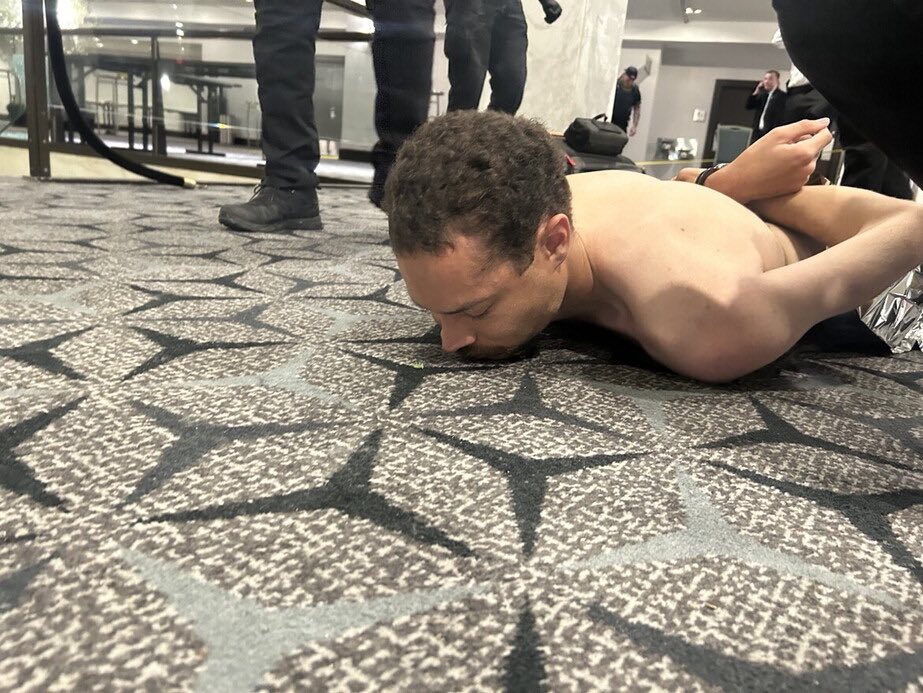
The suspect, identified by American media as 31-year-old Cole Tomas Allen of Torrance, California, is reported to have carried multiple weapons and to have charged a security checkpoint before being subdued. Surveillance footage released shortly afterwards appears to show a man sprinting towards the barrier, followed by the chaotic intervention of armed agents. Other images, shared by the President himself on social media, depict the suspect prone and handcuffed.
There is, in these early disclosures, a tension between transparency and spectacle. Modern presidencies, particularly this one, have shown a marked willingness to place raw imagery before the public with minimal mediation. It is an approach that speaks to an age of instant communication, but it also risks transforming acts of violence into something uncomfortably close to public theatre.
Reports that Allen told law enforcement he wished to target Trump administration officials, though not necessarily the President himself, complicate the narrative further. The distinction may be operationally significant, yet politically it offers little comfort. The mere proximity of such intent to the apex of American power underscores the fragility of even the most heavily guarded institutions.
Security at events of this nature is, by necessity, formidable. The Washington Hilton has long been regarded as one of the most secure venues in the capital when hosting the Correspondents’ Dinner. That an armed individual could penetrate as far as a checkpoint — let alone discharge a weapon — will inevitably prompt searching questions within the Secret Service and beyond. Inquiries will focus not only on procedural lapses but also on the broader challenge of anticipating threats that do not conform to established patterns.
For the assembled journalists, politicians and celebrities, the evening’s abrupt transformation will linger. The dinner has often been criticised as an exercise in mutual indulgence, a rarefied bubble in which power and those who chronicle it mingle with conspicuous ease. Saturday night’s მოვლენ served as a stark reminder that the world beyond that bubble remains volatile and, at times, violently unpredictable.
The political ramifications are less immediately clear but no less significant. Incidents of this nature tend to harden rhetoric and entrench positions. Calls for enhanced security, already a constant refrain, will grow louder. Equally, there will be renewed debate over the social and psychological conditions that give rise to such attacks — debates that, in recent years, have generated more heat than light.
For Donald Trump, the episode reinforces a central theme of his public life: the projection of resilience in the face of threat. His swift reappearance before the cameras, composed and emphatic, was as much a political act as a factual briefing. It conveyed continuity, a refusal to be visibly shaken, even as the circumstances suggested otherwise.
Yet beneath that display lies a more troubling reality. The normalisation of political violence, even in its thwarted forms, exerts a corrosive effect on democratic culture. Each incident chips away at the assumption that disputes can be contained within the bounds of discourse and law. Each “lone wolf” narrative, while perhaps accurate in a narrow sense, risks obscuring the cumulative impact of a climate in which anger is both amplified and weaponised.
As investigations continue, more details will emerge about the suspect, his motivations and his path to that hotel checkpoint. There will be the usual search for warning signs, missed signals and systemic failures. Some answers will be found; many will remain elusive.
What is already evident, however, is that an evening designed to celebrate the interplay of politics and the press has instead become a reminder of their shared vulnerability. The Correspondents’ Dinner will endure, as it always has. But the memory of this year’s gathering — of laughter cut short by gunfire — will not soon fade.
Main Image: @realDonaldTrump via TruthSocial
Click here for more News & Current Affairs at EU Today
Click here to check out EU TODAY’S SPORTS PAGE!
___________________________________________________________________________________________________________________

