
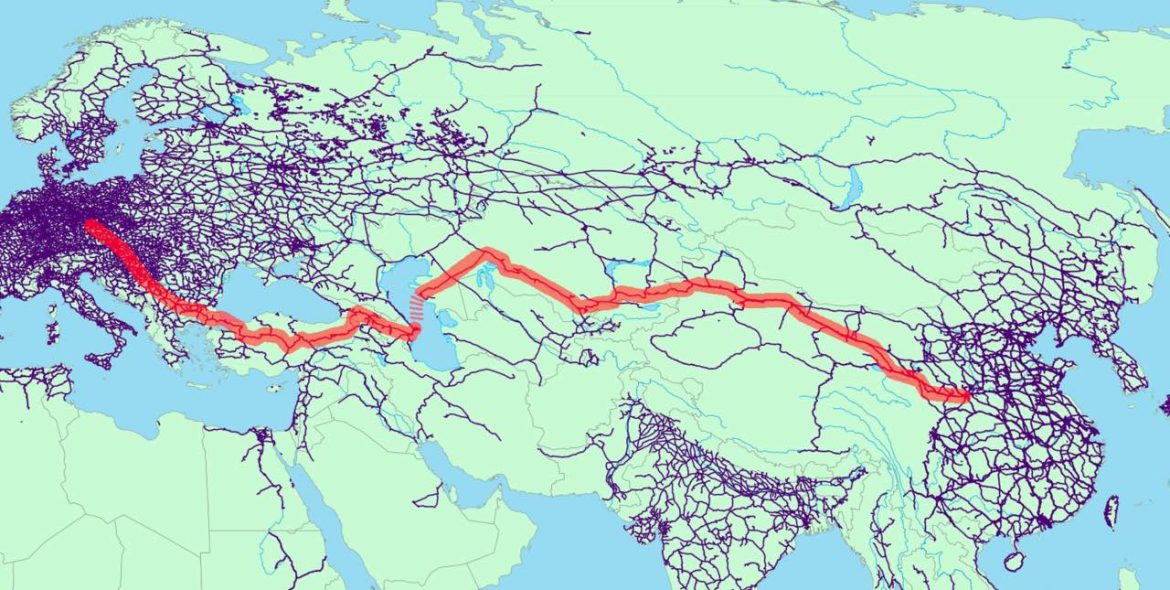
The Trans-Caspian International Transport Route (TITR), better known as the Middle Corridor, is no longer a theoretical alternative. In the face of the global logistical disruptions of April 2026, it has emerged as a critical artery linking European markets with Asia.
However, Western hesitation in securing timely investments risks ceding control of this route to other geopolitical players.
The Perfect Storm of Eurasian Logistics
Over the past four years, the architecture of global trade has been fundamentally rewritten. The traditional pillars of European logistics have collapsed one by one: the Northern Corridor has become “commercially toxic” since 2022 due to sanctions and compliance risks.
The Red Sea: The crisis of 2024–2025 forced up to 90% of vessels to reroute around Africa, adding 10–14 days to transit times and billions in extra costs.
The Strait of Hormuz: The escalation in March 2026 caused a near-collapse in tanker traffic, with daily transits dropping to well below 10% of normal volumes in the worst periods.
In this new reality, the Middle Corridor — spanning Kazakhstan, the Caspian Sea, Azerbaijan, and Georgia — has transformed from a niche experiment into a vital insurance policy for the European economy.
Figures that cannot be ignored
While spot rates for sea freight from Asia have skyrocketed to $10,000 per container, the Middle Corridor maintains a competitive benchmark of $3,500–4,500.
Speed: Transit times have been reduced from 53 days (in 2022) to 18–23 days in 2026.
Volume: Cargo traffic has grown significantly, reaching approximately 4.5–5 million tons annually by 2025, with container volumes hitting around 77,000 TEUs.
Critical Imports: The route has become the EU’s key gateway for uranium, lithium, and rare earth elements from Central Asia, fully bypassing Russian infrastructure.
The Investment Gap: Words vs. Yuan
The European Union pledged €10 billion for transport connectivity in Central Asia in 2024.
However, as analysts note, “promises are not payments.”While Brussels continues to debate grants and frameworks, China invested $23 billion in Kazakhstan in 2025 alone, with a significant portion directed toward multimodal infrastructure along the Middle Corridor.
The strategic risk for Europe is clear: if Western institutions (EBRD, EIB) do not accelerate financing for key bottlenecks — such as the Anaklia deep-sea port in Georgia or the double-tracking of the Dostyk–Moyynty railway — the corridor will develop largely under Beijing’s financial and operational influence.
Political Foundation: Reforms in Kazakhstan
For European capital, stability and predictability remain paramount. The constitutional referendum and adoption of the new Constitution in March 2026 have created a modernized legal framework. Kazakhstan’s political reforms aim to establish clearer rules of engagement and stronger protections for foreign investment, turning the TITR into not just a transport route, but a secure legal and economic space.
The Moment for “Global Gateway” has arrived Europe cannot credibly champion “strategic autonomy” while delegating the logistics of vital goods to third countries. The Middle Corridor is more than rails and ports — it is a question of who will set the rules of trade across Eurasia in the coming decades. For Brussels, the time has come to move from strategies and pledges to concrete action and steel. The window of opportunity created by the geopolitical crises of 2026 will not remain open indefinitely.
Click here for more News & Current Affairs at EU Today
Click here to check out EU TODAY’S SPORTS PAGE!
___________________________________________________________________________________________________________________

