
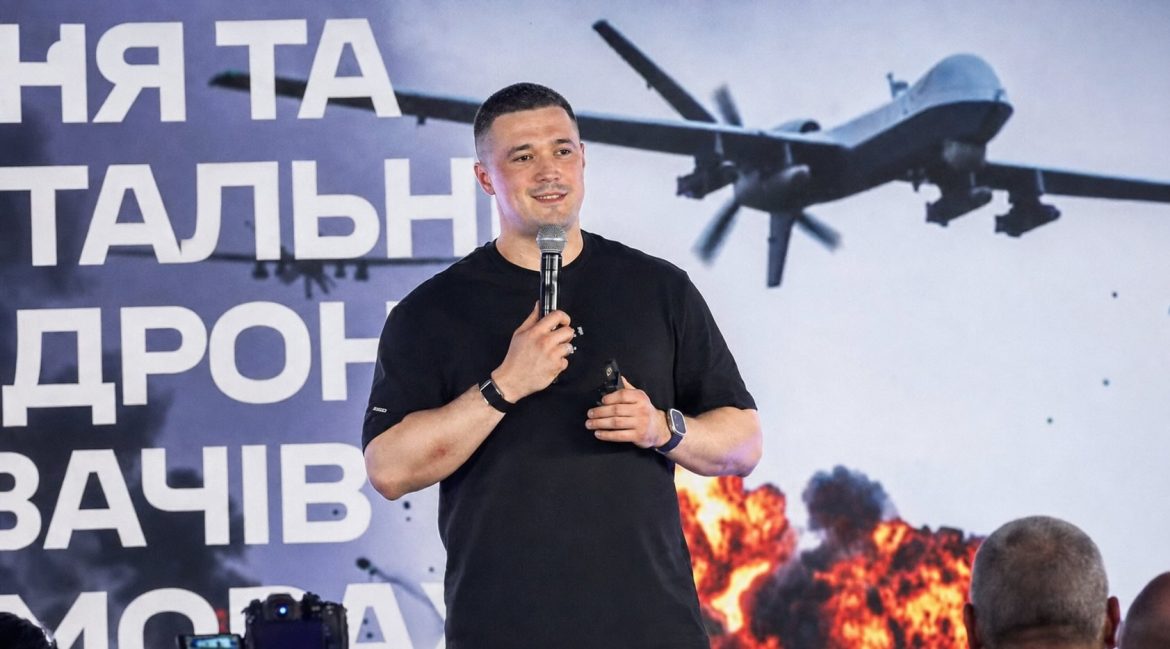
Mykhailo Fedorov has publicly called for the replacement of Ukraine’s commander-in-chief and chief of the General Staff, alleging that military leaders blocked reforms intended to reduce casualties, improve procurement and place technology at the centre of battlefield planning.
Ukraine’s outgoing defence minister, Mykhailo Fedorov, has called for the replacement of General Oleksandr Syrskyi, commander-in-chief of the Armed Forces, and the head of the General Staff following an increasingly public dispute over the management of the war.
Speaking at a briefing on his work at the Ministry of Defence, Fedorov said that he had presented President Volodymyr Zelenskyy with proposals for “radical personnel decisions” after conducting an audit of the ministry and consulting military personnel.
The proposals included changing both the commander-in-chief and the chief of the General Staff.
“We have no other choice if we want to defeat the enemy asymmetrically, with minimal losses, where strong leaders and commanders will develop rather than be suppressed,” Fedorov said.
His intervention followed the resignation of Prime Minister Yulia Svyrydenko’s government, which formally brought the mandates of its ministers to an end. The government reshuffle created uncertainty over Fedorov’s future after six months as defence minister and prompted public demonstrations in Kyiv and several other Ukrainian cities opposing his removal.
Allegations against military command
Fedorov alleged that initiatives proposed by the ministry had been obstructed by the military command and that Syrskyi had ultimately issued an ultimatum concerning their continued service.
The outgoing minister said he had accepted Zelenskyy’s earlier decision to retain Syrskyi and had been prepared to work with him. He acknowledged Syrskyi’s role in the defence of Kyiv and in the Kharkiv and Kherson operations in 2022, but argued that the character of the war had since changed.
According to Fedorov, drone technology can undergo major changes several times a year, requiring command structures and procurement systems to adapt at a comparable rate.
He accused the existing system of relying too heavily on personal loyalty when allocating equipment and making command decisions. He also cited frequent changes of brigade commanders, the separation of battalions from their parent brigades and an incomplete transition to a corps-based structure.
Fedorov said some corps contained five brigades while others had as many as 12 or 13, leaving responsibility and operational control unclear. He also claimed that military supplies continued to be allocated manually, meaning some formations could not predict how many drones or other resources they would receive.
Syrskyi, who has served as commander-in-chief since February 2024, had not issued a public response to the allegations at the time of publication.
Procurement and corruption
Fedorov presented procurement reform as one of the principal achievements of his tenure.
He said the ministry had introduced a data-based system under which 80 per cent of drone purchases were directed towards highly rated suppliers, based on verified battlefield performance and orders made through the Brave1 Market. The remaining 20 per cent was to be procured through competitive tenders.
Fedorov claimed that competitive procurement of long-range 155mm artillery ammunition had saved more than $100 million. He also said 59 companies had applied for a tender covering approximately 150,000 to 160,000 medium-range strike drones, with expected savings of between 20 and 30 per cent.
These figures were presented by Fedorov and have not yet been accompanied by published audit documents.
He said several direct contracts with Ukrainian and foreign suppliers had been halted after his arrival at the ministry. Controlled exports by Ukrainian defence manufacturers were also being prepared and would begin operating shortly, he added.
Drone-based doctrine
Fedorov said Ukrainian forces now inflicted 95 per cent of their recorded strikes using drones. He linked this change to programmes developed since 2022, including the Army of Drones, the Delta battlefield-management system, the Unmanned Systems Forces and the Brave1 defence-technology platform.
He claimed that drone interceptors were now destroying between 70 and 90 per cent of Shahed-type drones in areas where the system had been deployed.
The ministry had contracted 12,000 unmanned ground vehicles in 2025 and intended to procure 50,000 in 2026, he said. It had also begun developing drone-assault formations designed to suppress Russian positions with unmanned systems before infantry entered the area.
The objective, according to Fedorov, was to replace losses of personnel with losses of equipment wherever possible.
Political consequences
Fedorov’s briefing turns an internal dispute over military management into an open political question for Zelenskyy.
The president must now decide whether to retain Syrskyi, reconsider Fedorov’s departure or appoint a new defence minister capable of working with the existing command structure.
The disagreement also concerns civilian control over the armed forces. Fedorov argued that elected officials and parliament must scrutinise casualty levels, procurement, transfers, command appointments and the distribution of resources rather than treating these matters solely as military decisions.
His account remains that of one party to the dispute. However, the operational problems he identified — fragmented command, unpredictable supply, rapid personnel changes and resistance to technological reform — are likely to require examination regardless of who leads the ministry.

