
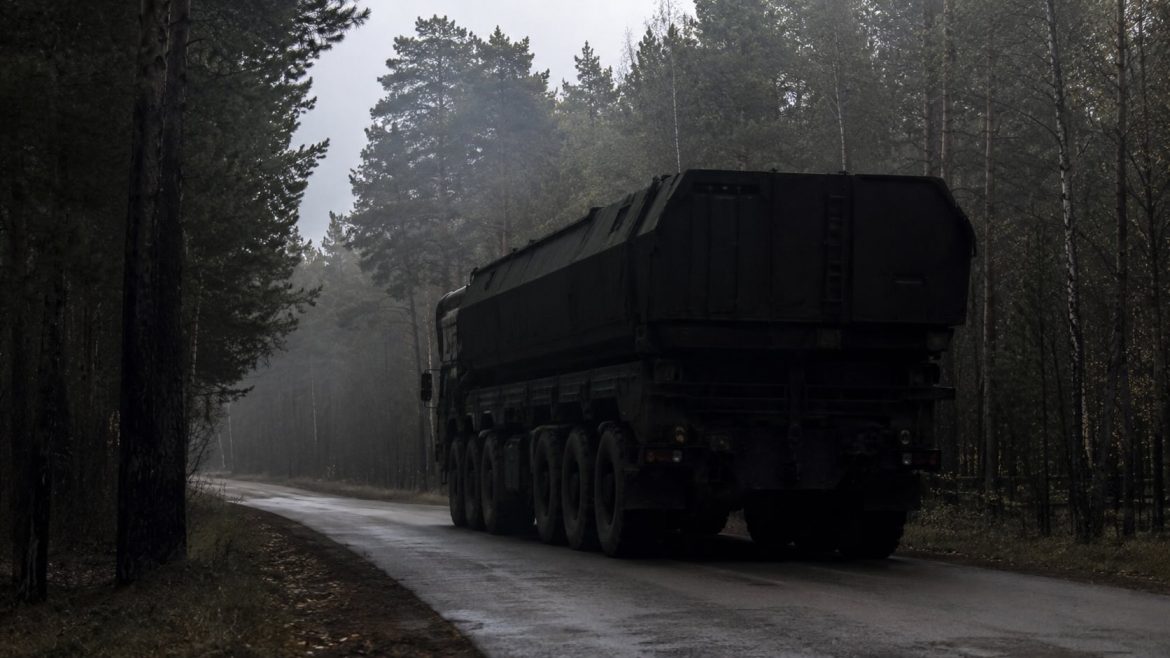
Belarus has begun training linked to the use of Russian nuclear weapons, adding a new military signal on NATO’s eastern border as Moscow and Minsk deepen their defence integration.
Belarus said on Monday that its armed forces had begun training connected to the use of nuclear weapons, a move that adds to security concerns along NATO’s eastern flank and further embeds Minsk within Russia’s military posture.
The Belarusian Defence Ministry said the exercise was intended to improve the readiness of personnel, assess the ability of airborne forces to operate from unexpected locations, and practise combat operations involving modern means of destruction. The ministry said the drills were not directed against any particular country and did not threaten regional security.
The exercise is significant because Belarus hosts Russian tactical nuclear weapons. Moscow has repeatedly stated that the weapons remain under Russian control, while Minsk has increasingly presented itself as part of a joint Russian-Belarusian deterrence system.
According to Belarusian reporting citing the Defence Ministry, the training is being conducted in cooperation with Russia and includes practice in the delivery of nuclear munitions and their preparation for use. The same account said the exercise would test readiness to carry out combat-use tasks from unprepared areas across the country, with emphasis on concealment, movement over long distances and operational calculations.
For NATO, the development is not only a matter of nuclear rhetoric. Belarus borders Poland, Lithuania and Latvia, all members of the alliance, and has already served as a platform for Russian military operations. Russian forces used Belarusian territory during the opening stage of the full-scale invasion of Ukraine in February 2022. Since then, Minsk has remained outside direct combat operations, but its military infrastructure, airspace and political alignment have remained central to Russia’s regional posture.
NATO says it has increased its presence along the eastern flank in response to Russia’s conduct, describing Russia as the most significant and direct threat to Allied security in the Euro-Atlantic area. The alliance’s eastern-flank posture is therefore shaped not only by Russian deployments inside Russia itself, but also by the use of Belarus as a forward military space.
The timing also matters. Only days earlier, Ukrainian President Volodymyr Zelenskyy said Russia was trying to draw Belarus deeper into the war and warned that Moscow could consider using Belarusian territory for an operation either against Ukraine or against a NATO country. He referred specifically to threats against northern Ukraine and to NATO members bordering Belarus. Moscow and Minsk did not immediately respond to those remarks in the available reporting.
Zelenskyy warning over Belarus puts NATO border states back on alert
The latest drills should be read in the context of a long-running Russian effort to complicate NATO planning by blurring the line between conventional exercises, nuclear signalling and hybrid pressure. Nuclear weapons based in Belarus shorten the political distance between Russian deterrence policy and NATO’s eastern border, even if operational control remains in Moscow.
They also create an additional problem for crisis management. In any confrontation involving Belarusian territory, NATO would have to assess not only Belarusian conventional forces, but the possibility that Russian nuclear-capable systems, command structures or delivery platforms could be present in the same operating environment. That does not mean the current exercise points to imminent use. It does mean that nuclear-related training is now being normalised inside Belarusian military activity.
Minsk describes the training as planned and defensive. That language is consistent with earlier Russian and Belarusian explanations of joint military activity. However, for neighbouring states, the issue is not only declared intent, but capability, geography and precedent. Belarusian territory has already been used to enable Russian military action against Ukraine. The presence of Russian nuclear weapons there changes the strategic weight of any future exercise, alert or mobilisation.
The drills may also be intended to send a message beyond the immediate military sphere. Russia has used nuclear language throughout the war against Ukraine to deter Western escalation, limit political appetite for direct involvement, and influence debates over weapons deliveries. Belarus gives Moscow another channel for that signalling, particularly toward Poland and the Baltic states.
For Europe, the policy implication is clear. NATO’s eastern flank cannot be assessed only through the number of battalions, aircraft or air-defence systems deployed in Allied territory. It must also account for the growing military integration of Belarus and Russia, the use of Belarusian territory for strategic pressure, and the operational uncertainty created by Russian nuclear deployments outside Russia’s own borders.
The immediate exercise may pass without incident. Its broader significance lies elsewhere: Belarus is no longer merely a Russian ally adjacent to NATO territory. It is increasingly part of Russia’s forward military architecture, including in the nuclear domain.

