
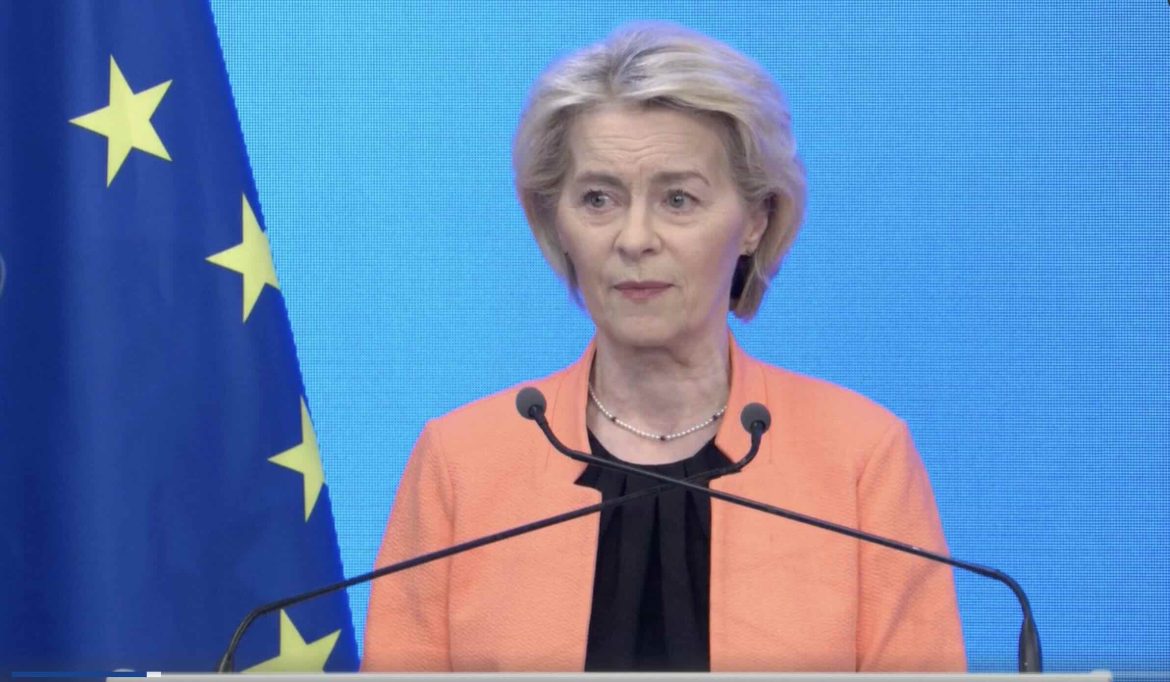
Ursula von der Leyen’s latest intervention suggests that the European Union is moving towards a more explicit doctrine of power politics.
Speaking at the EU Ambassadors Conference in Brussels on 9 March, the Commission President said the Union would “always defend and uphold the rules-based system that we helped to build with our allies”, but added that it could “no longer rely on it as the only way to defend our interests”. That formulation is important because it does not abandon the EU’s traditional attachment to multilateralism, but it does acknowledge that Brussels now sees rules, on their own, as insufficient protection in a more coercive international environment.
The Reuters report places that remark in a wider argument about the need for the EU to “project its power more assertively”. That is a notable shift in emphasis. For years, the EU has preferred to describe itself as a regulatory and normative power, one that shapes international behaviour through law, market access and institutional influence. Von der Leyen’s speech suggests that this model is now being supplemented by a harder reading of international affairs, one in which interests must be defended not only by legal frameworks but by political will, economic leverage and credible strategic capacity.
Her most revealing line may have been the one directed inward rather than outward. Von der Leyen said the EU must reflect urgently on “whether our doctrine, our institutions and our decision making – all designed in a postwar world of stability and multilateralism – have kept pace with the speed of change around us”. She then posed an even sharper question: whether the system built around “consensus and compromise” is now “more a help or a hindrance to our credibility as a geopolitical actor”. This goes beyond rhetoric. It amounts to a direct challenge to the Union’s long-standing decision-making culture, especially in foreign policy, where unanimity often slows or weakens collective action.
Analytically, the significance of these remarks lies in the fact that they formalise a trend that has been visible in Brussels for several years. The language of “strategic autonomy”, “de-risking”, “economic security” and defence industrial capacity has already entered the mainstream of EU policymaking. Russia’s war against Ukraine, instability in the Middle East, supply chain disruptions, technological competition with China and uncertainty over long-term American commitments have all weakened the assumption that Europe can prosper by relying mainly on rules, trade interdependence and diplomatic process. Von der Leyen is now giving that accumulated shift a clearer political vocabulary.
There is, however, a structural problem at the centre of her argument. The EU wants to act as a geopolitical power, but it remains institutionally ill-suited to rapid strategic action. The Commission can deploy trade tools, sanctions proposals, industrial instruments and budgetary incentives, yet foreign and security policy still depends heavily on the member states. That creates a recurring tension between ambition and capacity. Von der Leyen’s speech appears to recognise that the Union’s credibility is now tied less to declarations of unity than to whether it can take decisions quickly and enforce them effectively.
The political difficulty is that a more interest-driven foreign policy raises the unresolved question of whose interests count as European interests. The Union is not a state with a single executive centre. Poland and the Baltic states tend to frame strategy through deterrence against Russia; southern members often focus more on migration, North Africa and Mediterranean instability; larger western economies remain attentive to trade exposure and industrial competitiveness. A harder-edged foreign policy may be intellectually coherent, but it is much harder to operationalise inside a Union of 27 governments with different priorities and different readings of risk.
There is also an external credibility issue. The EU has long presented itself as a defender of international law and consistent standards. If Brussels now speaks more openly in the language of interests and power, it risks being accused of selective principle, especially by partners outside Europe who already see double standards in Western foreign policy. Von der Leyen seems aware of that tension, which is why she did not reject the rules-based system; instead, she argued that it is no longer enough on its own. The message is that values remain part of EU identity, but they now need to be backed by instruments of force, pressure and resilience.
What emerges from the speech itself is not a break with the EU’s past, but a harder interpretation of it. Brussels is not discarding multilateralism; it is admitting that multilateralism no longer provides sufficient shelter. Von der Leyen’s remarks therefore amount to an attempt to redefine realism in EU terms: retain the language of law and partnership, but prepare to defend European interests with greater urgency and fewer illusions. The real question now is whether the institutions she leads, and the member states behind them, are ready to follow that logic through.

