

KYIV — Parts of the Kyiv-Pechersk Lavra, Ukraine’s best-known monastic complex and a UNESCO World Heritage property, were damaged during a Russian combined missile and drone attack on the capital on the night of 23–24 January, Ukrainian officials said.
Maksym Ostapenko, director general of the Kyiv-Pechersk Lavra National Reserve, said two structures in the Far Caves area were affected: Building No 66, described as the entrance to the Far Caves complex, and Building No 67, the Church of the Conception of St Anne. He said the blast wave shattered windows and doors and damaged plasterwork in multiple places, while preliminary inspections suggested the caves themselves had not been harmed.
Ostapenko said it was the first time since the Second World War that an object in the Lavra had been struck as a direct result of military action. He added that a seismic sensor did not activate because of power outages, complicating efforts to gauge the effect of the blast on the reserve’s structures.
Ukraine’s deputy prime minister for humanitarian policy and minister of culture, Tetiana Berezhna, said specialists from the reserve and the National Police had worked at the site, and that a technical survey and restoration work would follow.
The damage came amid a wider strike on Kyiv and Ukraine’s energy system. Reuters reported that the overnight attack left large numbers of homes without electricity and disrupted heating supplies to thousands of buildings in the capital, with emergency crews deployed to restore services.
The Kyiv-Pechersk Lavra, founded in the 11th century, is a principal centre of Orthodox monasticism and includes underground cave systems containing chapels and the burials of monks. UNESCO lists the Lavra as part of the World Heritage property ‘Kyiv: Saint-Sophia Cathedral and Related Monastic Buildings, Kyiv-Pechersk Lavra’, describing an architectural ensemble formed over centuries and closely linked to the landscape.
The two damaged buildings sit within the Far Caves section of the reserve. Heritage references generally date the Church of the Conception of St Anne to the late 17th century, and it is among the structures that serve the cave complexes and their visitors.
The complex has been damaged before. The Dormition Cathedral, one of the Lavra’s principal churches, was destroyed by an explosion in November 1941 during the German occupation of Kyiv. Many historical references attribute the blast to the Soviet NKVD, although other accounts dispute responsibility. The cathedral was reconstructed and reopened in 2000.
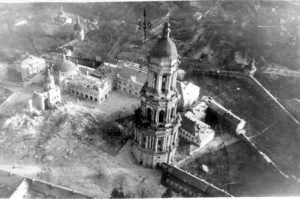
On 3 November 1941, a devastating explosion almost completely destroyed the ancient Lavra shrine Dormition Cathedral.
In comments carried by Ukrainian media, Ostapenko drew a historical parallel with violence around the monastery during the upheavals of 1918 and with the 1941 destruction of the Dormition Cathedral.
Beyond its architectural and religious significance, the Lavra has been a focal point of Ukraine’s internal church dispute since Russia’s full-scale invasion in 2022. For years, parts of the site were used by the Ukrainian Orthodox Church (UOC), a church historically aligned with the Moscow Patriarchate. In early 2023, Ukrainian authorities took control of key cathedral buildings at the Lavra after leases expired and allowed services by the Orthodox Church of Ukraine (OCU), recognised as independent by the Ecumenical Patriarchate in 2019, a status rejected by the Russian Orthodox Church.
The monastery has also featured in symbolic disputes involving figures from the Russian Empire. Pyotr Stolypin, Russia’s prime minister from 1906 to 1911, was buried at the Lavra after his assassination in Kyiv. In 2024, Russian officials criticised a suggestion that Stolypin’s remains could be considered as part of a wider exchange linked to prisoners of war, prompting public statements in Kyiv and Moscow.
UNESCO has tracked and verified damage to cultural sites across Ukraine since February 2022. As of January 2026, the agency said it had verified damage to more than 500 sites, including religious buildings, historic structures and museums, and has issued statements of concern about threats to the Kyiv World Heritage property following earlier attacks.
Ukrainian authorities said documentation of the January damage at the Lavra would guide conservation work and further assessments. More detailed findings are expected once power supplies and monitoring systems are fully restored.

