
More than 60 international delegations met in Brussels on Thursday for a high-level discussion on the reconstruction, governance and security of the Gaza Strip, in a meeting framed as a first step towards coordinating international support for a post-war settlement.
The gathering formed the inaugural session of the Palestine Donor Group (PDG), an EU-backed format announced earlier this year by European Commission President Ursula von der Leyen.
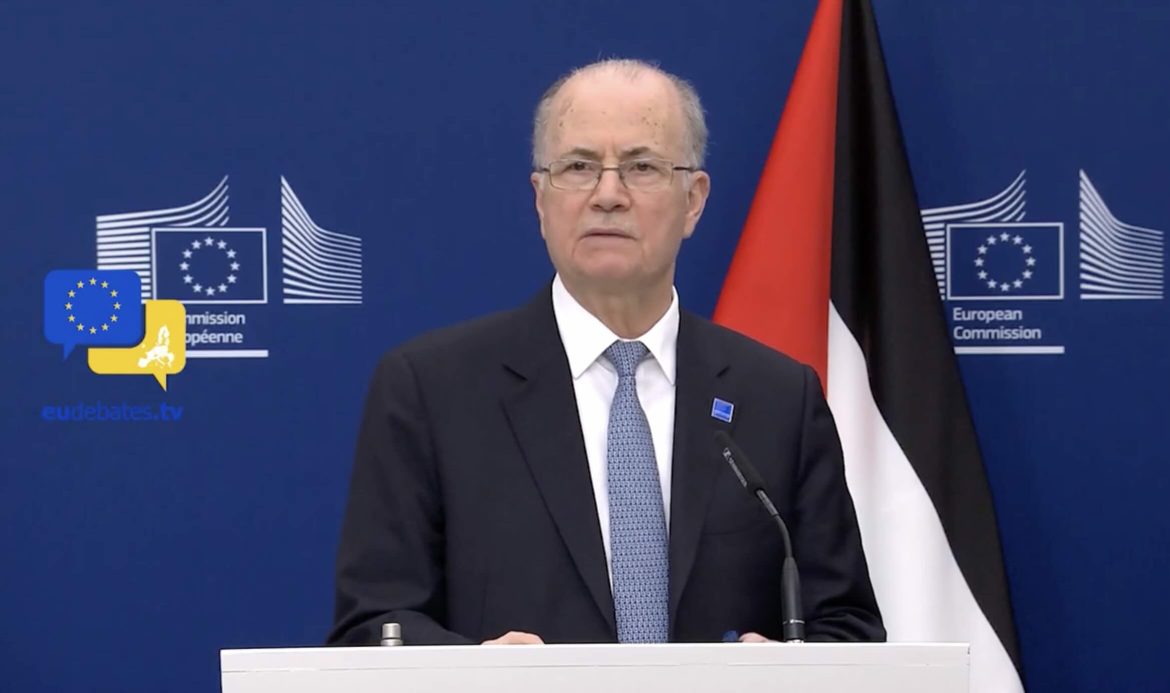
Hosted by the European Commission, the meeting brought together ministers and senior officials from around 60 countries and organisations. It was co-chaired by France and Saudi Arabia under the PDG framework, which is intended to serve as a political and technical platform for donors rather than a one-off pledging conference. Palestinian Prime Minister Mohammad Mustafa attended as the main Palestinian interlocutor.
The Brussels talks follow the adoption by the UN Security Council of a US-driven peace plan for Gaza. That plan envisages the unification of Gaza and the West Bank under a reformed Palestinian Authority (PA), a gradual Israeli military withdrawal and the deployment of an international stabilisation force. The PDG is designed to align donors around that framework and around an eventual two-state political solution.
EU officials presented the meeting as an opportunity to give the PA a visible role in setting out its reform and governance plans after a period in which key decisions on Gaza have been taken largely without Ramallah’s direct input. In advance of the meeting, Brussels sources said the forum would allow the PA to demonstrate progress on governance, financial management and security-sector reform.
Reconstruction of Gaza was a central theme but was treated primarily in political and technical terms rather than financial ones. Participants discussed how a restructured PA could oversee Gaza’s recovery, how an eventual stabilisation force might operate, and how to link any large-scale rebuilding effort to clear benchmarks on security and governance. The meeting did not seek new financial pledges.
Reform of the PA was presented as a key condition for long-term donor engagement. European and other officials have called for changes to contentious payment schemes, often referred to as the “martyrs’ fund”, and for revisions to educational materials, alongside wider steps to improve transparency and accountability in the PA’s institutions. EU representatives also pressed for the release of more than $2 billion in Palestinian tax revenues currently withheld by Israel.
Security arrangements in and around Gaza were another focus. Discussions included options for an international stabilisation presence and for a technocratic Palestinian committee to run day-to-day administration in the Strip, working under PA authority. Several proposals would place PA-linked technocrats at the core of Gaza’s governance and reconstruction structures, though these ideas remain subject to negotiation among Palestinian actors and regional states.
Israel did not attend the Brussels meeting. EU officials said Israel had not been invited and indicated that, in any case, Israeli authorities were unlikely to have taken part. Israel has repeatedly voiced reservations about a strengthened PA role in Gaza, even as it backs aspects of the US-led plan. Hamas was not represented and has already rejected the UN-endorsed framework.
On the financial side, the conference largely confirmed existing commitments rather than generating new ones. The European Commission announced the signing of €82 million in support for the PA, funding already pledged by Germany, Luxembourg, Slovenia and Spain. Other reporting has put total PA-related support channelled this year at around €88 million. No additional substantial contributions from non-EU donors were announced in Brussels.
The PDG meeting fits into a wider EU package for Palestinian recovery and resilience. Brussels has outlined a €1.6 billion multi-year programme covering humanitarian aid, budget support and institution-building for both Gaza and the West Bank, making the EU and its member states the largest collective provider of financial assistance to the Palestinians. Officials say this backing will increasingly be tied to specific reform benchmarks.
The humanitarian situation in Gaza and the broader political context formed the backdrop to the talks. EU leaders have previously warned Israel over the humanitarian conditions in the Strip and signalled that the EU-Israel association agreement may come under review if no improvement is recorded. At the same time, donors are attempting to match reconstruction planning with an agreed political and security framework that would allow large-scale works to proceed.
Attention now moves to a follow-up conference in Egypt, expected to focus on concrete financial commitments for Gaza’s reconstruction.

