
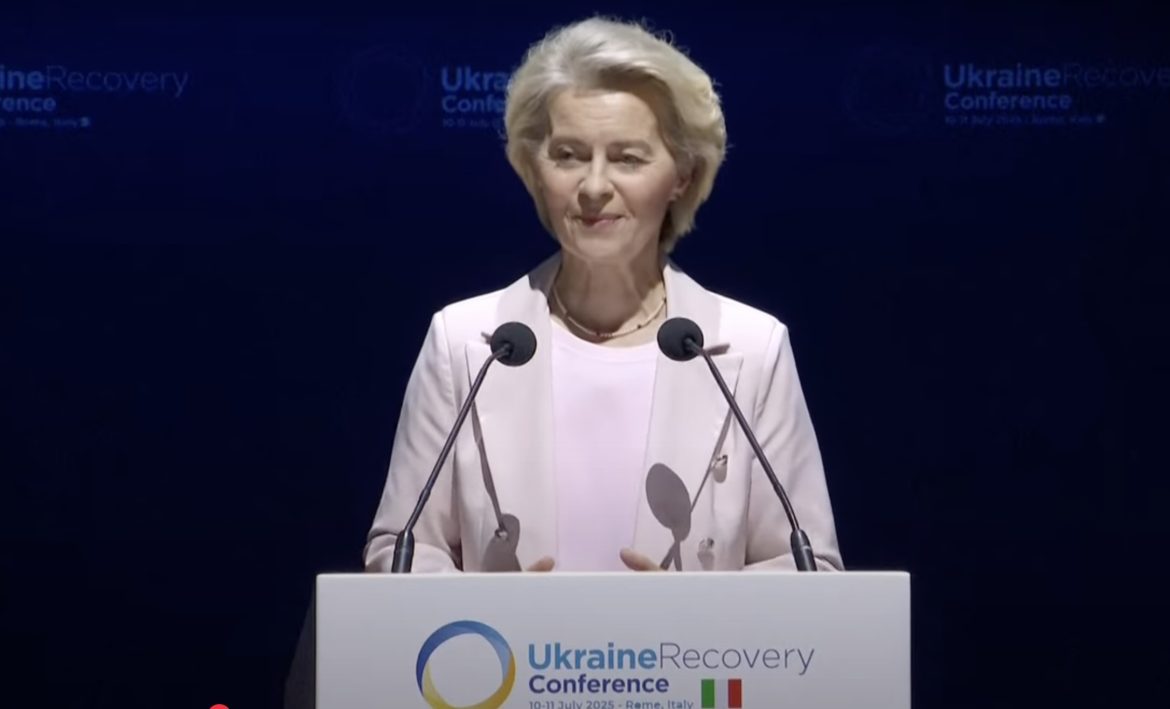
European Commission President Ursula von der Leyen has announced the creation of a new European Recovery Fund for Ukraine, described as the world’s largest equity fund dedicated to post-war reconstruction.
The declaration was made during the Ukraine Recovery Conference (URC-2025) held in Rome on Thursday, with the initiative launched in cooperation with Italy, Germany, France, Poland, and the European Investment Bank.
“I am especially pleased to announce today the creation of the European Flagship Fund for the recovery of Ukraine—the largest equity fund in the world to support reconstruction,” von der Leyen said in her address to delegates.
The fund is intended to mobilise significant private sector investment into key sectors of Ukraine’s recovery, including energy infrastructure, transport, critical raw materials, and dual-use technologies. According to von der Leyen, the initiative will use public funding as a basis to attract large-scale capital from private investors.
“We are quite literally investing in Ukraine’s future,” she said. “By leveraging public funds, we are enabling major private sector involvement to help rebuild the country. I am particularly grateful that we are doing this together with Italy, Germany, France, Poland, and the European Investment Bank. Thank you for your commitment.”
The announcement signals a strategic shift in the European Union’s approach to Ukraine’s post-war recovery, with a growing emphasis on structured financial instruments designed to unlock private capital alongside public resources. The new fund is expected to operate as a cornerstone mechanism in a broader recovery framework currently being developed in cooperation with the Ukrainian government and international partners.
The initiative complements calls made earlier in the day by Ukrainian President Volodymyr Zelenskyy, who urged the creation of an international recovery coalition based on the principles of the post-war Marshall Plan. Addressing the same conference, Zelenskyy stated: “Let this be the moment when we begin. We know what Russia has destroyed, and we know what is needed to restore Ukraine—our people, our way of life.”
Zelenskyy emphasised that recovery must be systematic and well-coordinated, involving countries and companies with the capacity to lead and engage others. “We need a Marshall Plan-style approach—and we must develop it together,” he said, underlining that Ukraine’s reconstruction is not solely a national concern but a shared European responsibility.
The Commission’s announcement of a flagship recovery fund was widely interpreted as a direct response to Zelenskyy’s appeal. Von der Leyen’s message reaffirmed the EU’s commitment to providing long-term financial and political support to Ukraine, framed within a strategic partnership model.
While specific figures for the fund’s capitalisation were not disclosed during the session, EU officials indicated that the mechanism will be designed to scale over time, drawing contributions from participating member states, financial institutions, and private investors. The fund is expected to prioritise projects that advance Ukraine’s economic modernisation, energy resilience, and integration with the European market.
Rome’s conference brought together senior officials, donors, and private sector stakeholders from across Europe and beyond. Italian Prime Minister Giorgia Meloni, who hosted the event, described the creation of the fund as a “milestone moment” in European support for Ukraine’s future.
“Reconstruction is not only a moral and political obligation—it is a strategic investment in European stability and economic security,” Meloni said.
The European Investment Bank (EIB), one of the institutions backing the fund, is expected to play a central role in managing investment flows and risk-sharing arrangements. A formal governance structure is due to be presented in the coming months, along with guidelines for project selection and monitoring.
The Rome conference follows previous donor coordination events in Lugano, London, and Berlin. Unlike those earlier summits, which focused largely on principles and pledges, the URC-2025 has seen a growing push for operational planning, including the presentation of financial instruments, oversight mechanisms, and sector-specific strategies.
Further announcements are expected in the second half of the year, with Brussels aiming to formalise funding streams and establish investment pipelines by early 2026.
Read also:
Berlin Conference URC2024 Highlights Realistic Approach Amidst Ukraine Conflict

