
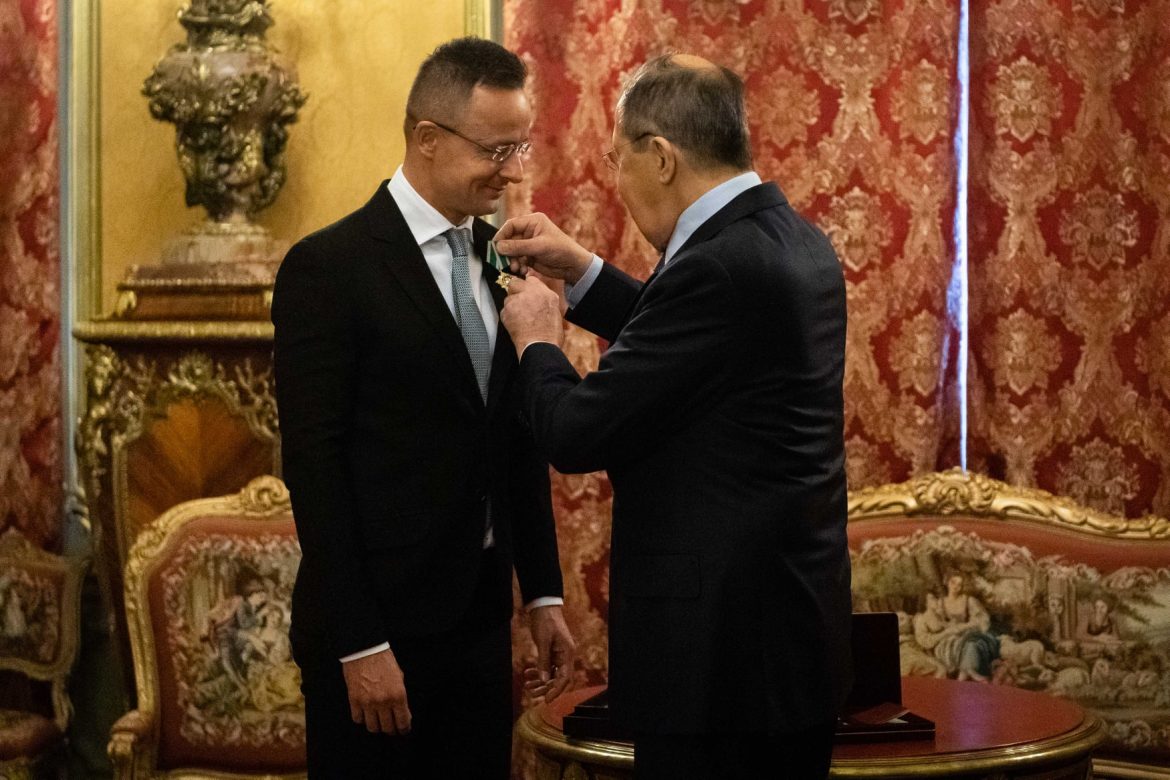
A report in The Washington Post has intensified concerns in Brussels over Hungary’s role inside the European Union, alleging that Foreign Minister Péter Szijjártó regularly briefed Russian Foreign Minister Sergei Lavrov on private discussions among EU foreign ministers.
According to the report, Szijjártó is said to have telephoned Lavrov during breaks in meetings of EU foreign ministers and relayed details of internal exchanges. One European official quoted in the reporting said the effect was that “Moscow was at the table”. The allegation, if substantiated, would deepen long-standing concerns among Hungary’s EU and NATO partners that Viktor Orbán’s government has acted not simply as a dissenting voice within Western institutions, but as a channel through which Russian interests can gain insight into internal Western deliberations.
The report comes at a particularly sensitive moment. Hungary is due to hold parliamentary elections on 12 April, and Orbán is facing his most serious challenge in years from Péter Magyar and the Tisza party. Recent polling reported by Reuters suggested Tisza had maintained a lead over Fidesz, though the gap had narrowed as the campaign entered its final stretch. Orbán remains a formidable electoral operator, but the coming vote is widely seen as the most competitive national contest of his long premiership.
For Hungary’s critics, the latest allegations fit a well-established pattern. Orbán has for years cultivated a distinctive relationship with Moscow, even while remaining formally within the EU and NATO mainstream. Hungary has repeatedly delayed or diluted common European positions on Russia and Ukraine, and in recent days Orbán again came under fire from fellow EU leaders for blocking a planned €90 billion loan package for Ukraine. European Commission President Ursula von der Leyen has since said the EU will find alternative ways to provide the money, underlining the degree of frustration with Budapest’s veto power.
That wider context matters. The question raised by the Washington Post report is not only whether confidential diplomatic conversations were shared with Moscow, but what that says about Hungary’s strategic position inside the Western alliance system. Orbán has long presented himself as a defender of Hungarian sovereignty and as a critic of what he calls Brussels orthodoxy. His opponents argue that this posture has too often translated into obstruction of common EU policy, particularly where Russia is concerned.
Energy is central to that debate. Hungary remains heavily reliant on Russian energy supplies, and Orbán’s government has maintained working links with Russian state energy interests even after the full-scale invasion of Ukraine. That dependence has shaped Budapest’s room for manoeuvre and has reinforced the perception, especially in central and eastern Europe, that the Hungarian government’s Russia policy is driven as much by material and political calculation as by ideology.
The international dimension of the election has also become more visible. Donald Trump endorsed Orbán’s re-election bid, calling him a strong leader, and senior figures in Trump’s administration have signalled support for the Hungarian prime minister.Washington’s current Republican leadership views Orbán as an important partner in Europe at a time when the Hungarian leader is under pressure at home.
That backing does not alter the immediate political arithmetic inside Europe. In Brussels, Orbán is increasingly seen as isolated on Ukraine, even if he still retains the institutional means to slow collective decisions. The allegation that Hungary’s foreign minister may have passed on details of EU discussions to Lavrov goes beyond the usual disagreements over sanctions, aid or energy. It raises a more fundamental issue of trust between member states.
For years, Orbán has argued that Hungary pursues a pragmatic foreign policy in a dangerous region. His government has maintained that it seeks stability, protects national interests and resists being drawn into a wider war. Yet the problem for Budapest is that reports of direct briefings to Moscow, combined with repeated clashes over Ukraine policy, risk turning a political dispute into a security question.
That is why the significance of the latest allegations extends beyond Hungary’s domestic campaign. If EU governments conclude that internal discussions cannot remain internal when Hungary is in the room, the consequences will be felt not only in Brussels but across the wider Western alliance. At a moment when Russia’s war against Ukraine continues to shape European security, that would leave Hungary formally inside the common structures of the West, but facing growing doubts about where, in strategic terms, it really stands.

