
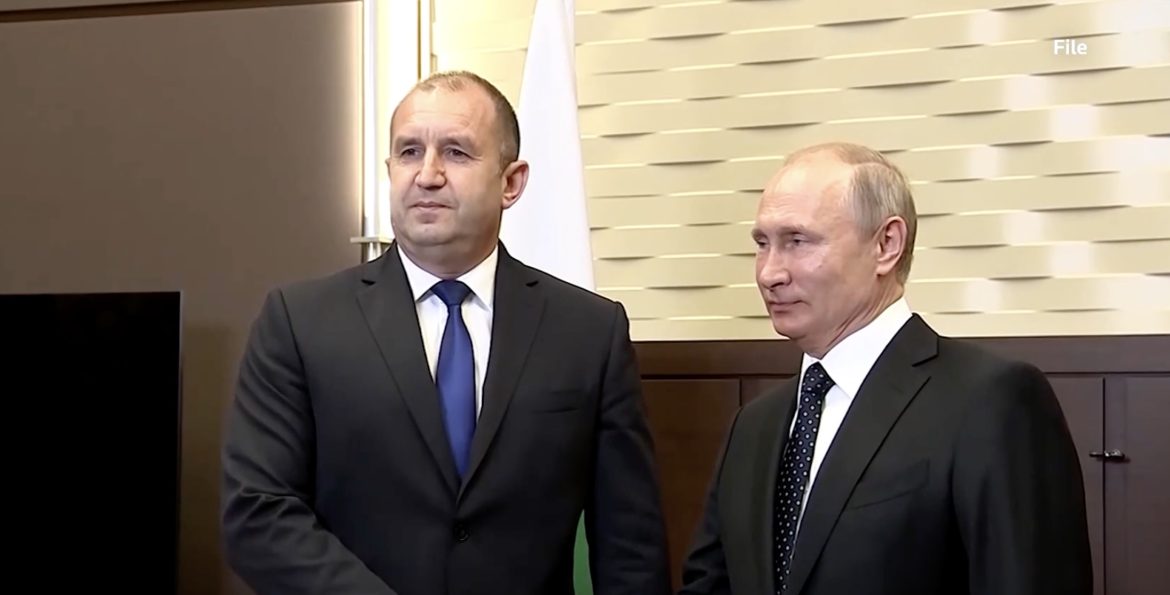
Sofia’s decision to halt arms supplies to Kyiv is not simply a national policy adjustment. It raises questions about EU cohesion, NATO reliability, defence-industrial planning, and the durability of long-term security commitments in wartime.
Bulgaria’s announcement that it will stop sending weapons to Ukraine marks one of the most consequential reversals in European policy towards Kyiv since the start of Russia’s full-scale invasion in February 2022. The decision, announced by Defence Minister Dimitar Stoyanov and aligned with the position of Prime Minister Rumen Radev, shifts Sofia from a discreet but important supplier of military support to a government openly questioning the value of further arms deliveries.
The immediate issue is the suspension of weapons transfers. The broader issue is reliability. Bulgaria is not the largest European donor to Ukraine by value, but it has occupied a specific and important place in the wartime supply chain. As a former Warsaw Pact state, it inherited Soviet-standard ammunition, weapons systems, repair capacity and defence-industrial expertise. These assets made Bulgaria particularly relevant for Ukraine, especially during periods when Kyiv urgently required ammunition compatible with older Soviet-calibre artillery and other legacy systems.
The new policy, reported after Stoyanov said Bulgaria would not provide further arms to Ukraine, therefore cannot be assessed only in terms of the next shipment. It carries strategic meaning because it interrupts a pattern of assistance that had developed through direct deliveries, commercial channels, re-export arrangements and defence-industrial cooperation with European partners.
For years, Bulgaria’s position on Ukraine was complicated by domestic divisions. Even before the latest shift, Sofia had often avoided open political ownership of arms transfers. Much of the supply was conducted through intermediaries or third countries, reflecting the resistance of pro-Russian and non-aligned forces in Bulgarian politics. Yet the practical effect was clear: Bulgarian ammunition and defence goods reached Ukraine and helped fill gaps that Western production was not yet able to cover at scale.
That role had begun to evolve into something more structured. On 30 March 2026, Ukraine and Bulgaria signed a ten-year security cooperation agreement, under which Sofia committed itself to continued military assistance, defence-industrial cooperation, ammunition production, drone development and broader security coordination. The agreement envisaged joint production facilities in both countries and linked Bulgaria to the EU’s wider efforts to increase defence output.
The contrast between that agreement and the new government’s position is sharp. A security pact designed to institutionalise long-term cooperation has now been followed by a political declaration that Bulgaria will not send more weapons. Legally, the agreement may remain in force. Politically, however, its implementation now depends on a government whose public position appears to contradict one of its core purposes.
Stoyanov presented the shift as a call for diplomacy, but the language closely follows arguments long used in Moscow’s playbook. His claim that Ukraine needs more people rather than more weapons, that the war has become an unwinnable contest of attrition, and that further arms deliveries only increase casualties reflects a Russian-framed narrative. The purpose of that argument is clear: to recast military support for Ukraine as an obstacle to peace, while ignoring the fact that the war began with Russia’s invasion and continues because Moscow has not abandoned its military objectives. Its central message is that weapons for Kyiv prolong the war; its practical effect would be to weaken Ukraine’s position before any negotiation begins.
Ukraine and most of its European supporters take the opposite view. Their position is that negotiations conducted from weakness would not be neutral diplomacy, but diplomacy under coercive pressure. From that perspective, weapons supplies are not a rejection of talks but a means of preventing Russia from using military force to dictate the terms of any eventual settlement.
Radev’s political profile makes the shift more significant. A former air force commander and NATO-trained figure, he has long argued that the war has no military solution and has opposed extensive Bulgarian involvement in arming Ukraine. His rise from president to prime minister has transformed a personal political line into state policy. That is why the change in Sofia is being interpreted not as a technical adjustment in defence procurement, but as a broader geopolitical pivot.
The decision also comes at a sensitive moment for the EU. Brussels is attempting to maintain pressure on Moscow while expanding European defence production and sustaining support for Kyiv. A new sanctions package is being prepared, with measures aimed at Russian military personnel, financial networks and parts of Moscow’s sanctions-evasion infrastructure. Against that background, Bulgaria’s change of course sends a signal in the opposite direction: one EU member state is moving from participation in the Ukraine support framework towards scepticism about its premise.
The NATO implications are equally important. Bulgaria’s decision does not alter the alliance’s collective defence commitments. Nor does it necessarily place Sofia outside NATO consensus on all Ukraine-related issues. But it introduces a new variable into alliance planning. If Bulgaria restricts export licences, slows Ukraine-related contracts, blocks or dilutes future assistance measures, or aligns more closely with governments sceptical of military aid, NATO’s internal coordination could become more difficult.
The comparison with Hungary is tempting but should be used carefully. Bulgaria is not Hungary. Radev does not possess the entrenched institutional control built over many years by Viktor Orbán. Bulgaria’s economy is also more dependent on European structures, and its defence industry has a direct interest in NATO and EU investment. Yet the comparison is not irrelevant. EU and NATO unity can be weakened not only by formal vetoes, but also by ambiguity, delay and uncertainty.
Defence planning depends on predictability. If allies and companies cannot be certain whether Bulgarian authorities will approve Ukraine-related production, export or re-export arrangements, then contracts become riskier. If Kyiv cannot rely on agreed channels remaining open after elections, long-term supply planning becomes more fragile. If European institutions invest in national defence production but national governments later restrict the use of that output for Ukraine, the EU’s industrial strategy becomes politically exposed.
This is where the defence-industrial dimension becomes central. Bulgaria had been positioning itself as a relevant part of Europe’s ammunition expansion. In October 2025, Bulgaria and Rheinmetall finalised a €1 billion agreement to build production capacity for gunpowder and 155mm artillery shells. The project, involving Rheinmetall and Bulgaria’s VMZ-Sopot, was designed to restore and expand ammunition output at a time when Europe was trying to address critical shortages exposed by the war in Ukraine.
The Bulgarian government may attempt to separate such industrial projects from weapons deliveries to Kyiv. It could argue that expanding ammunition production serves Bulgaria, NATO and European security more broadly, while refusing to send arms directly into the conflict. In practice, that distinction may be difficult to sustain. European ammunition production is now closely linked to the Ukraine war, NATO stockpile requirements and the EU’s ambition to reduce dependence on external suppliers. A government that benefits from Europe’s defence build-up while obstructing one of the principal reasons for that build-up will face questions from partners.
There is also a budgetary contradiction. Stoyanov has indicated that Bulgaria intends to raise defence spending to 5 per cent of GDP by 2030. Such an increase would require a major reallocation of resources. At the same time, Radev’s political platform has drawn on social and economic grievances, including inflation, energy costs and the condition of public services. A government promising both higher defence spending and social relief will have to explain how those commitments can be financed, particularly if relations with EU partners become more strained.
Energy policy adds another layer. Radev has criticised EU sanctions against Russia and argued that they have harmed European economies, including Bulgaria’s. Yet Bulgaria is also involved in regional energy infrastructure intended to reduce dependence on Russian routes. Days before the arms announcement, Sofia said work was progressing on the Vertical Gas Corridor, designed to improve gas flows between Greece, Bulgaria, Romania, Moldova and Ukraine. This creates a complex picture: Bulgaria is rhetorically challenging parts of the EU’s Russia policy while participating in infrastructure that supports regional diversification away from Moscow.
For Ukraine, the operational effect of Bulgaria’s decision is likely to be manageable but not negligible. Ukraine has diversified supply sources, expanded domestic defence production and shifted heavily into drone warfare. Bulgarian supplies alone do not determine Ukraine’s ability to resist Russia. However, Soviet-calibre ammunition and repair capacity remain relevant, particularly for older systems still in use. Any reduction in supply adds pressure to an already strained logistics network.
The larger danger for Kyiv is political contagion. If Bulgaria’s argument gains ground elsewhere, military support could be reframed not as a necessary means of resisting aggression, but as an obstacle to diplomacy. That narrative is attractive to governments facing war fatigue, fiscal pressure or strong domestic constituencies opposed to involvement. It is also consistent with Moscow’s long-standing effort to depict Western assistance as the cause of prolonged conflict rather than a response to invasion.
Brussels will now need to assess whether the Bulgarian shift is declaratory, partial or structural. A declaratory shift would involve strong rhetoric but limited practical change, with commercial exports and third-country channels continuing. A partial shift would halt direct military aid while allowing some industrial cooperation and existing contracts to proceed. A structural shift would involve a deeper realignment: blocking Ukraine-related defence cooperation, challenging sanctions, slowing EU decisions and presenting Bulgaria as a neutral mediator rather than a participant in Europe’s Ukraine policy.
The distinction matters because each scenario requires a different response. If Sofia is primarily seeking domestic political credit, diplomatic engagement may preserve parts of the existing cooperation. If the government intends to revise or suspend key commitments, Kyiv and Brussels will need to examine the legal status of existing agreements and contracts. If Bulgaria moves towards systematic obstruction, the EU and NATO will have to reduce dependence on Bulgarian channels and diversify production elsewhere.
The March 2026 security agreement will be an early test. Its provisions on military support, joint production, drones, ammunition and training were intended to create continuity beyond short-term political cycles. If they can be preserved despite the change of government, the damage may be contained. If they are hollowed out, the agreement will become an example of how fragile bilateral security pledges can be when not backed by enforceable mechanisms and cross-party political consensus.
For the EU, the lesson is broader. European defence planning cannot rely solely on political goodwill. It requires contracts, production redundancy, multiple supply routes, common financing, enforceable delivery schedules and contingency arrangements for domestic political reversals. The war in Ukraine has already shown that Europe entered the conflict with insufficient stockpiles and limited industrial readiness. Bulgaria’s pivot now shows that political volatility can be as disruptive as industrial weakness.
For Sofia, the risks are also considerable. A government that halts Ukraine-related support may gain approval from some domestic constituencies, but it could weaken Bulgaria’s standing among allies, complicate defence-industrial partnerships, and reduce confidence among investors involved in strategic projects. If Bulgaria is seen as an unreliable node in Europe’s security architecture, the cost may be measured not only in diplomatic criticism but also in lost contracts, reduced influence and lower trust.
The coming weeks will show how far Radev’s government intends to go. It may maintain its rhetoric while allowing some practical cooperation to continue. It may use the announcement as leverage with Brussels over sanctions, energy or budgetary issues. Or it may pursue a deeper repositioning, aligning Bulgaria more closely with Europe’s Ukraine-sceptical camp.
What is already clear is that Bulgaria’s decision has opened a new fault line. It affects Ukraine’s supply picture, but its consequences extend further. It tests the durability of European commitments, the resilience of NATO coordination, and the credibility of EU defence-industrial planning. In a war shaped not only by battlefield developments but by endurance, production and political will, Sofia’s pivot is a warning that Europe’s security architecture remains vulnerable to domestic political reversal.

