
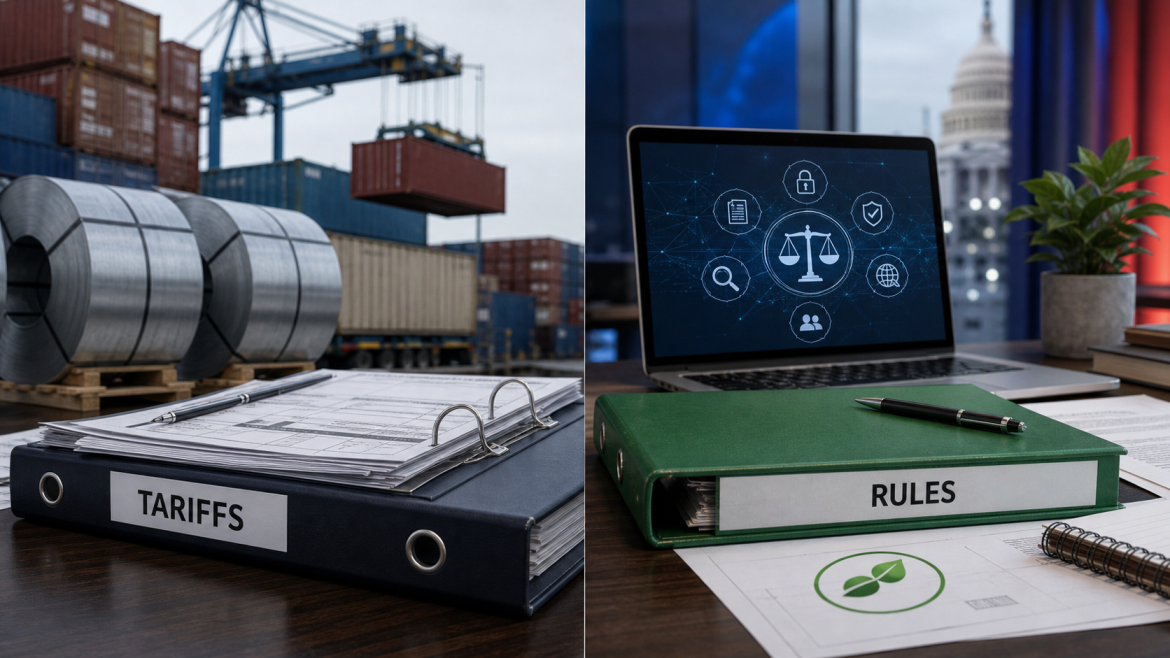
The Council’s final approval lowers the immediate risk of a new EU-US tariff fight, but leaves the harder conflict over regulation, steel, aluminium, digital rules and environmental standards unresolved.
The Council’s final approval of legislation implementing the EU-US tariff joint statement has lowered the immediate risk of a renewed transatlantic trade war, but it has not resolved the deeper conflict over regulation, industrial policy and Europe’s rulebook.
The Council of the EU gave final approval on 25 June to two tariff regulations implementing the EU’s side of the bargain, while preserving safeguards if Washington fails to meet its commitments. The decision follows the European Parliament’s approval earlier this month.
The political problem is that the tariff package is only the visible part of a broader settlement. It reduces one source of pressure but leaves others intact: steel and aluminium, digital regulation, environmental standards, pharmaceutical pricing and Washington’s objections to the EU’s wider regulatory model.
Tariff Relief, Not Trade Peace
The European Parliament approved the tariff legislation on 16 June by 440 votes to 151, with 50 abstentions. The MEPs backed the deal after securing safeguards, including a sunset clause at the end of 2029 and conditions linked to US tariffs on products containing steel and aluminium.
Under the arrangement, the United States maintains a 15% tariff on most EU exports, while the EU reduces duties on a range of US goods. That asymmetry is why the deal remains politically sensitive in Brussels and several member states.
Supporters argue that the agreement gives exporters predictability and prevents a more damaging escalation. Critics say Europe is opening its market while many European exports continue to face US duties.
The Council’s final approval therefore formalises the EU’s tactical choice: make concessions now to cap the immediate tariff threat, while retaining legal tools to respond if Washington moves again.
The Safeguard Question
The safeguards are central to the political defence of the deal. The EU has preserved the ability to suspend tariff preferences if the United States fails to deliver, especially on steel and aluminium.
Le Monde reported that MEPs added conditions allowing the Commission to suspend EU tariff preferences if US steel and aluminium tariffs remain above agreed levels, or if Washington does not restore the promised tariff treatment.
Steel and aluminium remain the unresolved industrial core of the dispute. Washington has used national-security arguments to justify measures that Brussels views as protectionist. The EU can accept temporary tariff concessions more easily than it can accept a precedent that US security law can be used repeatedly against European industry.
Regulation Becomes the Battlefield
The bigger issue is that the tariff deal moves pressure into non-tariff areas. Washington has repeatedly objected to EU digital regulation, sustainability reporting, carbon-border rules and other measures that US companies say impose costs.
The EU sees those rules differently. Brussels argues that its digital, climate and consumer standards are legitimate exercises of regulatory sovereignty. The question is whether the tariff truce creates pressure to dilute those standards.
The agreement is not a classic free-trade deal. It is a political bargain designed to reduce tariff escalation while managing a wider relationship that includes technology, energy, defence and industrial competitiveness.
A Fragile Truce
The fragility of the truce has been clear even before the Council’s final approval. EU Today reported separately that the United States had launched a Section 301 investigation into Germany’s pharmaceutical pricing practices, raising the possibility of renewed pressure on a sector not settled by the tariff legislation.
US Opens Trade Probe Into German Drug Pricing, Raising Tariff Risk
That episode shows why businesses may welcome the Council decision but still remain cautious. The tariff package may reduce uncertainty in one channel, but US pressure can reappear through sectoral investigations, export controls, digital complaints or demands over environmental regulation.
For European exporters, the practical effect is mixed. The deal may reduce the risk of a sudden tariff shock, but companies still face the possibility that regulatory disputes will become bargaining chips in future trade confrontations.
Brussels’ Regulatory Model
The Council’s approval therefore creates a test for Brussels. Can the EU use tariff concessions to stabilise trade without weakening its regulatory model? Or will the agreement become a route through which Washington pushes Europe to soften digital, climate and industrial rules?
That question matters beyond EU-US trade. The EU’s global influence rests partly on its ability to set rules that others adapt to. If Brussels retreats under tariff pressure, its regulatory leverage weakens.
At the same time, the EU cannot ignore the economic cost of escalation. A full transatlantic trade war would hit exporters, supply chains, investment and industrial confidence.
The tariff deal may buy time. It does not settle the argument over who writes the rules of the transatlantic economy.

