
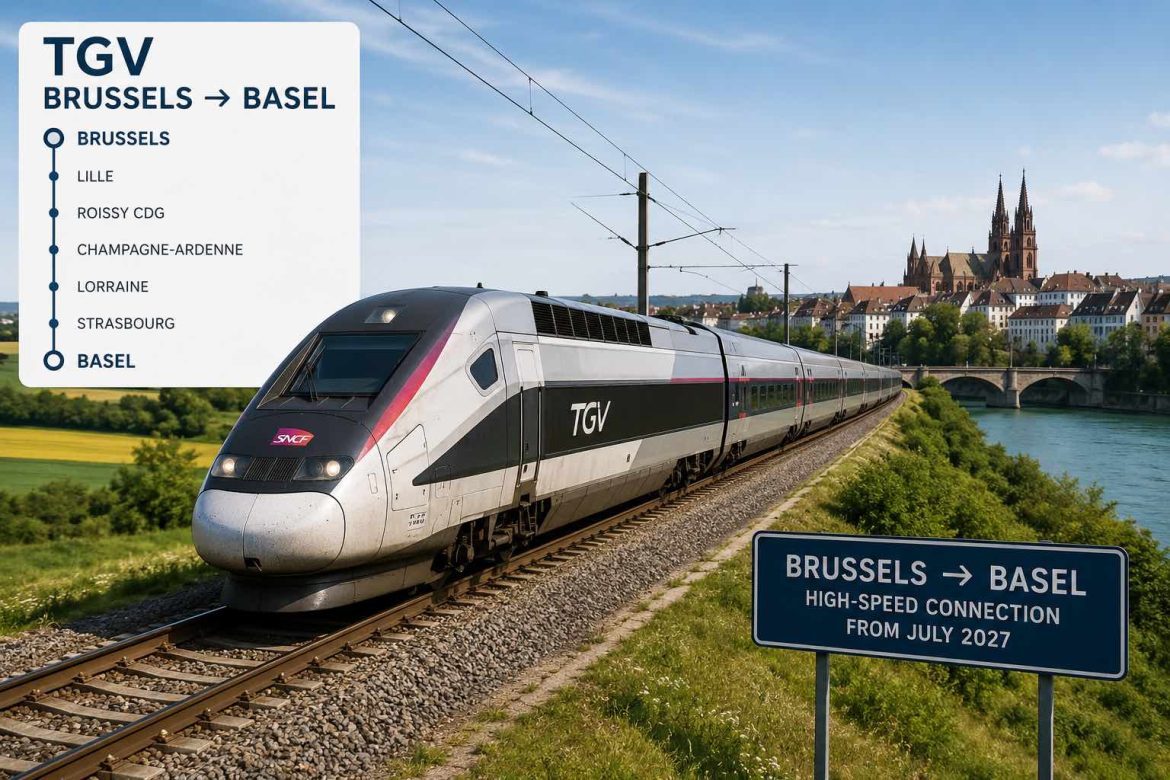
The announcement of a direct high-speed rail link between Brussels and Basel from July 2027 marks another incremental but symbolically significant step in Europe’s gradual reconfiguration of cross-border mobility.
The new service, to be operated jointly by Belgium’s SNCB/NMBS, France’s SNCF Voyageurs and Switzerland’s SBB, will extend an existing Brussels–Strasbourg TGV inOui connection deep into Swiss territory, creating a weekend-oriented corridor linking three of the continent’s most integrated rail economies.
On paper, the timetable is modest. The train will operate only on Fridays, Saturdays and Sundays, with a single daily return service. Departures from Brussels-South are scheduled for around 07:00, arriving in Basel shortly after midday. The return journey leaves Basel in the early afternoon, reaching the Belgian capital by early evening. Yet despite its limited frequency, the route’s significance lies less in capacity than in connectivity: a direct, no-change service linking Brussels, northern France, and north-west Switzerland.
Rail operators describe the initiative as a pilot project designed to test demand for long-distance international rail travel beyond traditional high-volume corridors. That caution reflects both opportunity and constraint. Demand for cross-border rail within Europe has grown steadily in recent years, driven by environmental policy, shifting consumer preferences, and improvements in high-speed infrastructure. Yet international services remain operationally complex, requiring coordination between multiple national operators, differing signalling systems, and tightly constrained high-speed network capacity.
The Brussels–Basel extension sits squarely within that tension. It builds on existing infrastructure rather than requiring new construction, but still depends on careful orchestration of timetables across France’s high-speed lines and the shared Franco-Swiss border network. The inclusion of intermediate stops — including Lille, Roissy Charles de Gaulle airport, Champagne-Ardenne, Lorraine and Strasbourg — also underlines the service’s dual role as both a point-to-point connector and a multi-city spine.
Strategically, the route also reflects a broader recalibration of European transport priorities. Rail operators and policymakers have increasingly framed high-speed international trains as a viable alternative to short-haul flights, particularly on journeys under six hours. The Brussels–Basel service, at roughly five and a half hours end-to-end, sits neatly within that competitive window. Environmental considerations, particularly pressure to decarbonise aviation, are likely to further strengthen the policy case for such routes, even where profitability remains uncertain.
However, the decision to limit operations to weekends suggests that commercial viability has yet to be fully established. Operators are effectively hedging: testing passenger appetite without committing to daily services that could strain rolling stock availability and network capacity. Ticketing details have not yet been released, but sales are expected to open in 2027, closer to launch.
There is also a geopolitical dimension, albeit understated. The service strengthens Switzerland’s rail integration with the European Union’s core transport networks, despite the country’s non-EU status. By linking Basel directly with Brussels — home to EU institutions — the route symbolically reinforces Switzerland’s practical dependence on EU infrastructure corridors, even as it maintains institutional independence.
For Belgium, the new connection forms part of a broader effort to position Brussels as a hub for international rail interchange. Connections via Lille also allow onward travel to London, reinforcing the city’s role as a continental junction. Yet challenges remain, particularly around capacity in the heavily used Brussels rail tunnels, which already operate near saturation.
Ultimately, the Brussels–Basel service is unlikely to transform European travel patterns on its own. But it does reflect a steady accumulation of similar extensions across the continent, each marginal in isolation but collectively reshaping the geometry of medium-distance mobility. Whether demand will justify expansion beyond weekends will be the key test — and one that operators themselves are openly acknowledging they are still learning how to answer.
Click here for more News & Current Affairs at EU Today
Click here to check out EU TODAY’S SPORTS PAGE!
___________________________________________________________________________________________________________________

