

It is always sad to see a friend go down, and so it is when we observe the current pitiful state of political discourse in our former American colonies.
The latest example of this degradation comes in the form of a White House press statement that reads less like a dignified government communication and more like an incendiary partisan attack. Issued this morning, the statement lambasted Democrats for failing to applaud Donald Trump’s latest proclamations, equating this lack of deference with opposition to motherhood, security, and basic decency.
The statement, brimming with hyperbole, accuses Congressional Democrats of being so consumed by their “hatred” of Trump that they refused to support tax cuts, fighting childhood cancer, capturing terrorists, protecting women and girls in sports, and upholding law and order. It is a laundry list of virtues, neatly repackaged to suggest that failure to cheer for the president is synonymous with opposing these causes. This is a textbook case of political discourse reduced to its most crude and misleading form.
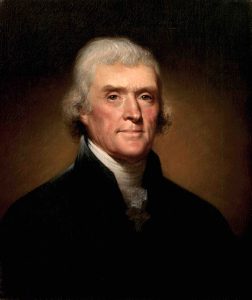
“I tolerate with the utmost latitude the right of others to differ from me in opinion without imputing to them criminality.
“Both of our political parties, at least the honest portion of them, agree conscientiously in the same object—the public good; but they differ essentially in what they deem the means of promoting that good.” – Thomas Jefferson, 1804.
The statement’s use of a quote from former White House Press Secretary and now political commentator for Fox News, Dana Perino, is even more egregious. “The Democratic Party still has no common sense. They have no ideas and they have no heart. They couldn’t even stand for the most inspiring moments of the speech.” This kind of rhetoric is designed not to engage in reasoned debate but to demonise political opponents, presenting them as heartless obstructionists rather than elected officials with legitimate policy disagreements.
Politics has always been a battlefield of ideas, but what we are witnessing today in the land of the freebie and the home of the depraved is the death of constructive debate. The American political landscape has been transformed into a stage for grandstanding, where ideological purity tests and performative outrage have replaced substantive policy discussions.
The expectation that members of the opposition party must stand and applaud the president’s every utterance is not democracy—it is authoritarian theatre. The function of opposition parties in any healthy democracy is to provide checks and balances, not to act as a cheerleaders for the government.
Moreover, not everyone finds Trump’s agenda inspiring. While his supporters may cheer his tax cuts, others see them as a boon for the wealthy at the expense of public services. While he touts his approach to law and order, critics view it as a thinly veiled dog whistle for policies that disproportionately harm marginalised communities.
While his administration decries the supposed unwillingness of Democrats to celebrate national security victories, others lament the reckless trade wars and diplomatic betrayals that are alienating allies and destabilising global relations. If there are cheerleaders to be found, the Kremlin will be the place to look for them.
The demand for unwavering allegiance to a leader’s rhetoric, without room for dissent or discussion, is a dangerous trend. The greatness of a democracy lies in its ability to accommodate differing viewpoints and to encourage debate rather than to suppress it. That the White House is now framing disagreement as hatred and lack of applause as disloyalty is emblematic of the deepening erosion of political norms.
The American political system was built on robust debate, not blind obedience. The fact that this principle is now under attack from the very institutions meant to uphold it is a troubling sign for the future.
If the United States is to reclaim the spirit of genuine democratic discourse, it must abandon this era of hyper-partisan theatrics and return to an environment where ideas, not insults, shape the national conversation.

