
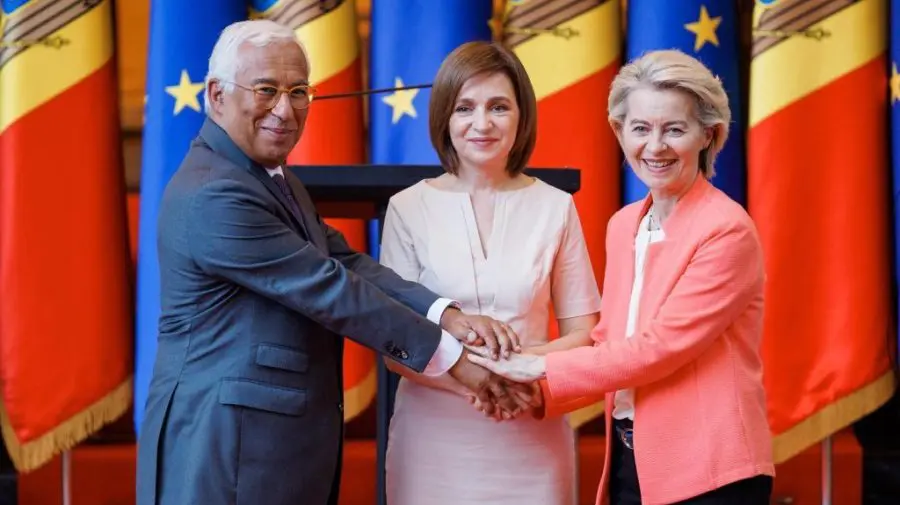
The second EU-Moldova summit in Brussels is not only another enlargement meeting. It is a test of whether the EU can turn accession into practical protection for a vulnerable candidate state facing Russian pressure, energy insecurity and hybrid threats.
The second EU-Moldova summit in Brussels is putting security, resilience, energy supply and reform delivery at the centre of the enlargement debate, turning Moldova’s accession path into a practical test of whether the European Union can protect vulnerable candidate states as well as promise them membership.
EU and Moldovan leaders are meeting in Brussels on 22 June, with the EEAS agenda listing arrivals at 11:00, a signing ceremony at 14:05 and a press conference at around 14:30. The Council notice dated 17 June framed the summit around bilateral cooperation, reform progress and Moldova’s European path.
The timing is important. It follows the opening of the first accession cluster for Moldova and Ukraine, a step the Guardian described as the start of substantive membership negotiations after earlier political delays. That makes the Brussels summit more than a diplomatic photo opportunity. It is the first major test of what enlargement means when a candidate country is under direct pressure from Russia.
Enlargement as a security instrument
Moldova has always made the EU’s enlargement debate more concrete. It is a small country with limited military capacity, a constitutional neutrality clause, a Russian-backed separatist region in Transnistria and a record of energy vulnerability. It has also faced cyberattacks, disinformation, political interference and repeated attempts to destabilise its pro-European course.
That context changes the meaning of accession. For Moldova, EU membership is not only a long-term economic project. It is a security anchor. For Brussels, Moldova is a test of whether enlargement can be treated as a strategic instrument on Europe’s eastern flank.
The European Commission’s Moldova enlargement page sets out the formal accession track. But the summit agenda shows the process is now inseparable from resilience, energy and hybrid-threat policy. Moldova is not simply being asked to adopt EU law. It is being asked to do so while defending its institutions from external pressure.
Hybrid pressure
The hybrid-threat dimension is central. The EU created the European Union Partnership Mission in Moldova in 2023 to help strengthen crisis-management structures and resilience against hybrid threats, including cybersecurity and foreign information manipulation. The mission was one of the clearest signs that Brussels sees Moldova as a security partner, not only an accession file.
That matters because Russia’s pressure on Moldova rarely looks like a conventional military threat. It can involve energy coercion, disinformation, cyber activity, pressure through Transnistria, political financing concerns and attempts to exploit social divisions. Those tools are designed to make a pro-European government look unstable, expensive or unsafe.
The summit therefore tests whether the EU can provide practical support: cyber resilience, border management, energy diversification, institutional capacity, strategic communication and financial help that reaches beyond speeches.
Energy resilience
Energy is the other hard test. Moldova has spent years reducing dependence on Russian gas and electricity flows linked to Transnistria. That shift has required emergency support, market integration and new infrastructure links with Romania and the wider European energy system.
The Energy Community framework is relevant because Moldova’s energy reforms are tied to the wider extension of EU energy rules beyond the Union. But reform alone is not enough if supply remains vulnerable to pressure, sabotage or price shocks.
For Moldovan households, energy security is not an abstract accession chapter. It affects bills, winter resilience and public confidence in the pro-European path. For the EU, helping Moldova through energy vulnerability is a way to make enlargement credible in daily life.
That is why summit language on energy supply should be read as security policy. A country that can keep lights and heating stable is harder to destabilise politically.
Reform under pressure
The opening of the first accession cluster brings the rule of law, democracy and institutional reform into sharper focus. Moldova will have to continue work on the judiciary, anti-corruption, public administration and regulatory alignment. Those are demanding reforms in any candidate country. They are harder when external actors are trying to weaken trust in the state.
This is the enlargement dilemma. The EU cannot lower standards because a country is geopolitically vulnerable. But it also cannot pretend that Moldova is reforming in normal conditions. If Brussels wants Moldova to meet accession benchmarks, it must help protect the state capacity needed to deliver them.
That means financial assistance, technical support and political backing must be aligned with reform expectations. Conditionality without protection would be too thin. Protection without reform would be too weak.
What Brussels must prove
The EU has repeatedly described enlargement as a strategic choice. Moldova is where that statement becomes measurable. Can Brussels help a candidate state resist hybrid attacks? Can it reduce energy vulnerability? Can it support reforms without overwhelming a small administration? Can it keep the accession process credible when Russia is actively trying to discredit it?
Those questions are especially important because Moldova’s path will be watched by Ukraine, Georgia and the Western Balkans. If the EU cannot support Moldova in a serious way, its wider enlargement promise will look more symbolic than strategic.
The summit should therefore be judged by practical outcomes: agreements signed, resilience measures funded, energy commitments clarified, reform milestones advanced and security cooperation strengthened.
A test case on the eastern flank
Moldova will not join the EU quickly. Accession remains a long and technical process requiring unanimous approval by member states. But the security environment does not wait for accession treaties.
That is the real significance of the Brussels summit. Moldova needs help now, not only a membership horizon later. It needs protection against hybrid pressure while it implements reforms. It needs energy resilience before the next crisis. It needs EU institutions to treat its vulnerability as part of Europe’s own security problem.
If the summit delivers only symbolism, it will fall short. If it links accession to concrete resilience, it will show that enlargement can be more than a promise. It can be a security instrument.

