
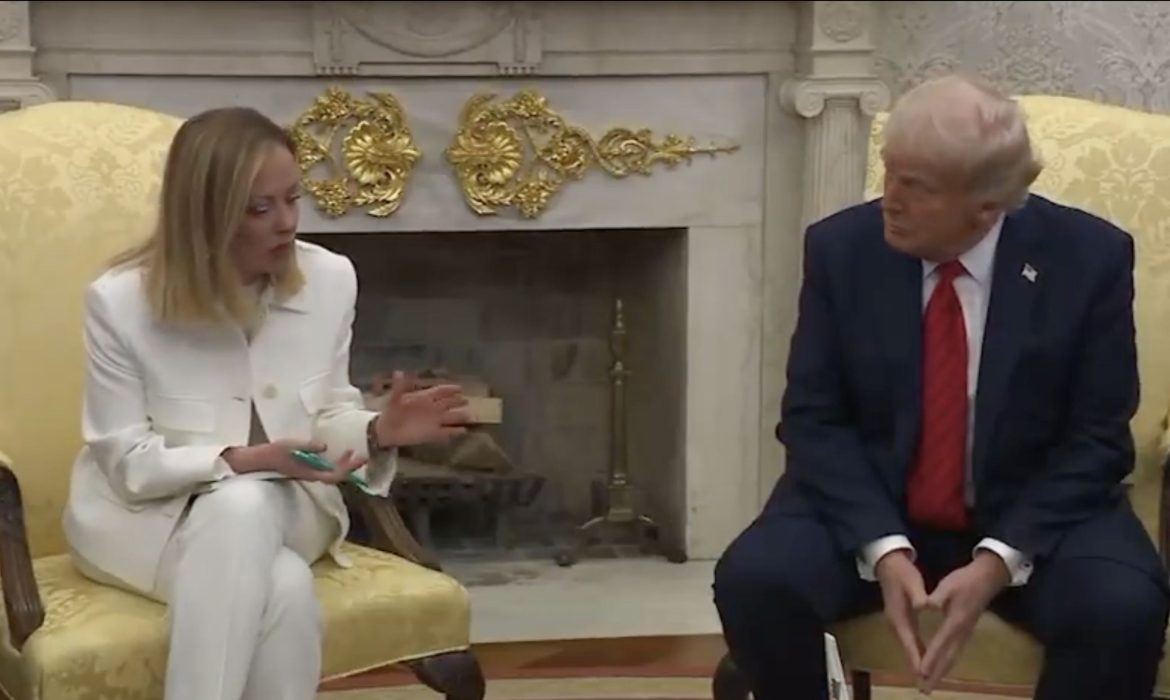
Italian Prime Minister Giorgia Meloni is rapidly asserting herself as the most influential political figure in Europe, leaving EU Commission President Ursula von der Leyen scrambling to keep pace.
Following her high-profile meeting with U.S. President Donald Trump, Meloni’s star is rising — and so too are anxieties across European capitals.
While von der Leyen remains the formal face of the European Union, it is Meloni who is commanding attention on the world stage. Her decision to hold bilateral talks with President Trump, independent of wider EU coordination, has sent shockwaves through Brussels and beyond. European leaders fear the encounter could unravel the bloc’s fragile unity, particularly amid tense trade negotiations with Washington.
The former firebrand from Rome, who once drew scepticism for her right-wing credentials, now finds herself cast as a pragmatic powerbroker — deftly balancing nationalist instincts with strategic diplomacy. Yet for many of her European peers, her approach risks crossing a line from assertiveness into unilateralism.
Brussels on Edge
A one-on-one meeting between Meloni and Trump — whose administration has recently proposed sweeping tariffs on European goods — was particularly galling for EU officials. The European Commission has been working tirelessly to construct a common front in response to Washington’s economic salvos, which threaten to hit key sectors such as automotive, agriculture, and luxury exports.
Meloni’s charm offensive in Washington is being watched warily. Diplomats fear Italy may attempt to carve out a privileged trading arrangement with the U.S., potentially securing exemptions or concessions in a move that could fracture the EU’s negotiating position.
“It’s not about Italy alone — it’s about Europe’s collective strength,” said one senior EU diplomat. “If one member state starts freelancing with Trump, it undermines everything we’ve been working toward.”
Von der Leyen, who has spoken repeatedly about the importance of European unity in the face of external pressure, is understood to have held last-minute talks with Meloni in an attempt to ensure the Italian leader will carry a message aligned with Brussels.
Coordinated — (At Least In Theory)
Officially, Meloni has expressed her commitment to the European cause. In a press briefing ahead of the trip, her office stressed that she had coordinated closely with von der Leyen and other EU figures and would present a “unified message” in discussions with the U.S. President.
But the mood in Brussels remains sceptical. Meloni’s track record suggests a willingness to act decisively — and, at times, independently — when Italian interests are at stake. And with a domestic audience cheering her for standing tall on the international stage, the incentives for breaking ranks are only growing.
The Italian prime minister has cultivated a relationship with Trump since his re-election, embracing a tone that blends ideological kinship with transactional realism. For Trump, who has long expressed disdain for the EU and preference for bilateral dealings, Meloni represents a more agreeable partner than the rigid machinery of Brussels bureaucracy.
Divisions on Ukraine and Russia
Beyond trade, Meloni’s foreign policy has sparked unease over deeper ideological divides within the bloc. While she has publicly supported Ukraine and backed sanctions on Russia, her coalition includes factions with historic ties to Moscow, and her stance has sometimes been seen as softer than that of northern European hawks.
Von der Leyen has pushed for unwavering European support for Kyiv and continued pressure on the Kremlin. Meloni, though aligned on paper, is seen as more flexible — and Trump’s more ambiguous position on Ukraine only adds to the uncertainty surrounding their upcoming discussions.
“It’s not just about tariffs or diplomacy,” said a Brussels policy advisor. “It’s about the direction of European leadership. Meloni is making a bid to redefine it — and von der Leyen is being left behind.”
A New Power Dynamic
What is emerging is a stark contrast in leadership styles. Von der Leyen embodies institutional continuity and careful consensus-building. Meloni, by contrast, is brash, media-savvy, and seemingly unconstrained by the traditional norms of EU diplomacy.
Her boldness has resonated not just in Italy, where her approval ratings remain solid, but across parts of Europe that feel increasingly disconnected from Brussels technocracy. Some see in her a model of how to engage global powerhouses without always waiting for consensus.
Yet this rise is not without risk. A poorly handled meeting with Trump could isolate Italy from its EU partners. A favourable outcome for Italy alone, on the other hand, could embolden others to pursue their own bilateral paths, spelling trouble for the EU’s long-term cohesion.
As Meloni prepares to shake hands with the leader of the free world, one thing is clear: the centre of gravity in Europe may be shifting — and Ursula von der Leyen is no longer the only one steering the continent’s course.
_____________________________________________________________________________________________________________________
Read Also: RETHINKING EUROPE: DISESTABLISHING THE EUROPEAN COMMISSION TO RESTORE SOVEREIGNTY AND DEMOCRACY
“Disestablishing the European Commission does not imply the abandonment of the European project. Rather, it offers an opportunity to revive it along more democratic, accountable, and pluralistic lines.”
_____________________________________________________________________________________________________________________

