
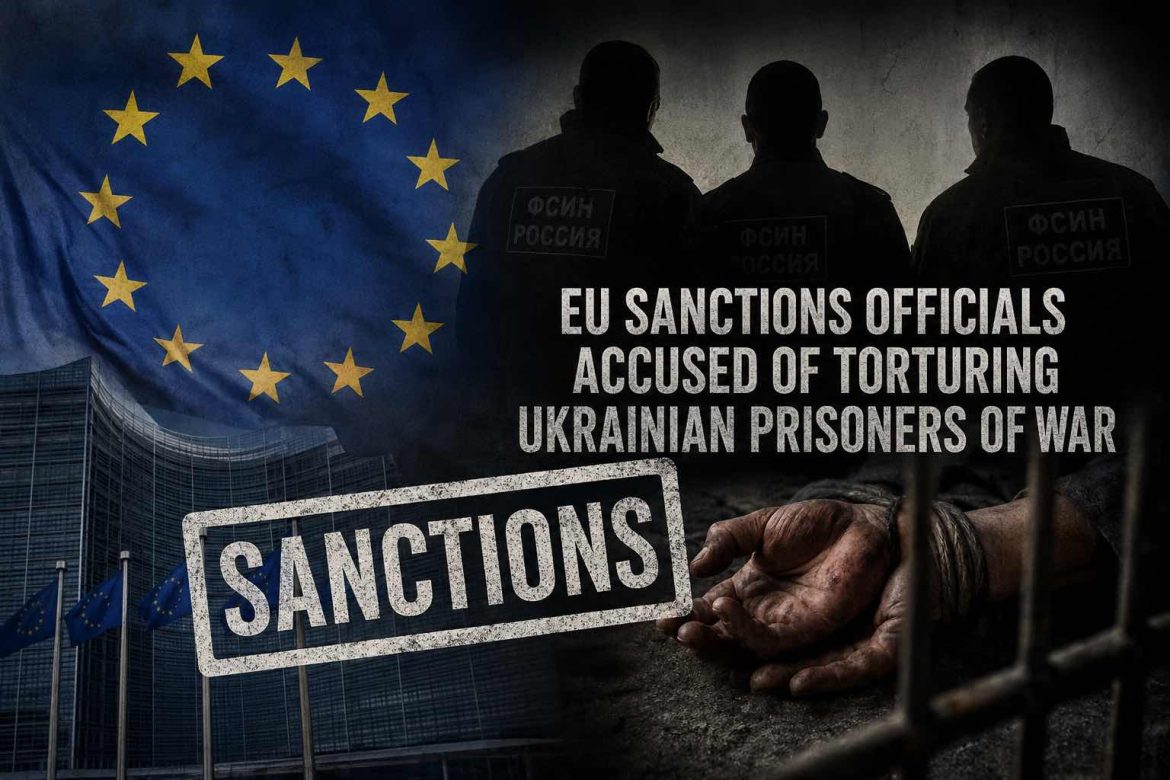
The Council has listed 15 individuals and one entity over alleged human-rights violations against Ukrainian prisoners of war and civilian detainees.
The European Union has imposed targeted sanctions on officials and an entity accused of serious human-rights violations against Ukrainian prisoners of war and civilian detainees, adding a sanctions layer to the fragmented legal response to alleged abuse in Russian custody.
The Foreign Affairs Council record for 13 July says ministers adopted restrictive measures over serious violations against Ukrainian prisoners of war and civilian detainees. The Council’s press listing states that 15 individuals and one entity were added in connection with alleged violations in temporarily occupied regions of Ukraine and in Russia.
The measure sits at the intersection of sanctions law and international humanitarian law. The treatment of prisoners of war is governed by the Geneva Conventions, while abuses against civilian detainees may also fall under international human-rights law and war-crimes investigations. EU sanctions do not replace prosecutions, but they can restrict movement, freeze assets and signal that named officials are part of an accountability file.
That distinction matters. Criminal cases require evidence that can meet a courtroom standard and identify individual responsibility. Sanctions require a different administrative threshold and can be imposed faster. The EU is therefore using a tool that is quicker than prosecution but less conclusive than a court judgment.
The central question is evidence. To be effective and credible, targeted sanctions should connect named individuals to detention facilities, command structures, orders, supervision or documented abuse. That is why the next stage should be to cross-check the Council list against Ukrainian investigations, UN monitoring, International Criminal Court material and national universal-jurisdiction cases.
For Ukrainian families, sanctions may look inadequate compared with prosecutions or prisoner releases. But they can still matter. A travel ban and asset freeze make it harder for accused officials to operate internationally, move wealth through Europe or present themselves as ordinary state employees. They also preserve names in a formal legal record.
The measure also fits a wider EU pattern. On the same day, ministers considered Ukraine’s most urgent military needs and adopted separate cyber and human-rights listings against Russian actors. That combination shows Brussels using sanctions not only to pressure Russia’s economy, but to document specific categories of alleged abuse.
There is a risk of symbolic overload. If designations are not followed by evidence gathering, coordination with prosecutors and public explanation, they can become another list with limited deterrent effect. The credibility of this measure will depend on whether names, roles and alleged conduct are clear enough for future accountability work.
The EU should therefore treat the listing as an opening step, not an endpoint. Prisoner abuse cases require documentation, witness protection, forensic evidence and cooperation among Ukrainian, European and international authorities. Sanctions can support that process by naming alleged perpetrators and limiting their access to Europe.
The political message is nonetheless direct: the treatment of Ukrainian prisoners and detainees is not only a humanitarian issue. It is now part of the EU’s formal sanctions response to Russia’s war and occupation practices.
__________________________________________________________________________________________________________________
Click here for more News & Current Affairs at EU Today
Click here to check out EU TODAY’S SPORTS PAGE!
___________________________________________________________________________________________________________________

