
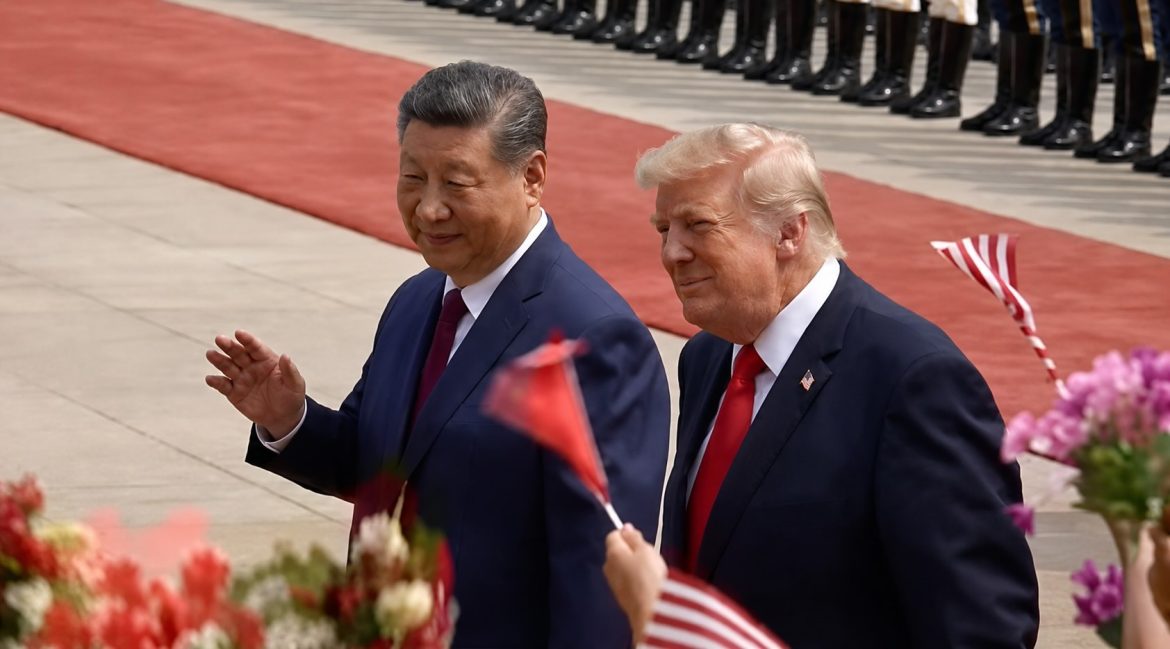
The US president’s talks with Xi Jinping produced public language about co-operation, but the main strategic disputes between Washington and Beijing remain unresolved.
President Donald Trump’s visit to Beijing has taken place in a markedly different international environment from the one in which it was prepared. Initially presented as a major diplomatic opening with China, the visit has instead been shaped by the consequences of the US-Israeli operation against Iran, the disruption around the Strait of Hormuz, and renewed tension over Taiwan.
The meeting with Chinese President Xi Jinping produced formal statements about dialogue, stability and the need to manage differences. Yet the available evidence points to limited substantive progress. The two leaders discussed Iran, trade, energy security and Taiwan, but there was no clear indication that either side had shifted its core position on the issues most likely to define the next phase of US-China relations. Xi warned that mishandling Taiwan could push relations into a dangerous place, while the US account of the meeting placed greater emphasis on broader co-operation and the need to keep the Strait of Hormuz open.
For Trump, the timing is difficult. The visit had been planned before the escalation with Iran and before the resulting uncertainty over one of the world’s most important maritime energy routes. Washington has sought to present China as a potential partner in stabilising the situation around Hormuz. The White House said Trump and Xi agreed that the strait “must remain open”, while earlier US statements indicated that Washington and Beijing opposed any attempt to impose tolls on shipping through the waterway.
That does not mean the two governments share the same view of how the crisis should be resolved. China remains a major buyer of Iranian oil and has maintained close political and economic ties with Tehran. Reports that Iran has begun allowing some Chinese vessels to pass through the Strait of Hormuz underline Beijing’s separate channel of influence, but also demonstrate that Chinese interests do not necessarily align with Washington’s preferred strategy.
The same pattern is visible on Taiwan. Trump avoided a direct public confrontation on the issue, while Secretary of State Marco Rubio said after the talks that US policy remained unchanged. Rubio also acknowledged that Beijing would prefer Taiwan to move towards unification voluntarily, including through a vote or referendum, while warning that any attempt to use force would create a serious confrontation.
Such a scenario remains remote. Taiwan’s political reality, its separate democratic institutions and the experience of Hong Kong make the idea of voluntary absorption into the People’s Republic of China highly improbable. The formula of “one country, two systems”, once promoted by Beijing as a possible framework for Taiwan, has lost much of its persuasive force after the erosion of Hong Kong’s autonomy. The legal and political dispute is also deeper than a single referendum could resolve: Beijing and Taipei continue to represent rival claims rooted in the unresolved legacy of China’s civil war.
The Beijing summit therefore exposed a wider structural problem. Washington wants Chinese help in limiting the consequences of the Iran conflict, stabilising energy markets and restraining escalation in Asia. Beijing, however, is unlikely to provide such assistance on American terms. Xi’s objective is not to reinforce US leadership, but to position China as an equal power capable of shaping outcomes in the Middle East, the Indo-Pacific and the global economy.
Public courtesy in Beijing should not be mistaken for strategic convergence. The ceremonial language surrounding the visit, including references to partnership and dialogue, sits alongside continuing confrontation over Taiwan, technology, military power, sanctions, energy and China’s relations with states opposed to US policy.
For Trump, the visit may offer a short-term diplomatic image: a US president received in Beijing, speaking directly with Xi, and claiming progress on global crises. But the substance is more limited. China has not abandoned its claim to Taiwan. It has not aligned itself with the full American position on Iran. It has not accepted Washington’s interpretation of sanctions enforcement. Nor has it shown any intention of subordinating its economic interests to US strategic priorities.
The result is a summit that may reduce the tone of confrontation temporarily, but is unlikely to alter the direction of the relationship. Once the formalities end, the underlying rivalry will remain. The question is not whether the United States and China can issue statements about co-operation. It is whether they can prevent competing ambitions from turning into direct confrontation. On the evidence from Beijing, that question remains unanswered.

