Amid the din of geopolitical disruption, from Russian aggression to the rise of digital authoritarianism, it is tempting to forget that the international legal order still matters.
But this week, in a quietly significant gathering in London, the British Government made a formal and visible commitment to that very principle. Whether the gesture becomes policy or remains pageantry is the real test.
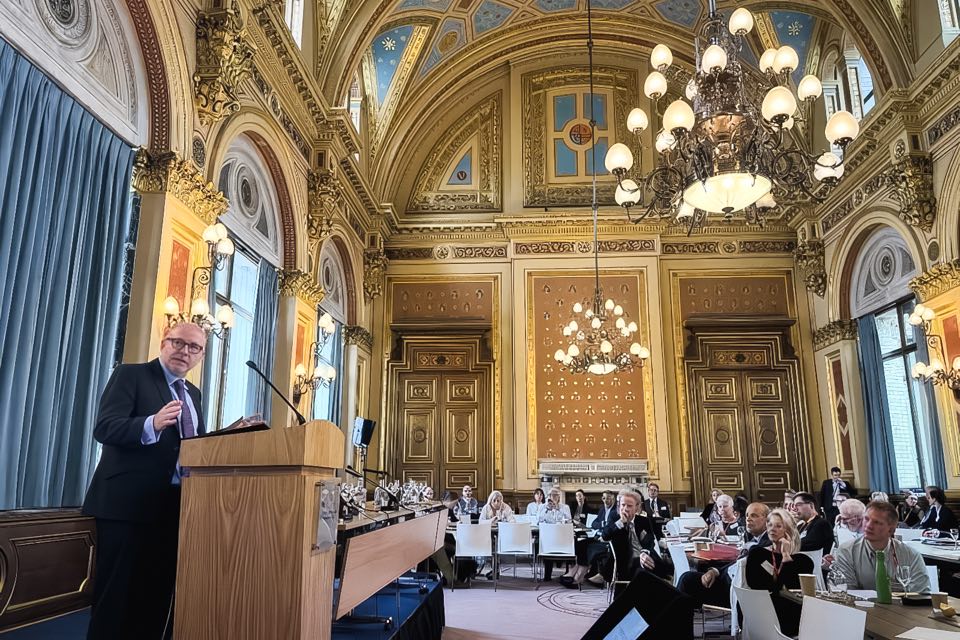
At an event hosted jointly by the Attorney General’s Office, the Foreign, Commonwealth and Development Office, and the Bingham Centre for the Rule of Law, the UK welcomed representatives of the Council of Europe’s Venice Commission—one of Europe’s more venerable yet underappreciated legal institutions.
The occasion marked the 35th anniversary of the Commission, created in 1990 to guide member states in upholding democratic standards, constitutional governance, and—most crucially—the rule of law.
In his remarks, the Attorney General, Lord Hermer KC, sounded the right notes. “At a time when it feels like the world is becoming ever more polarised,” he said, “it is important to use what we have at our disposal to encourage cooperation and shared understanding.” That cooperation, he argued, must be grounded not in slogans but in enforceable legal principles.
At first glance, this may seem routine, yet another conference with lofty ideals and official speeches. But the mood music is different. This was not Brussels or Strasbourg but London: a capital still finding its post-Brexit footing. And the UK, now no longer a member of the EU but still a pivotal member of the Council of Europe, appears increasingly eager to assert its voice in shaping the future of multilateral legal cooperation.
That eagerness, one suspects, is not entirely altruistic. It is no secret that Britain’s departure from the European Union has left behind deep uncertainties, not just in trade and foreign policy, but in the UK’s relationship with continental legal frameworks. While the Government insists it remains committed to European values, there are tensions bubbling beneath the surface, particularly in areas such as human rights law and migration policy.
Resetting relations with Europe, then, cannot be done solely through trade deals or defence partnerships. It also requires reaffirming Britain’s place within the moral and institutional architecture that underpins Western civilisation. And the rule of law, as Lord Collins of Highbury put it at the event, is not merely a legalistic abstraction: “It is the foundation of public trust and institutional legitimacy.”
This makes the Venice Commission’s work timely. Among the more practical outcomes of the event was a discussion around the updating of the Commission’s “Rule of Law Checklist”—a diagnostic tool used to evaluate whether laws, systems, and institutions uphold basic legal standards. In an age of surveillance capitalism, algorithmic governance, and creeping authoritarianism, the checklist’s revision is long overdue. Britain’s involvement in that process is to be welcomed.
Yet questions linger. What does it mean for the UK to support the “rules-based order” while its domestic politics has seen repeated clashes with that very notion? Ministers have openly criticised the European Convention on Human Rights. Legislation on immigration has skirted the edge of international norms. The desire to “take back control,” while electorally effective, has sometimes sat awkwardly with Britain’s historic role as a beacon of legal continuity and constitutional restraint.
Events like this week’s gathering risk becoming symbolic fig leaves unless backed by concrete action. The legal order must not merely be performed, it must be practiced. That means consistent respect for judicial independence, transparency in lawmaking, and a willingness to abide by international rulings, even when they prove inconvenient.
And there is another point. While Britain may now approach Europe from outside the EU, it still shares its political and legal DNA. The Venice Commission exists not for Brussels technocrats but for all European democracies, and its work reminds us that sovereignty and cooperation are not mutually exclusive. Indeed, they are often mutually reinforcing.
As Lord Hermer rightly noted, the Rule of Law Checklist is “one of those rare things” that commands cross-border, intergovernmental support. In an age of fragmentation, this is no small thing. If Britain is serious about its global role—as a stabilising legal force, as an exporter of democratic norms—then this is a cause worth championing.
The rule of law may not set hearts racing on the campaign trail, but it is the quiet foundation upon which every free society rests. If the UK can help defend it—not just in London, but in Warsaw, Tbilisi, and beyond—then this week’s event will have been more than just ceremonial.
It will have been the start of a necessary renewal.
Story/Image: GOV.UK