
769

EUToday Correspondents
EUToday publishes articles from a variety of outside sources which express a wide range of viewpoints.Opinions expressed in these articles are not necessarily those of EUToday.
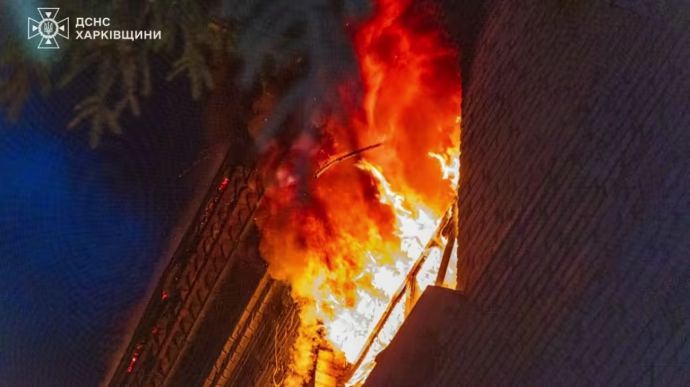
The mayor of Ivano-Frankivsk, Ruslan Martsinkiv, described the assault on his city and surrounding communities as the most extensive since the start of the full-scale invasion in February 2022. The strike involved multiple missile types and drones. Several residential areas were damaged, with injuries reported in at least three villages within the municipality. A later update from the mayor clarified that no fatalities were recorded in the region.
Images released from affected villages showed widespread structural damage. A regional air raid alert remained in effect into Monday morning, with emergency services continuing rescue and recovery operations.
According to the Ukrainian Air Force, the missiles included:
5 Kh-47M2 Kinzhal aeroballistic missiles, launched from Russian airspace over Tambov Oblast;
4 Kalibr cruise missiles, launched from vessels in the Black Sea;
1 Iskander-K cruise missile, fired from the area near Millerovo in Russia’s Rostov region;
14 Kh-101 cruise missiles, launched from aircraft over Saratov Oblast.
Of the 426 drones launched, 200 were confirmed as Shahed-type loitering munitions, and another 203 were decoy UAVs. Most were either shot down by anti-aircraft units or suppressed by electronic warfare systems.
President Zelenskyy stated that the attack came in multiple waves and continued until morning. Fresh drone incursions were reported over Kharkiv Oblast during the day. In addition to the Air Force and ground-based missile units, the defence effort involved mobile fire teams, interceptor drones, electronic warfare operators, and army aviation.
One of the fatalities occurred in Kyiv, where eight others were injured, including a 15-year-old girl. Damage was recorded to residential buildings, a kindergarten, garages, a supermarket, and metro infrastructure. In Ivano-Frankivsk Oblast, local authorities confirmed injuries to three adults and one child, with further destruction to homes and public buildings.
Additional drone activity and interceptions were recorded over Sumy, Khmelnytskyi, Kirovohrad, Mykolaiv, Poltava, and Kherson regions. Air defence and emergency units remain on alert amid the ongoing threat.
Despite the high interception rate—Ukraine’s air defences neutralised approximately 95% of airborne threats—the attack highlights the continued vulnerability of critical civilian infrastructure. President Zelenskyy reiterated the need for scaling up interceptor capacities: “There were many shootdowns, but unfortunately not all. We must continue to expand our interceptor capabilities. That is the only way to defend against mass attacks.”
Ukrainian officials have renewed calls for additional international support, including modern air defence systems and further investment in electronic warfare capabilities. Kyiv has repeatedly warned that Russia is attempting to exploit gaps in air coverage by using saturation tactics—overwhelming defences with mixed waves of missiles, drones, and decoys.
Search and recovery operations continue across multiple oblasts, with authorities assessing the full extent of the damage. While the immediate threat from this wave has been largely mitigated, officials warned that further attacks remain likely.
EUToday publishes articles from a variety of outside sources which express a wide range of viewpoints.Opinions expressed in these articles are not necessarily those of EUToday.

