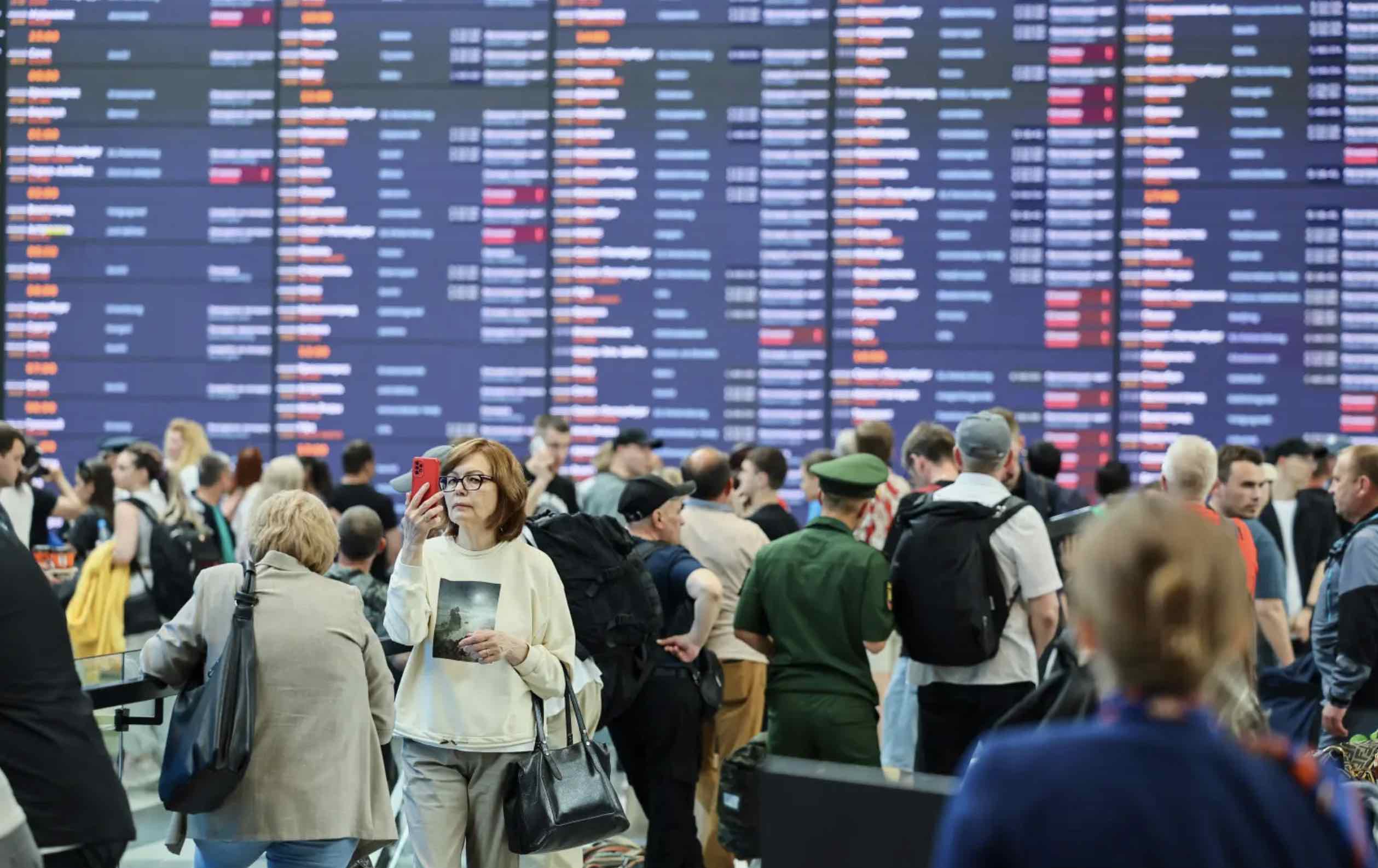
Russian air defences may claim to have intercepted the drones, but they could do nothing to hide the mayhem on the ground at the three busiest Moscow Airports.
At Sheremetyevo, Domodedovo, and Vnukovo thousands of passengers found themselves stranded, disgruntled, and in many cases, curled up asleep on tiled floors as another wave of Ukrainian drone attacks forced widespread delays and cancellations on Monday.
Videos widely circulated by Russian media painted a grim picture: the departure boards were awash in red, security personnel attempted to corral agitated crowds, and weary travellers, some of them with young children, slumped against their suitcases with the resigned look of people who no longer expected to reach their destinations.
The Kremlin has, until recently, made a point of portraying life in Moscow as untouched by the war it unleashed on Ukraine. But the conflict is now quite literally landing on the capital’s doorstep, and in doing so, it is chipping away at the myth of invulnerability Vladimir Putin has worked so hard to cultivate.
Monday’s disruption is only the latest in a string of increasingly frequent drone incursions aimed at the Russian heartland. According to Russian officials, more than a dozen unmanned aerial vehicles were intercepted over the wider Moscow region overnight, with several reported to have been shot down near key infrastructure.
Though damage was said to be minimal, the impact on the civilian population was anything but. “It was pandemonium,” said Dmitri M., a passenger whose flight to Sochi was cancelled without notice. “First we were told there was a technical delay, then they said the airspace was temporarily restricted. Now we’re being told nothing at all.”
The Federal Air Transport Agency confirmed that flights were suspended early Monday morning “in the interest of aviation safety” and later resumed, albeit with significant backlog. Yet for many, the damage had already been done. At Sheremetyevo—Russia’s largest and busiest airport by passenger numbers—dozens of flights were affected, and lounges were overwhelmed.
One video, aired by the state-run Channel One, showed the departure terminal strewn with families huddled under jackets and makeshift bedding, while an airport worker in a reflective vest paced helplessly through the crowd. “I’ve never seen anything like it,” said Marina K., who was due to fly to Kaliningrad. “Not even during COVID lockdowns.”
Official Russian media initially downplayed the cause of the disruption, with some reports vaguely attributing delays to “temporary logistical challenges.” Only later in the day did state news outlets acknowledge that air defences had been activated in response to what they called a “mass drone attack” from Ukraine.
Kyiv, as is customary, did not claim direct responsibility for the strike. But senior Ukrainian officials have made no secret of their intention to bring the war home to Russians. “If Russians can sit in cafés while our cities burn, then something has gone wrong,” one Ukrainian MP recently remarked. Monday’s events seem aimed at correcting that imbalance.
What is clear is that Ukraine’s long-range drone programme—once dismissed by analysts as limited and symbolic—is now having a real and visible effect. Western intelligence estimates suggest that Kyiv is increasingly capable of launching cheap, GPS-guided drones from within Ukrainian territory that can reach deep into Russia, exploiting gaps in its layered air defence systems.
The result is both military and psychological. While the drones rarely cause large-scale physical damage, their ability to penetrate Russian airspace with increasing frequency is sowing uncertainty—and not just among ordinary citizens. Sources in Moscow suggest that the attacks have prompted internal reviews of critical infrastructure security and even discussions about the resilience of central government command functions.
Domestically, the Kremlin faces a delicate balancing act. On one hand, it must reassure the public that the motherland is well protected; on the other, it must acknowledge the practical realities of an airspace increasingly contested by forces beyond its immediate control.
Thus far, official communications have focused on technical heroism and swift recovery. The Ministry of Defence praised air defence crews for their “flawless interception” of all incoming threats. A government spokesman insisted that “public safety was never in question.”
Try telling that to the hundreds still sleeping on cold airport floors at dawn, or to the airline staff struggling to rebook angry customers with little information and fewer resources. For them, the idea of safety is abstract; their reality is one of missed flights, unanswered questions, and a creeping sense that the war is no longer something that happens somewhere else.
This latest disruption also raises broader questions about Moscow’s ability to shield its civilian infrastructure from asymmetric warfare. With each successive drone flight, the facade of invincibility cracks just a little more. And with Russia’s resources increasingly tied up in Ukraine and elsewhere, that crack is unlikely to be sealed any time soon.
For now, passengers at Sheremetyevo and its sister airports can only wait. Wait for the skies to reopen. Wait for the next drone strike. Wait for the war to end. Whatever they’re waiting for, one thing is certain—they’re no longer spectators. Whether they realise it or not, they’ve joined the front line.
Main Image: Mario Nawfal via X
Read Also: A DRONE SURGE COULD TILT THE BALANCE IN UKRAINE’S WAR AGAINST RUSSIA
A large-scale Western-funded expansion of Ukraine’s drone capabilities could decisively alter the course of Russia’s invasion, according to a new analysis by Atlantic Council senior fellow Mark Boris Andrijanič.