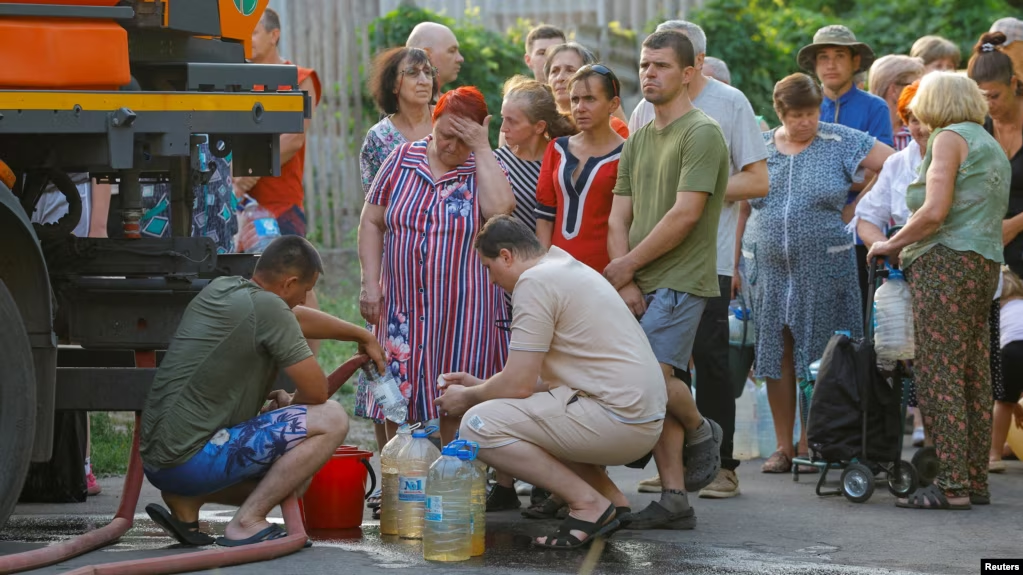
Residents of Russian-occupied Donetsk are enduring one of the region’s worst water shortages in years, with supplies now rationed to a few hours every two or three days in many districts.
The collapse has multiple causes: combat damage to the Siverskyi Donets–Donbas (SDD) canal and associated pumping stations, accelerated pipe failures in a network already near the end of its life, and an under-performing emergency pipeline from Russia that cannot meet demand.
The SDD canal, built in the 1950s, has for decades been the main water artery for the Donetsk region, feeding filtration plants and lift stations that serve both sides of the front line. OSCE monitoring documented repeated interruptions and repair missions around the Donetsk Filtration Station and the South Donbas water pipeline long before the full-scale invasion, underscoring the canal’s centrality and its vulnerability.
Following Russia’s 2022 offensive, critical nodes lost power and pumping stopped. Human Rights Watch traced the early collapse around Mariupol to the “de-energising” of the Third Lift Pumping Station, which halted flows from the Siverskyi Donets into the SDD canal. Since then, shelling and access constraints have repeatedly prevented routine maintenance across the network.
In 2023, Moscow installed a rapid “Don–Donbas” link to bring water from the Don River in Russia into occupied territory. Local authorities now concede it delivers only a fraction of what is needed and has itself sustained damage. Independent reporting and BBC Monitoring of pro-war Russian channels describe capacity shortfalls and high losses across the system. France 24 likewise notes the pipeline’s insufficiency. The project was overseen by then deputy defence minister Timur Ivanov, later arrested on bribery charges in April 2024, according to Reuters.
By late July 2025, occupation authorities intensified rationing: in Donetsk city distribution shifted from every two days to every three, with Yenakiieve reportedly receiving water once every four days. Denis Pushilin, the Kremlin-appointed head in Donetsk, has acknowledged network losses “up to 60 per cent” due to irregular supply and decayed infrastructure. The Institute for the Study of War reported that major settlements—Donetsk, Makiivka, Yenakiieve and Mariupol—now receive water only intermittently.
Public frustration has moved into the open. In early August, videos of residents appealing directly to President Vladimir Putin circulated widely; coverage in international media described undrinkable tap water and multi-day gaps in supply. RFE/RL and France 24 reported similar accounts, with queues at water tankers and widespread complaints of service collapse.
The structural condition of the network compounds the wartime damage. Former employees of Voda Donbasa, the regional utility, told reporters that by 2014 the system was already roughly 80 per cent worn, and sections in Donetsk’s Kirov district are now close to complete corrosion. Leaks and bursts are daily occurrences and were not factored into the Don–Donbas pipeline’s design assumptions.
Environmental risks are rising alongside scarcity. Years of disrupted mine dewatering across the coalfield have accelerated flooding, with researchers warning of saline and metal-laden minewater entering aquifers and surface streams. The Yunkom site near Yenakiieve—where the Soviet Union conducted an underground nuclear test in 1979—features prominently in assessments of potential radiological hazards if minewater continues to rebound. Open-source analyses and peer-reviewed work since 2020 flag increased contamination risks under current conditions.
Occupation officials have floated technical fixes. Pushilin has spoken of dredging canals, clearing blockages and even building desalination capacity for Mariupol after visits to Crimea. Analysts, however, note that the principal constraint remains geography: much of the SDD corridor and its power supply lie near or across the front, and pro-Kremlin media figures themselves have suggested that the crisis will persist unless Russia captures Sloviansk, upstream on the canal.
International humanitarian trackers frame the shortages within a wider pattern. The Institute for the Study of War has described a “Russian-created and propagated” water crisis in occupied areas and highlighted the legal responsibilities of an occupying power to ensure essential services. Meanwhile, the UN’s WASH assessments project very high needs across conflict-affected regions in 2025, with millions requiring basic water and sanitation support.
In practical terms for households in occupied Donetsk, the outlook remains poor. With the SDD canal degraded, the Don–Donbas link under-sized, and urban pipes failing faster than they can be replaced, intermittent trucking and standpipe distribution are likely to continue. Without secure access for repairs along the canal corridor—and major capital investment once fighting subsides—reliable potable supply to the city will be difficult to restore.