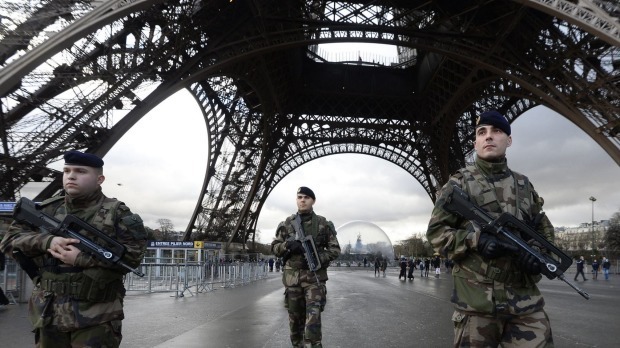
Paris insists that the decision to cancel its New Year’s Eve open-air concert on the Champs-Élysées is merely a matter of crowd control.
Officials speak of logistics, unpredictability and prudence. Yet few observers truly believe this is the whole story. The reality, uncomfortable though it may be, is that Europe’s great capitals are quietly recalibrating public life in response to a persistent and ideologically driven threat — one that has now asserted itself far beyond Europe’s borders.
This week’s attack on the Jewish community in Australia, reportedly carried out by Muslim gunmen and now under intense investigation by the authorities, has sent a chill through Western capitals. It was not simply another act of violence; it was a reminder that antisemitic jihadist violence is not confined to one continent or one set of political circumstances. From Sydney to Paris, the pattern is increasingly recognisable: symbolic targets, communal spaces, moments of celebration.
Seen in this light, Paris’s muted New Year feels less like administrative caution and more like an admission of reality – Europe’s Muslim population has its own ideas about Europe’s future.
The Champs-Élysées has long been more than a boulevard. It is a statement — of openness, civic confidence and national pride. To cancel a live concert there, even while allowing fireworks to proceed, is to draw a subtle but telling distinction between spectacle and congregation. Fireworks can be controlled. Crowds cannot. And crowds have become dangerously attractive targets.
Europe knows this all too well. Christmas markets, once the embodiment of seasonal warmth and civic joy, have repeatedly been turned into killing grounds. Berlin’s Breitscheidplatz in 2016 remains etched into the continent’s memory, when an Islamist terrorist ploughed a lorry into revellers, killing 12. Strasbourg followed in 2018, when a gunman shouting Islamist slogans murdered shoppers near the city’s Christmas market. There have been others — attempted attacks foiled, quieted down, or forgotten outside the communities they traumatised.
Each incident was met with the same ritual incantations: “lone wolf”, “nothing to do with religion”, “no wider meaning”. And yet this pattern of apologising for the perpetrators has persisted.
France, more than most, understands the price of denial. From the Bataclan to Nice, from the murder of Samuel Paty to the killing of worshippers in Nice’s basilica, the country has been forced to confront a form of violence that is ideological, transnational and explicitly hostile to Western pluralism — particularly where Jews are concerned. That Paris now hesitates to place tens of thousands of people shoulder-to-shoulder on a single, symbolic avenue is not cowardice. It is institutional memory.
The Australian attack sharpens this point. For years, Europe reassured itself that its troubles were the product of specific domestic failures — integration, policing, colonial history. But when Jewish communities are attacked in countries as geographically distant and socially distinct as Australia, the illusion of localised causation collapses. What remains is a shared vulnerability across liberal democracies.
Against that backdrop, the decision to replace a live Parisian celebration with a recorded broadcast begins to look less like a temporary measure and more like a template for the future. Authorities speak carefully of “not wanting to take risks”. What they mean is that the cost of getting it wrong is now intolerably high.
Critics will argue, not without reason, that this amounts to surrender — that by cancelling concerts and fencing markets, Europe is allowing extremists to reshape public life. There is considerable truth in this concern. A civilisation that cannot celebrate in public without fear is already compromised.
But there is another danger too: pretending that nothing has changed, until the inevitable happens again.
The challenge for Europe is not simply to protect events, but to recover moral clarity. For too long, officials have been willing to treat Islamist violence as an unfortunate but disconnected phenomenon, while aggressively policing speech, symbolism and tradition in the name of sensitivity. Christmas markets were hardened with concrete barriers; Christmas itself was rhetorically softened. The threat was external; the concessions internal.
Paris’ New Year’s Eve decision encapsulates this contradiction. The fireworks will still explode over the Arc de Triomphe, broadcasting an illusion of continuity to the world. But the people — the human closeness that gives such moments meaning — are being quietly dispersed, encouraged to celebrate at home, behind screens.
That is not how a confident society behaves. Yet neither is it how a reckless one should. It is, however, exactly how a weak and emasculated society can be expected to behave.
The attack in Australia should serve as a final warning that this is not Europe’s problem alone, and not one that can be managed indefinitely through security measures alone. Concerts can be cancelled. Markets can be fortified. But unless Western governments confront the ideological roots of this violence — including its fixation on Jewish communities and its exploitation of open societies — the slow retreat from public life will continue.
Paris may yet celebrate again on the Champs-Élysées, but whether it does so freely will depend not on police numbers or crowd modelling, but on whether the West finds the courage to name the threat it is facing — Intifada — and to defend, unapologetically, the way of life, our way of life, that extremists are determined to erase.
Click here for more News & Current Affairs at EU Today
Click here to check out EU TODAY’S SPORTS PAGE!
_____________________________________________________________________________________________________________________________